What is structured output in AI?
Updated · By Robert Breen
Structured output is AI output arranged in fixed, predictable fields, such as a table with set columns, a list of labeled values or JSON, instead of free-flowing prose. Because every answer has the same shape, people can scan it and software can read it without guessing.
Why it matters for a small business
Prose is fine for an email, but a lot of business work needs data: a row per task, a score per requirement, a category per expense. When the AI returns the same fields every time, you can compare results side by side, spot gaps (an empty owner column jumps out), and pass the output to a spreadsheet or another step without retyping.
In automations it is essential. An n8n agent that saves to Google Sheets works because its instructions list the exact fields to return, matching the sheet's column headers. If the fields drift, rows land in the wrong columns.
In a real lesson: Turn an Interview Debrief into a Scorecard and a Candidate Follow-Up (Recruiting & HR)
In Turn an Interview Debrief into a Scorecard, Hannah, the HR manager at Willow Bend Physical Therapy (a made-up practice), pastes the transcript of a panel debrief for Kira Delgado, a Front Desk Lead candidate. The request asks for structure, not a recap.
It names four must-haves (two or more years running a front desk, insurance verification, calming upset patients, training other staff) and asks for a score on each from a fixed set of values: Strong, Partial or Not discussed, with a short quote from the interview as evidence. Action items come as a table with task, owner and due date, and anything missing is written as "Not stated".
Because the fields are fixed, gaps are visible. Training other staff comes back Not discussed, since the panel ran out of time, and two due dates say Not stated until you fill them in. The request also limits the content to job-related points, so a comment about the candidate's kids never reaches the notes.
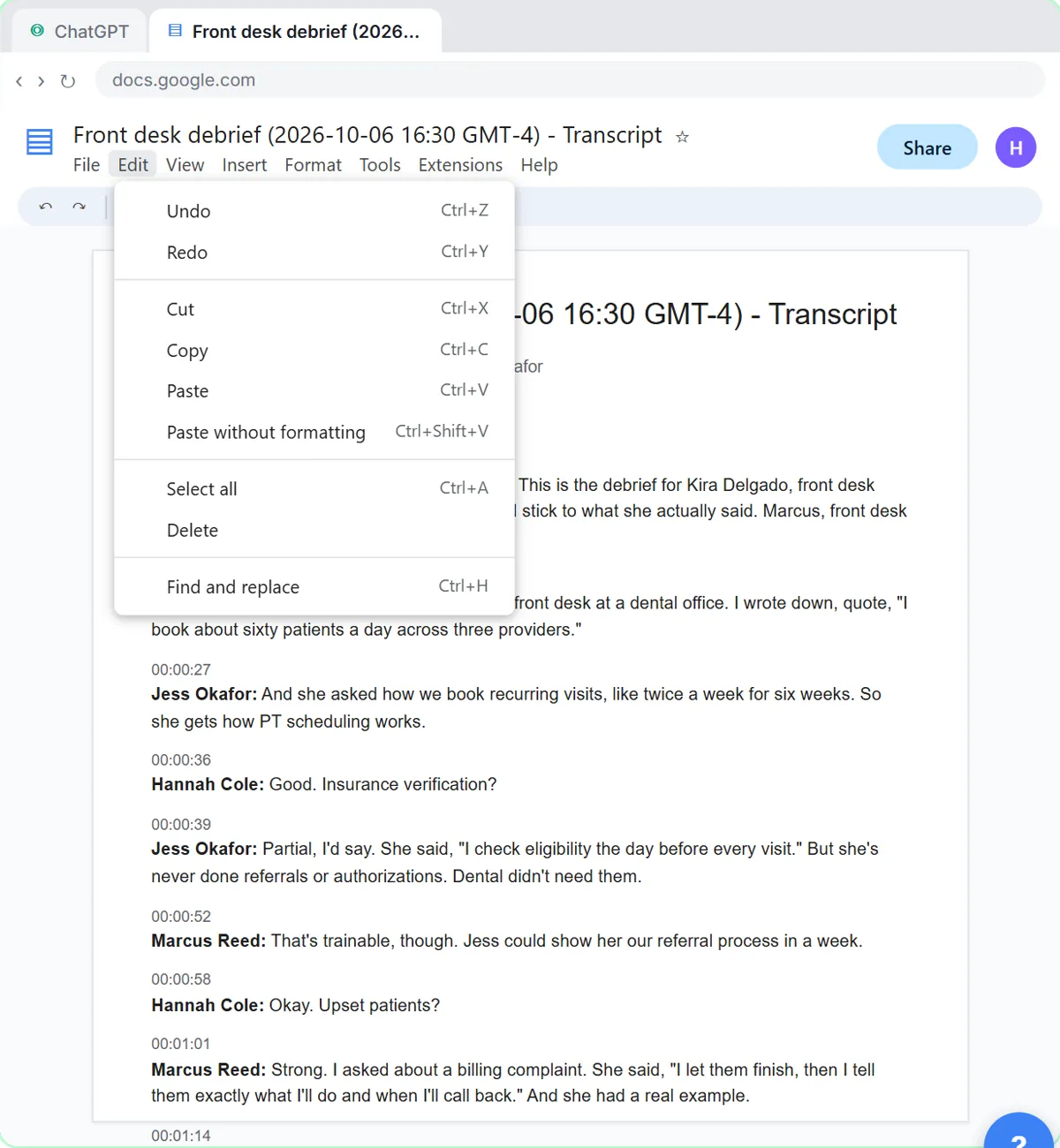
Try this lesson free or read the step-by-step guide.
Common confusions
Structured output vs output format
Output format is any instruction about shape, including a prose layout. Structured output is the stricter kind: fixed fields with allowed values, meant to be compared or read by software.
Table vs JSON
Tables suit people reading in a chat. JSON suits software, which is why web forms and APIs send it. Some AI platforms can enforce a JSON schema exactly; in a plain chat, you ask for it and check.
Tips
- List the fields in the order you want them, with the exact names you'll use elsewhere.
- Limit values where you can (Strong, Partial, Not discussed) instead of free text.
- Give every field an "unknown" value so the model doesn't fill gaps with guesses.
Related terms
Where you use it: free lessons
- Turn an Interview Debrief into a Scorecard and a Candidate Follow-Up (Recruiting & HR) (ChatGPT, 9 min)
- Summarize a Meeting Transcript with ChatGPT (ChatGPT, 9 min)
- n8n AI Agent Tutorial: Save Social Media Ideas to Google Sheets (n8n, 12 min)
Prompt templates that use it
Visual guides
Structured output in a few slides, with the same guide written out as text.
 5 Steps to Turn an Interview Debrief into a Scorecard
A visual guide: turn an interview panel's debrief transcript into a ChatGPT scorecard with evidence for each must-have, then a candidate follow-up.
Step-by-step guide 7 slides
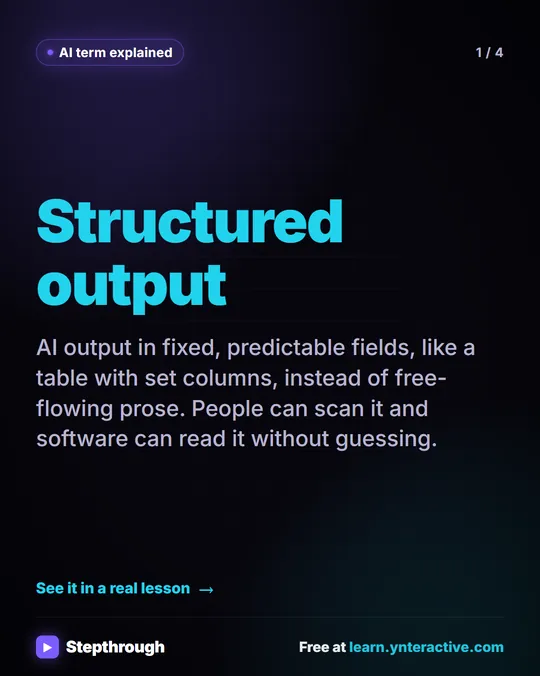 What Is Structured Output? A Visual Guide
A visual guide to structured output: AI answers in fixed fields people can scan and software can read, shown with a real interview scorecard.
AI term explained 4 slides
Frequently asked questions
- How do I get ChatGPT to return a table?
- Ask for it and name the columns, for example "the action items as a table: task, owner, due date." Naming the columns is what keeps the structure consistent.
- Can structured output go straight into Google Sheets?
- Yes, in an automation. In n8n, an AI Agent with a Google Sheets tool can write each item as a row when its instructions list fields that match your column headers.