Updated . Built step by step in a real Runable Free-plan account on 19 October 2026. Every screen in the practice is a real Runable screen, and every output is what Runable produced in that run. How we check this lesson
Most new founders buy stock first and research later. In this free lesson you follow Maya Chen (made up) as she checks the market for Harbor & Pine, a small-batch soy candle brand in Portland, before spending $3,000. You brief Runable, an AI agent, with the decision and three questions, approve its plan, and get a one-page brief with a sourced market-size range, five competitors and their prices, and two gaps to test. Then you check a source, download it, and ask which numbers are estimates. Our run used 562 of the 1,500 free daily credits.
At a glance
| Question | Answer |
|---|---|
| What you build | A business case for new founders: before you buy stock, have Runable, an AI agent, research the market size, five competitors and their prices, and two gaps, with a source for every number. Then check the sources and ask which numbers are guesses. Free plan. |
| Tools | Runable |
| Time | About 12 minutes, 23 steps in 6 parts |
| Level | Beginner, no coding needed |
| Cost | Free |
| Ways to learn it | Practice it step by step |
The 6 parts, in short
- Before you spend a dollar: Put a price on guessing, Meet Runable, Read the research brief first.
- Open Runable and check your credits: Check your credits, See the daily allowance.
- Brief the agent: Paste the brief, Send it, Read the plan before it works, Say yes, and 2 more steps.
- Read the brief and check the sources: Open the brief, Check a source, Find the export options, Download it as a PDF.
- Ask what is a guess: Ask which numbers are guesses, Send the question, Read the honest answer, Close the brief, and 2 more steps.
- What it saved, and what is next: See what you have now, Up next.
Part of: AI Apps Worth Knowing (step 9 of 49). Next up: Turn Your Research into a One-Page Business Plan using Runable
The business case: research before the first order
Maya is about to spend $3,000 on wax, jars and fragrance, at a price of $28 to $34 a candle that feels right but has never been checked. A consultant would charge $1,500 or more for a market scan. Doing it herself takes about 12 hours of tabs and notes, about $480 of her time at $40 an hour. Most founders skip both and buy on a guess. These are example numbers; use your own.
The job is small and well defined: how big is the market, who already sells to it and at what price, and where is the gap. That is exactly the kind of work an AI agent can do in minutes, as long as you check what it hands back.
What you do in the lesson
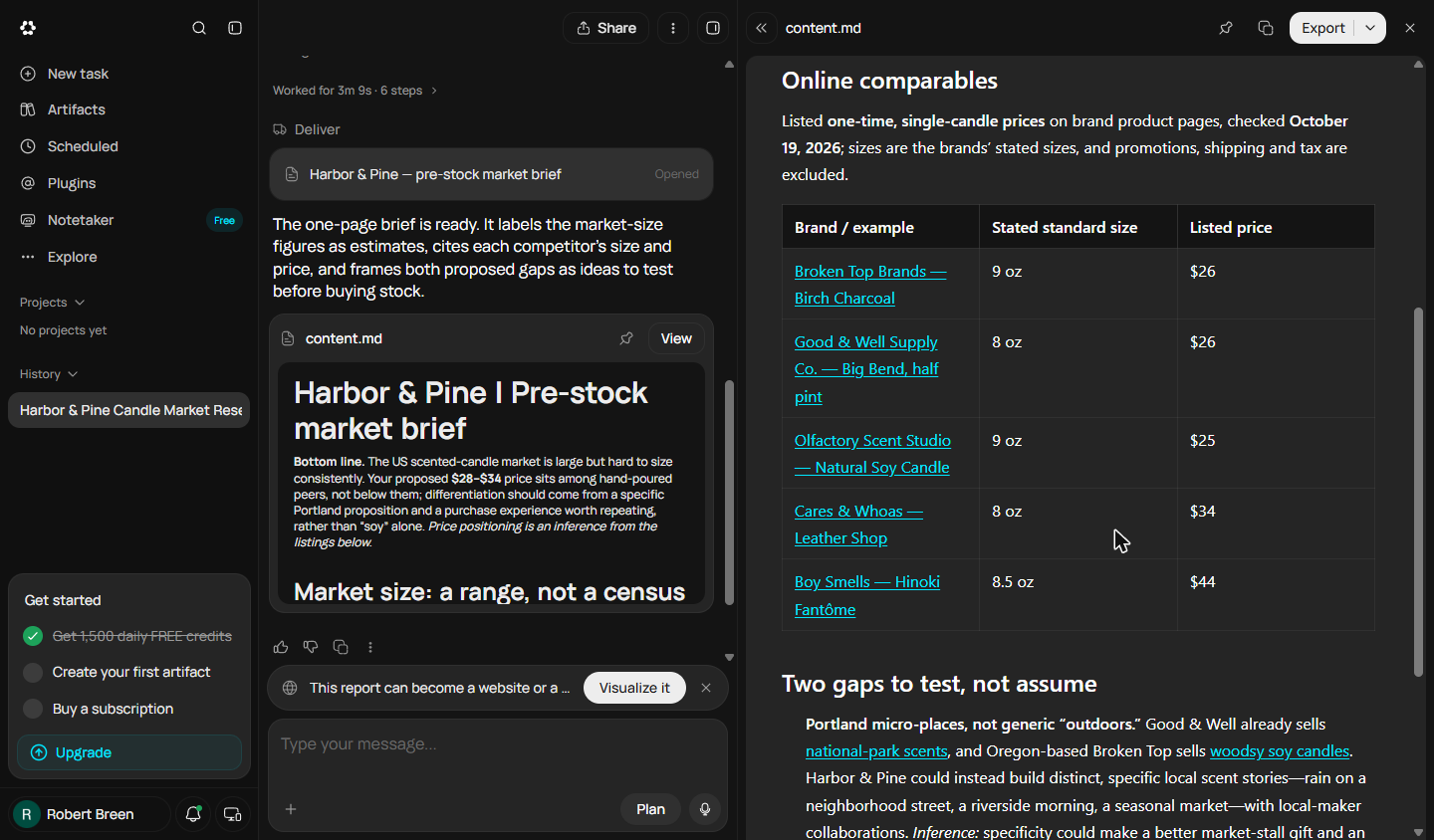
You check your credits, paste a research brief with three questions and four rules, and read the scope Runable writes back before it starts. It worked for about three minutes and read 205 sources. The brief gave a range of $1.4 to $2.4 billion for the 2025 US scented-candle market from three analyst estimates, five online brands selling 8 to 9 oz candles for $25 to $44, and two gaps marked as ideas to test.
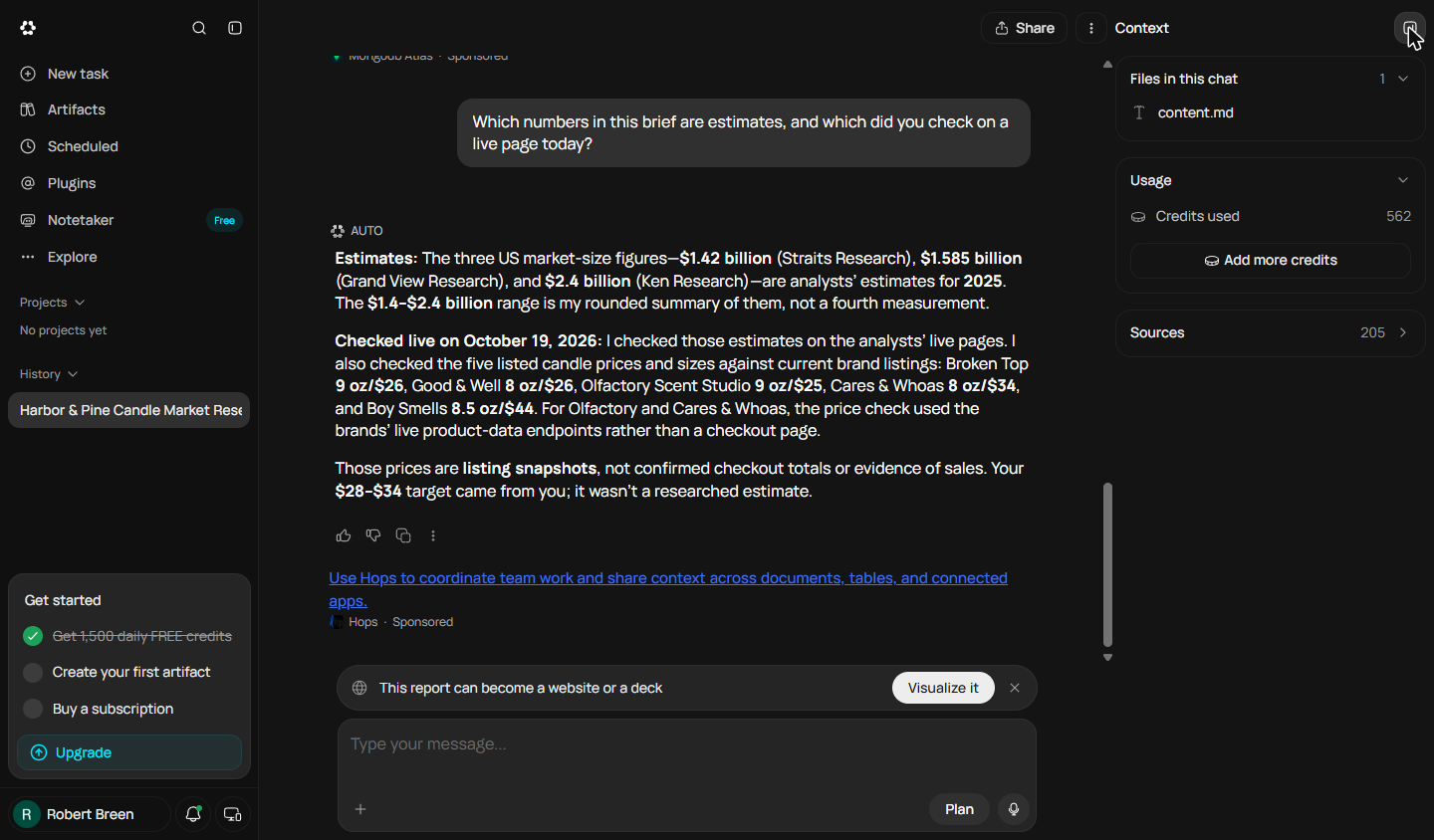
Then you do the part that matters: open a source, export the brief, and ask which numbers are estimates. Runable separated the analysts' estimates from the prices it checked on live pages that day, and pointed out that the $28 to $34 target came from Maya, not from research.
What it does not do
It does not prove anyone will buy. Market reports disagree, listings change, and citations only show you where to look. Open two or three sources yourself and mark them verified in the competitor check sheet before the numbers go into a plan.
Links
- Runable: the AI agent this course teaches. Its Free plan showed 1,500 credits a day when we tested it in October 2026.
- Runable pricing: current plans, credits and limits. Check them before you rely on the Free plan.
Try it yourself, free
Reading the steps is a start. Doing them is how it sticks. The interactive module walks you through every click in a practice copy of Runable, checks each step, and never touches your real accounts.
Start “Size Up Your Market and 5 Competitors Before You Spend a Dollar using Runable”Step by step: Size Up Your Market and 5 Competitors Before You Spend a Dollar using Runable
All 23 steps of the interactive module, in order. In the module you watch each one, then do it yourself in a practice copy that checks your work.
1. Before you spend a dollar
- Put a price on guessing. Maya Chen (made up) is starting Harbor & Pine, a small-batch soy candle brand in Portland. She is about to spend $3,000 on stock. A consultant's market scan costs $1,500 or more, and doing it herself takes about 12 hours. Most founders skip it. Click the stock bought on a guess total.
Meet Maya. She's starting a small candle brand in Portland. She's about to spend three thousand dollars on stock. But she hasn't checked the market.
- Meet Runable. Runable is an AI agent. You describe the finished work, it asks what it needs, searches the web, cites its sources and hands you a document. The Free plan gives you 1,500 credits a day. Click the Runable card.
Runable is an AI agent. You describe the finished work. It searches, cites sources, and hands you the result. The free plan gives you fifteen hundred credits a day.
- Read the research brief first. This is the brief we will paste into Runable. It names the decision (before I spend money on stock), asks three questions, and sets rules: a range, say what is an estimate, cite every number, keep it to one page. Download a copy on this page, then click the brief.
Here's the brief we'll paste in. It says what decision the research is for. It asks three questions. And it sets the rules. Cite every number. Keep it to one page.
2. Open Runable and check your credits
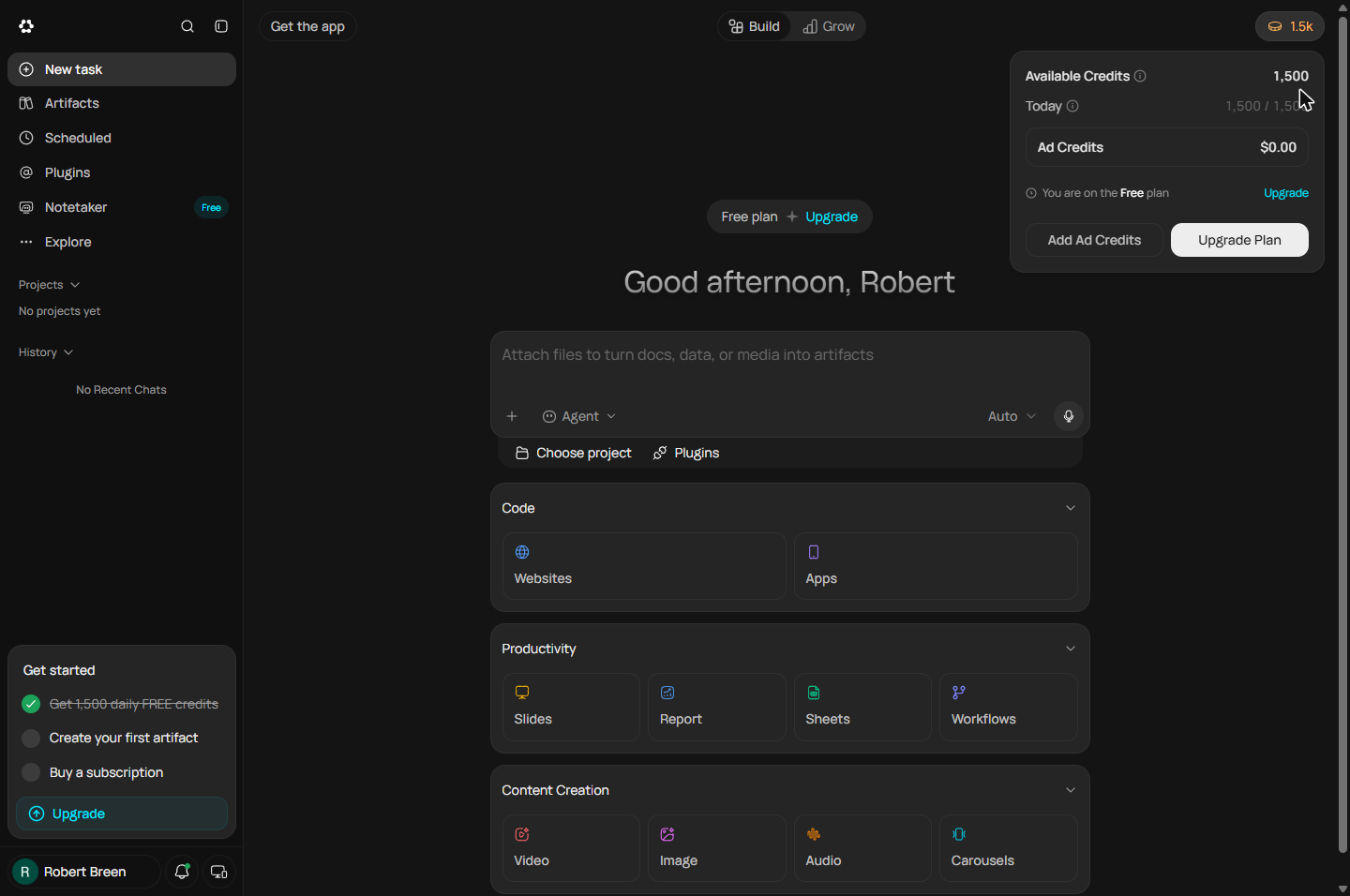
- Check your credits. This is Runable's home screen. Every task costs credits. The pill at the top right shows what you have left. Click the credits pill.
This is Runable's home screen. Every task costs credits.
- See the daily allowance. On the Free plan you get 1,500 credits a day. Today shows what is left of them. Paid plans add monthly credits on top. A research brief like this used about 560 in our run. Click Today.
On the free plan you get fifteen hundred credits a day. Today shows what's left. Our research run used about five hundred and sixty.
3. Brief the agent
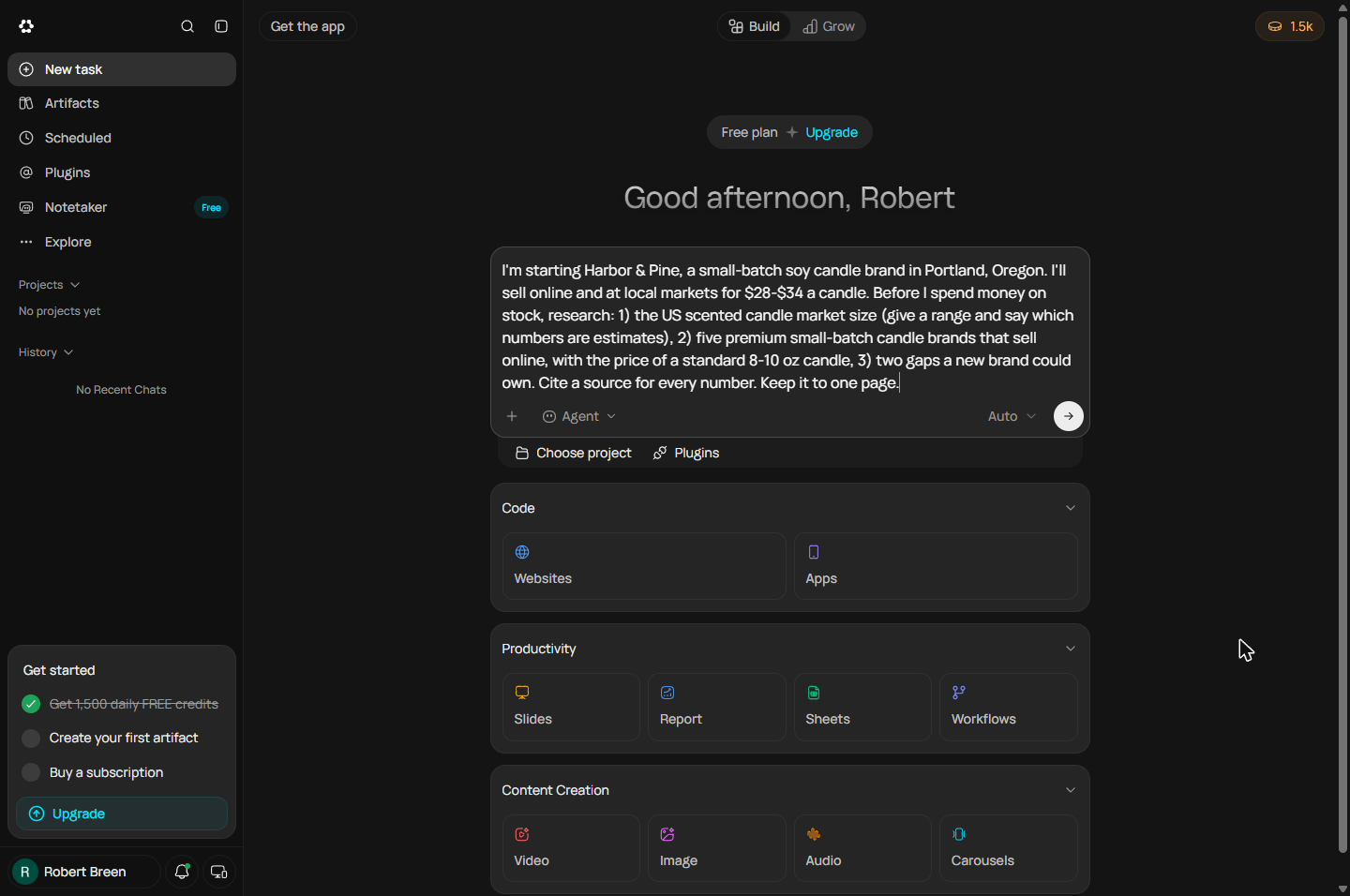
- Paste the brief. Click into Describe what you want Runable to build... and paste the research brief. Keep Agent mode on, which is the default.
Keep Agent mode on.
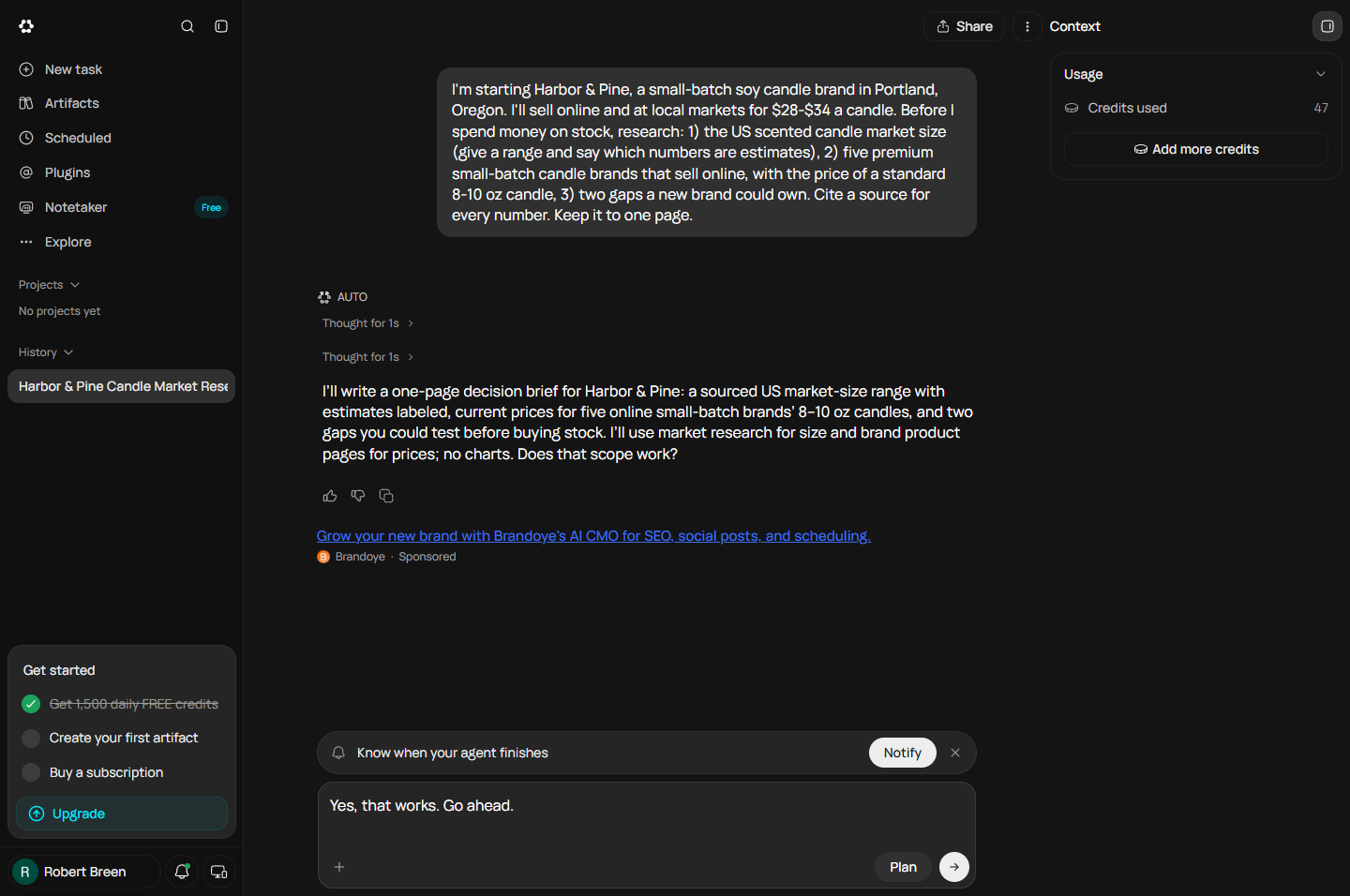
I'm starting Harbor & Pine, a small-batch soy candle brand in Portland, Oregon. I'll sell online and at local markets for $28-$34 a candle. Before I spend money on stock, research: 1) the US scented candle market size (give a range and say which numbers are estimates), 2) five premium small-batch candle brands that sell online, with the price of a standard 8-10 oz candle, 3) two gaps a new brand could own. Cite a source for every number. Keep it to one page.
- Send it. The brief is in. Click the arrow to send it.
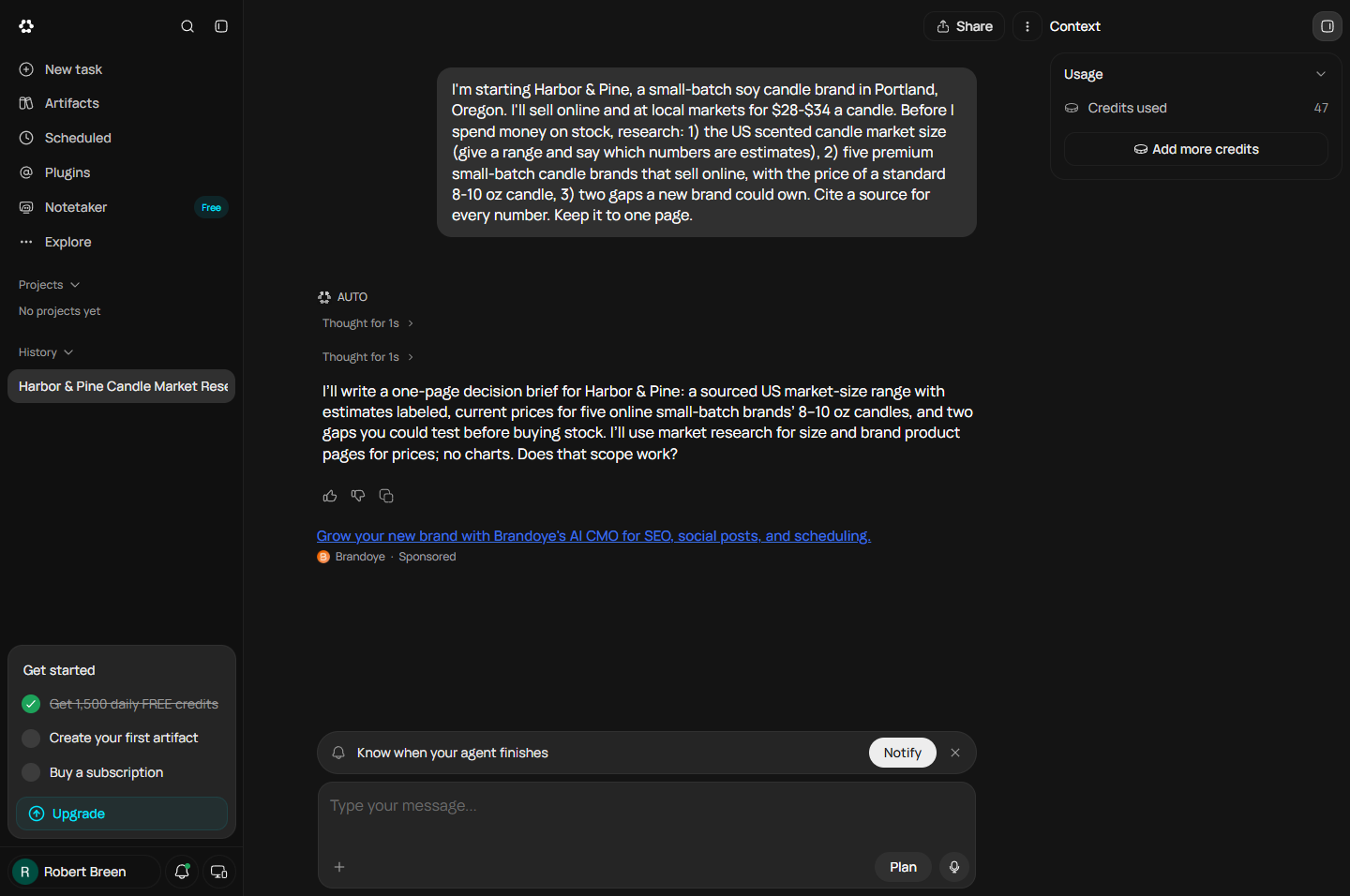
- Read the plan before it works. Runable does not start straight away. It says back what it will make: a one-page decision brief with a sourced market-size range, prices for five brands, and two gaps, using market research and product pages. Then it asks Does that scope work? Click its plan.
Runable doesn't start straight away. It tells you what it plans to make. Then it asks, does that scope work? Read it.
- Say yes. The plan matches the brief, so approve it. Paste the reply into Type your message...
The plan matches what we asked for. So say yes.
- Send your answer. Click the arrow to send it. The agent starts working.
Now it gets to work.
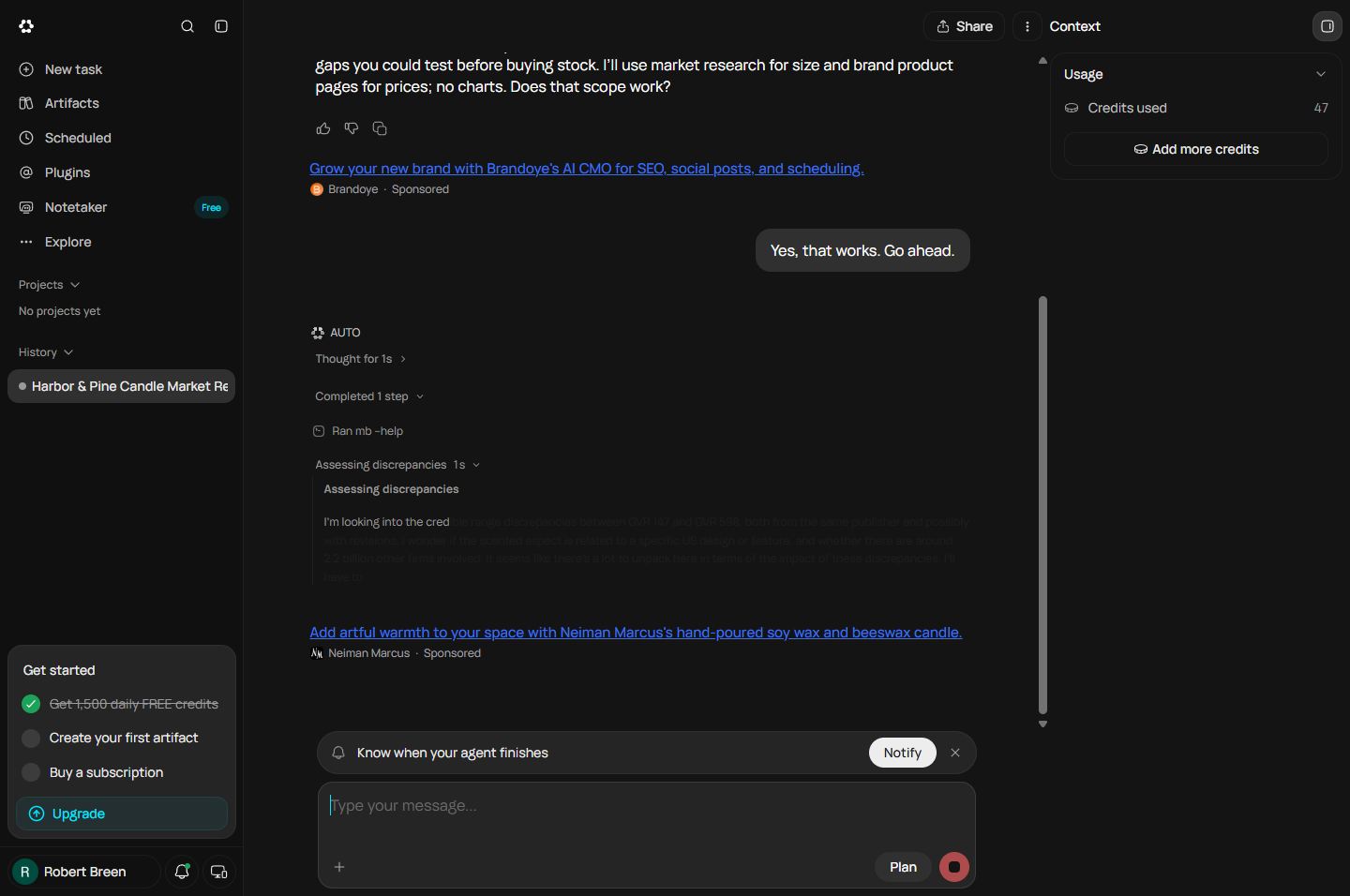
- Watch it work. You can see each step as it runs: searching for brands, running tools, and here, Assessing discrepancies between two market reports. Ours took about 3 minutes and used 205 sources. Click Assessing discrepancies.
You can watch each step. Here it's comparing two market reports that disagree. Ours took about three minutes.
4. Read the brief and check the sources
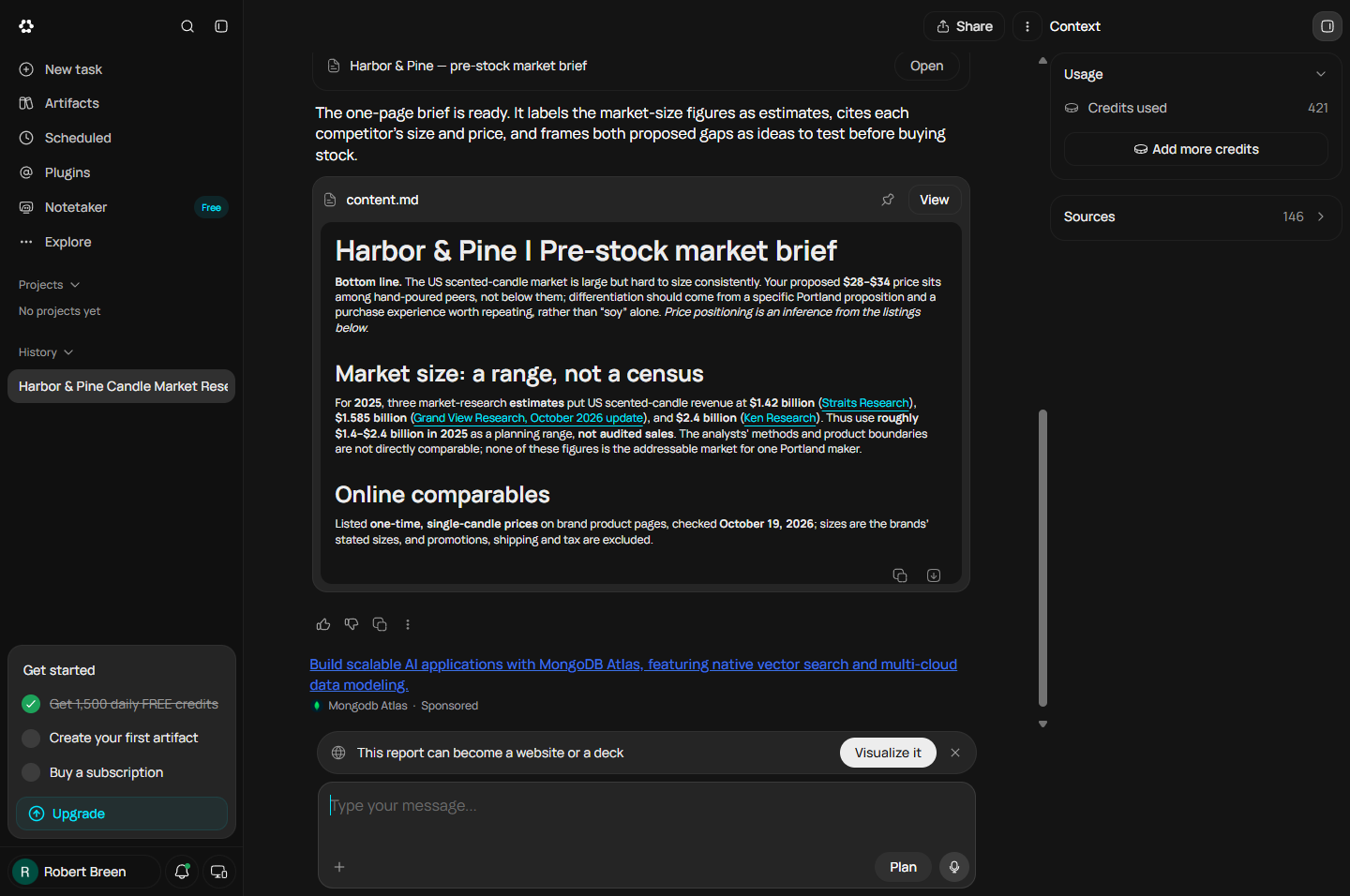
- Open the brief. The brief is ready. Runable says it labelled the market figures as estimates and framed the gaps as ideas to test. Click Open.
The brief is ready.
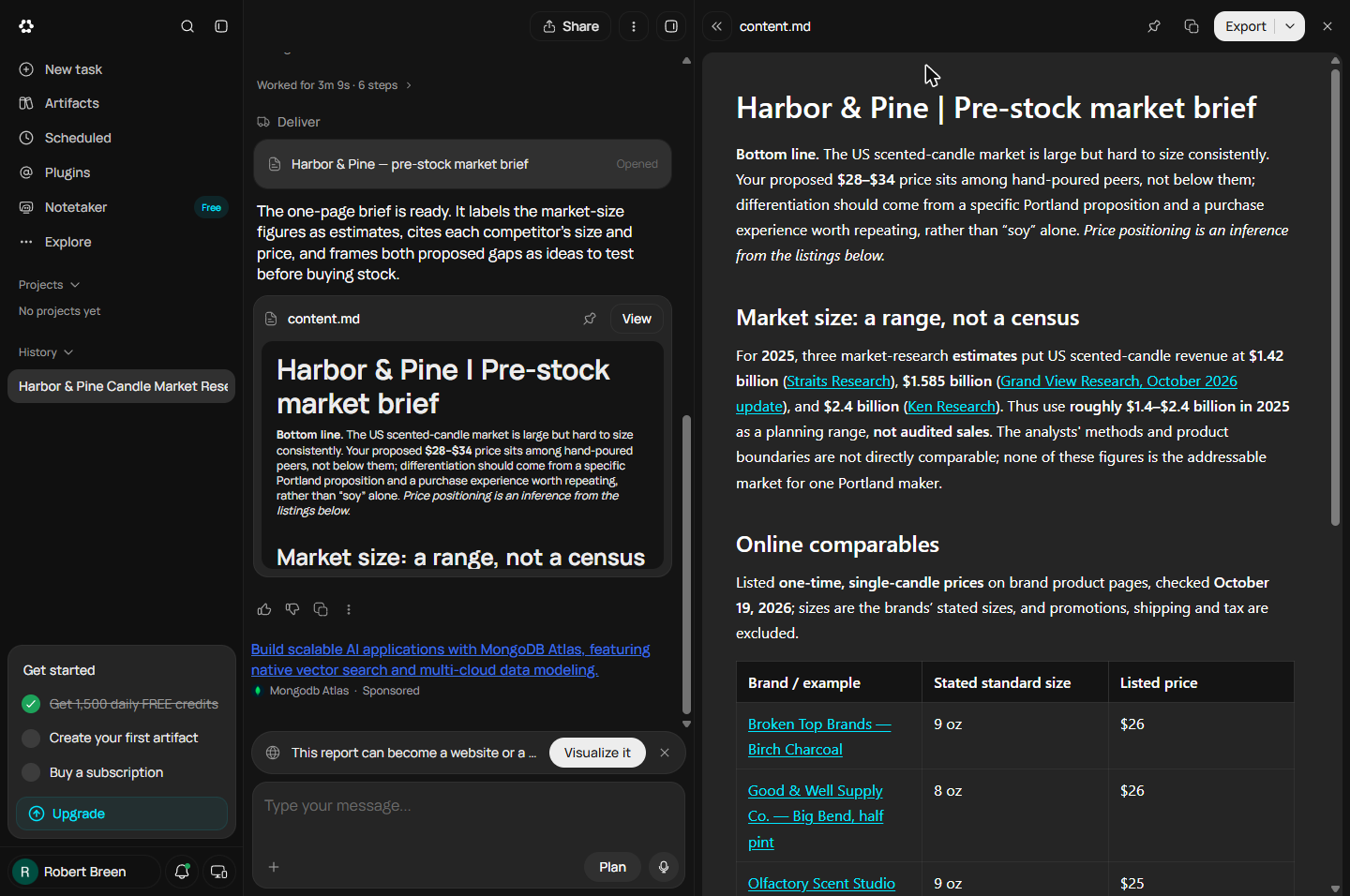
- Check a source. The brief opens on the right. Three analysts estimate the US scented-candle market at $1.42 billion, $1.585 billion and $2.4 billion for 2025, so the brief gives a range, not one number. Every figure has a link. Open each one in a new tab and check the number is really there. Click Grand View Research.
Three analysts. Three different numbers. So the brief gives you a range. Every number has a link.
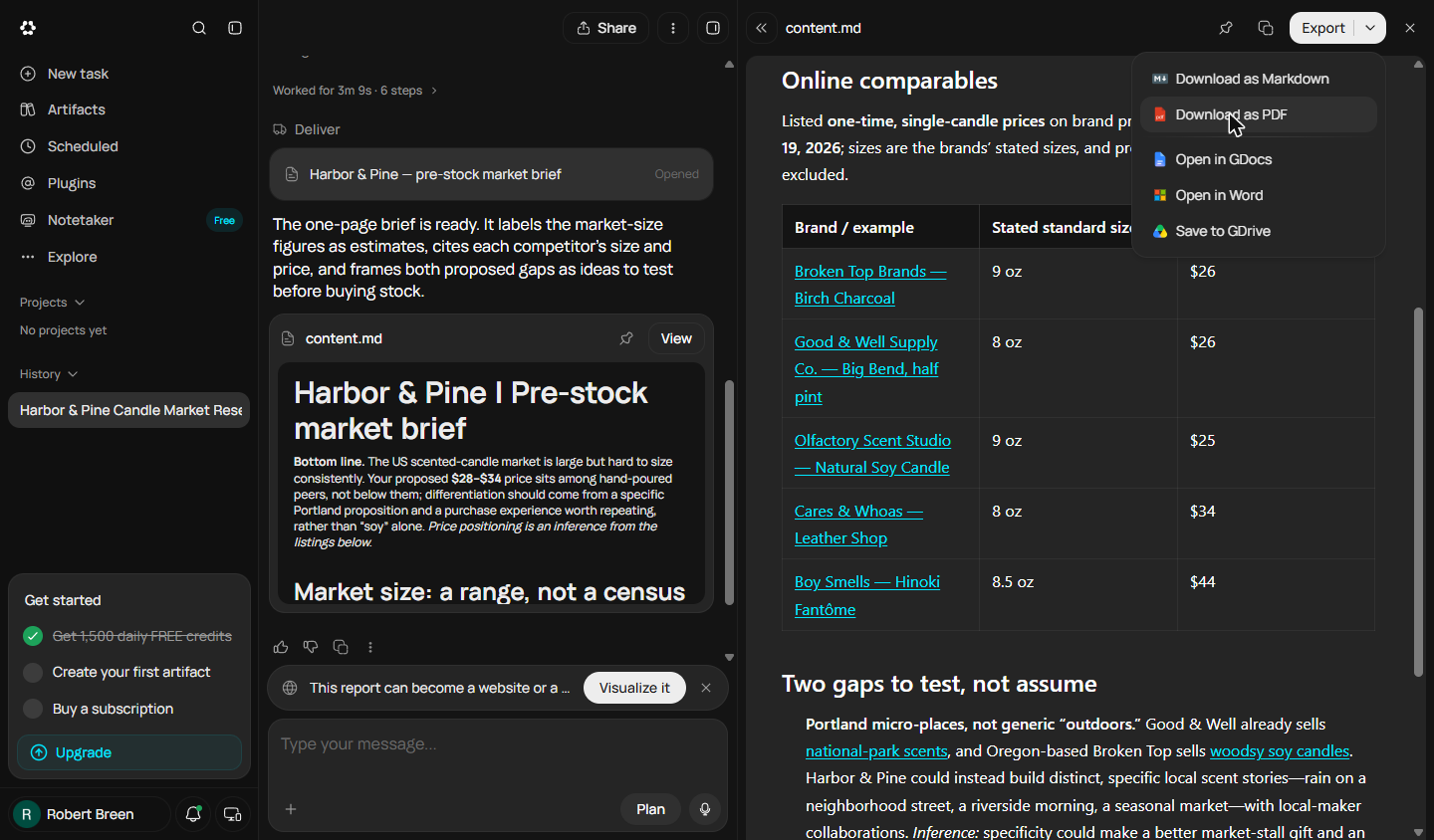
- Find the export options. Scroll down to Online comparables: five brands that sell an 8 to 9 oz candle online for $25 to $44. Your $28 to $34 sits among them. Now save the brief. Click the arrow next to Export.
Here are five competitors and their prices. Twenty-five to forty-four dollars. Your price fits right in. Now save it.
- Download it as a PDF. You can download it as Markdown or PDF, or open it in Google Docs or Word. Click Download as PDF.
You can download it, or open it in Google Docs or Word.
5. Ask what is a guess
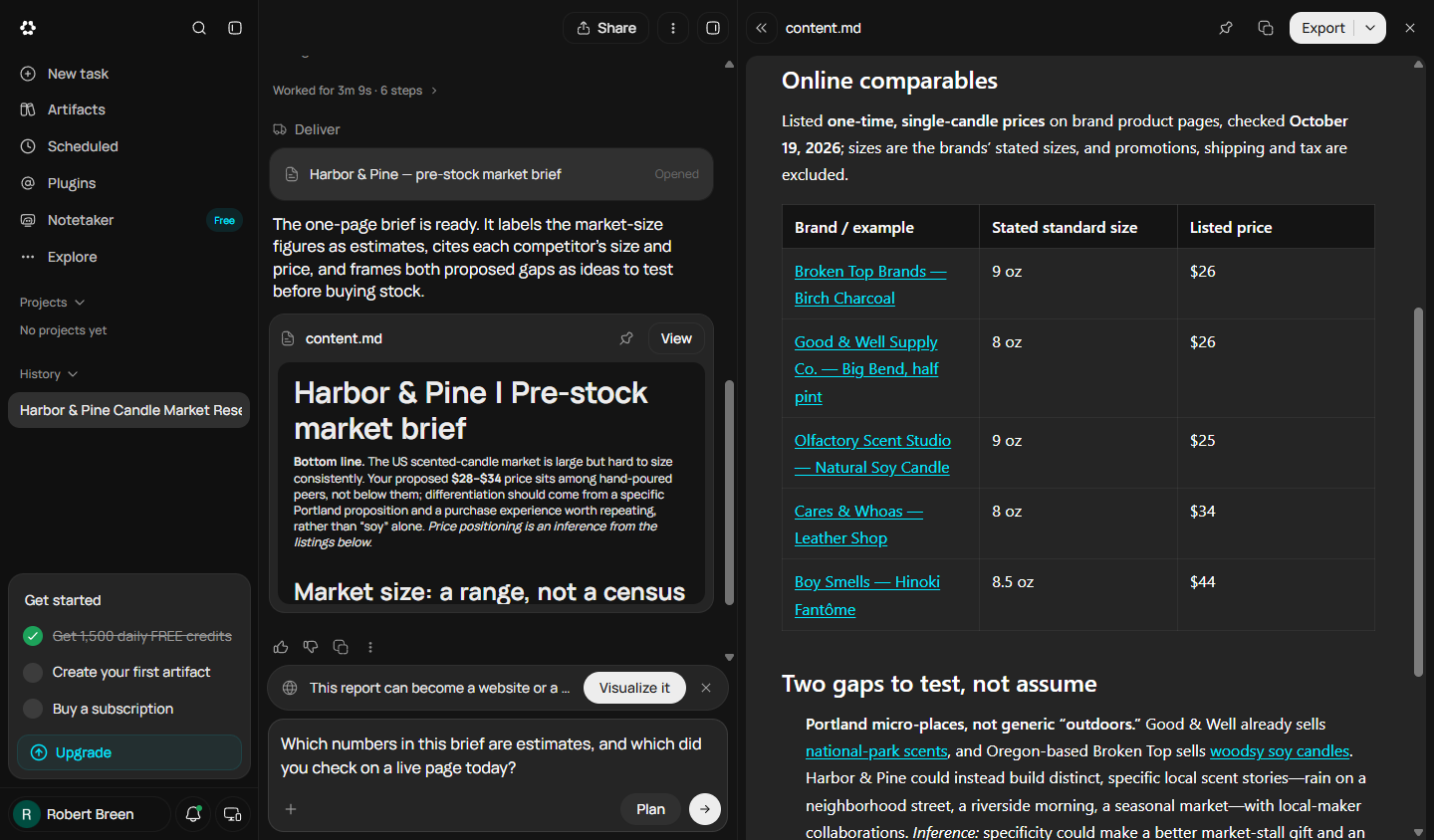
- Ask which numbers are guesses. Before you trust a number, ask where it came from. Paste the question into Type your message...
Before you trust a number, ask where it came from.
- Send the question. Click the arrow to send it.
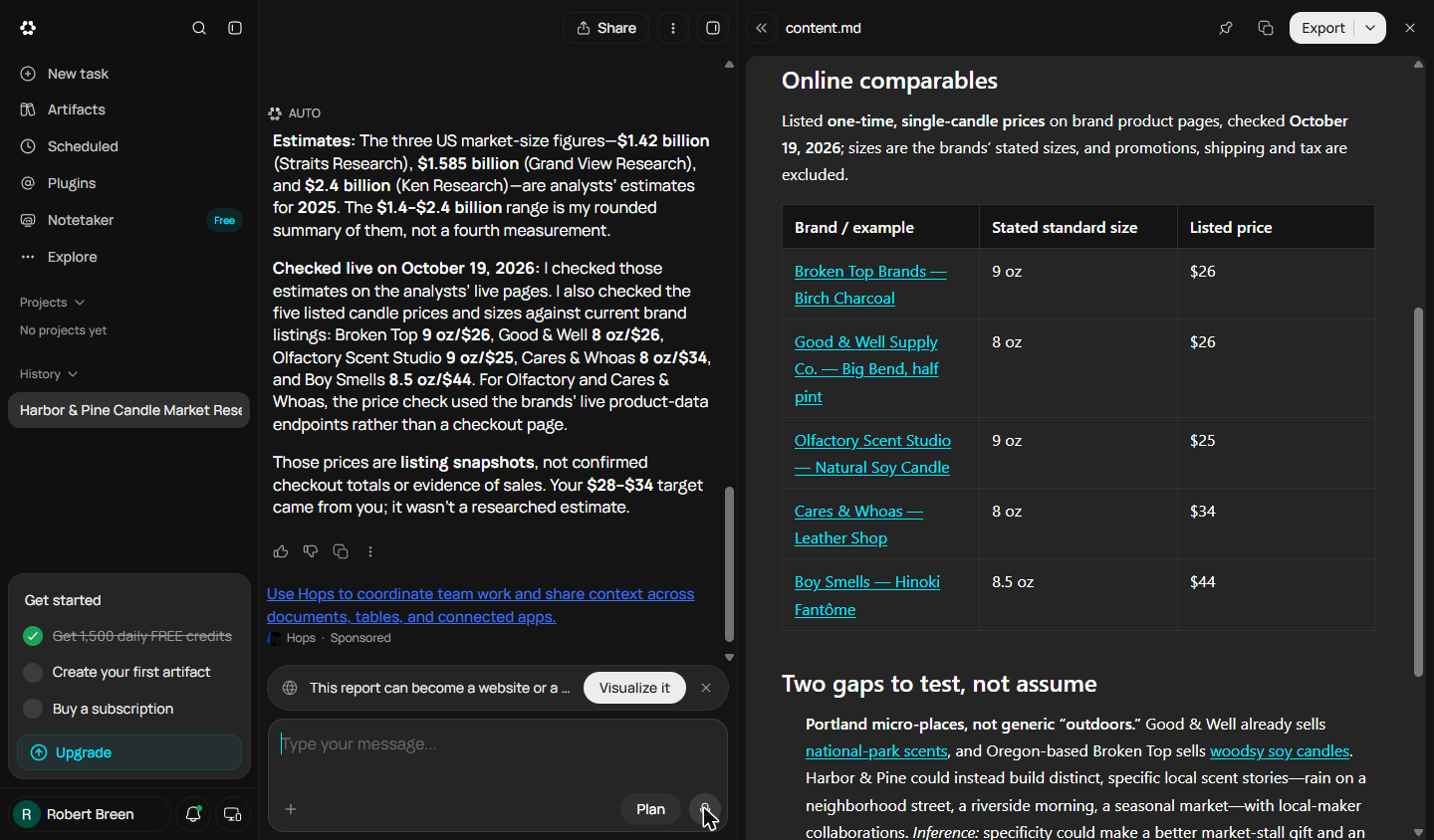
- Read the honest answer. Runable splits it out: the three market sizes are analysts' estimates, the range is its own rounded summary, and the five prices were checked on live pages today. It also points out that your $28 to $34 came from you, not from research. Click Estimates.
Runable splits it out. The market sizes are estimates. The prices were checked today. And it reminds you, your price came from you.
- Close the brief. Click the X at the top right to close the brief and see the chat details.
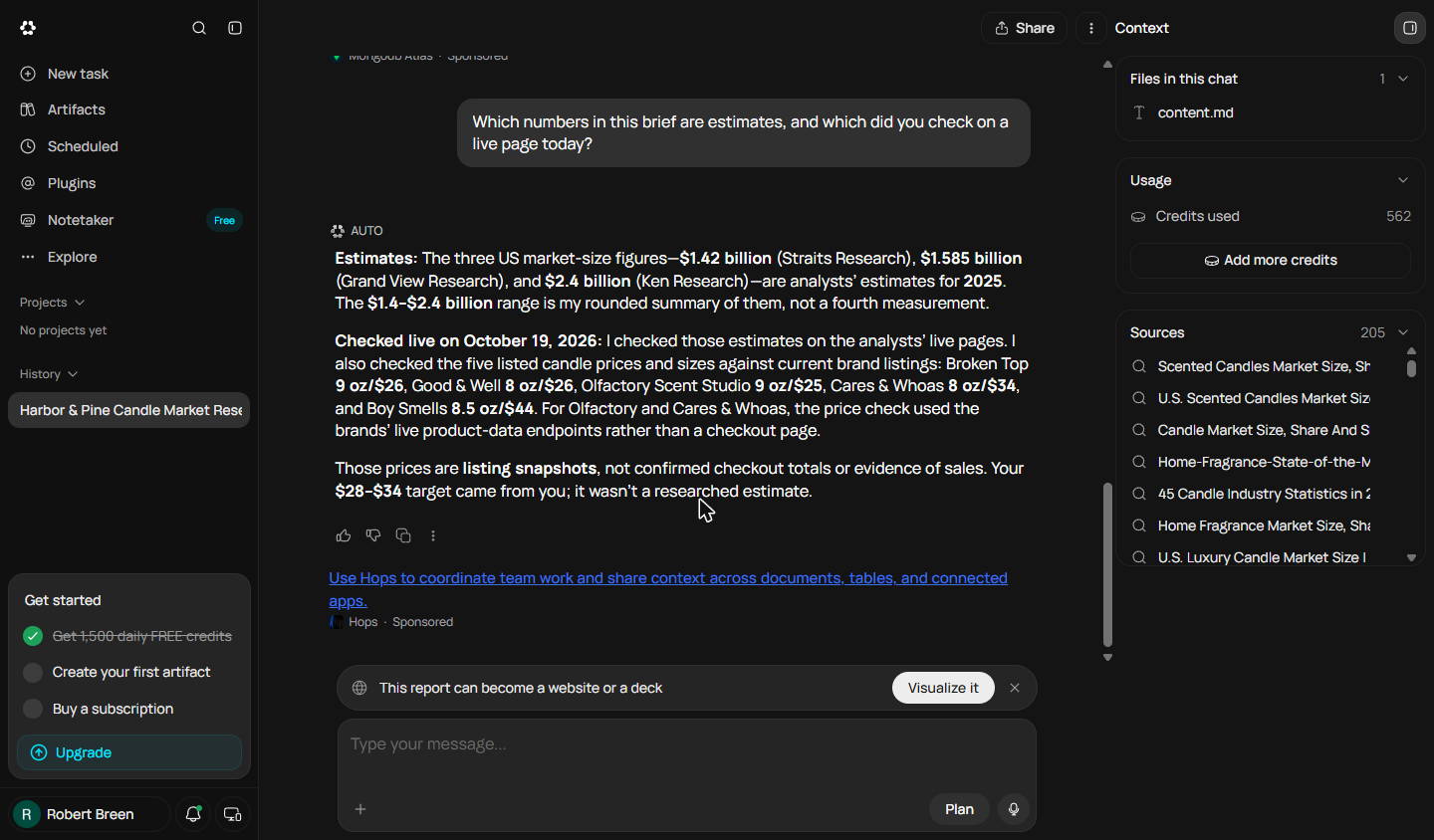
- Open the sources list. The right panel shows Credits used: 562 for this chat, and 205 sources. Click Sources.
This chat used five hundred and sixty-two credits. And it read two hundred and five sources.
- Spot-check a source. Every page Runable read is listed here. Pick two or three, open them, and tick them off in the competitor check sheet you downloaded. Click the first source.
Every page it read is here. Tick them off in your check sheet.
6. What it saved, and what is next
- See what you have now. A sourced market range, five competitor prices, and two gaps to test, for 562 free credits and about 5 minutes. It did not prove anyone will buy. Click What you have now.
A market range. Five competitor prices. Two ideas to test. All for free credits. But it didn't prove anyone will buy.
- Up next. Next you turn this research into a one-page business plan with Runable's Report tool. Click Up next.
Next, you'll turn this research into a one-page business plan.
Screenshots
Frequently asked questions
- Can Runable do market research?
- Yes. In our test Runable searched the web, read 205 sources and wrote a one-page brief with a market-size range, five competitors with prices and two gaps, citing a source for each number. Check the sources yourself before you rely on them.
- How many credits does a research brief use on Runable's Free plan?
- Our brief and one follow-up question used 562 credits. The Free plan showed 1,500 credits a day in October 2026. Check runable.com/pricing for current limits.
- Is this lesson free?
- Yes. The practice copy needs no account. To do it for real you need a Runable account; the Free plan is enough.
More in Runable for Entrepreneurs
All 3 modules in Runable for Entrepreneurs
More Runable tutorials
Terms in this lesson
Plain-English definitions, each with an example from a free lesson.