Why this matters
Most new founders buy stock first and research later. Before Harbor & Pine (a made-up candle brand) spends $3,000 on wax, jars and fragrance, Maya needs three answers: is the market real, who already sells to it and at what price, and where is the gap. A consultant charges $1,500 or more for that, and doing it yourself takes a weekend of tabs.
Runable is an AI agent: you describe the finished work and it researches, cites and writes it. In our run it checked the plan with us first, read 205 sources in about three minutes, and handed back a one-page brief that labelled its estimates. It used 562 of the 1,500 free daily credits.
Practice
Do every step yourself in a practice copy of the real tool. It checks your work, and “Do it for me” finishes any step you get stuck on.
What you’ll build
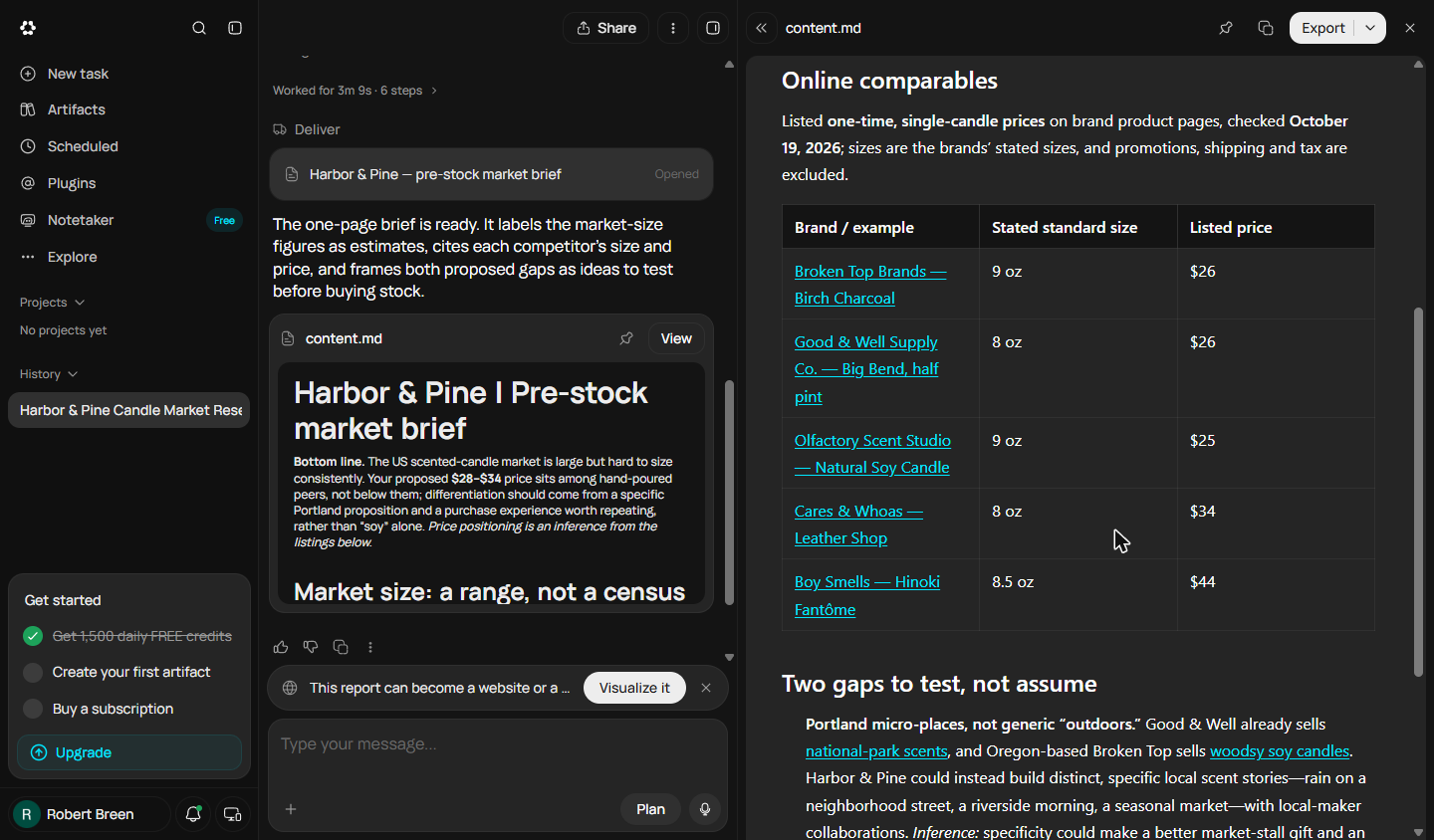
You help Maya Chen at Harbor & Pine, a made-up small-batch soy candle brand in Portland, check her market before she buys stock.
You paste a research brief into Runable, approve its plan, open a sourced one-page brief (market size range, five competitors with prices, two gaps), check a source, download it, and ask which numbers are estimates. The screens are real Runable screens from the Free plan, captured October 2026.
What you need
- Nothing to start the practiceThe lesson is a practice copy built from real Runable screens. Harbor & Pine is made up.
- The research briefThe exact prompt we pasted, ready to copy and change.
- A Runable account, to do it for realThe Free plan showed 1,500 credits a day in October 2026. This task used 562.
Concepts
An agent, not a chatbot
A chatbot answers from what it already knows. An agent takes a goal, makes a plan, uses tools (here web search and code) and hands you a finished file. Runable showed us its plan and asked "Does that scope work?" before it spent credits.
Brief it like a contractor
Our brief named the decision ("before I spend money on stock"), asked three specific questions, and set rules: give a range, say which numbers are estimates, cite every number, keep it to one page. Those rules are why the brief came back with a range instead of one confident number.
Check the source, not the summary
Three analysts put the 2025 US scented-candle market at $1.42 billion, $1.585 billion and $2.4 billion. That spread is normal. Open two or three sources, find the figure on the page, and tick it off in a sheet before you put it in a plan.
Do it for real
Now repeat it in your own account. Tick each step as you go.
Downloads
- The research brief (.txt)The exact prompt, the reply and the follow-up question we used.
- Competitor check sheet (.csv)The five brands and three market estimates from our run, with a column to mark each source verified.
Quick check
3 questions to check you’ve got it.
1. Runable writes back a plan and asks "Does that scope work?" What do you do?
- Ignore it and wait
- Read it and approve or correct it before it starts
- Start a new chat
Show the answer
Read it and approve or correct it before it starts. Approving the scope first means credits are spent on the job you meant, not a guess at it.
2. Three reports give three different market sizes. What does a good brief do?
- Pick the biggest
- Give the range and label them as estimates
- Average them and call it a fact
Show the answer
Give the range and label them as estimates. Our brief gave $1.4 to $2.4 billion and said these were analysts' estimates, not audited sales.
3. The brief cites a source for every number. Are you done checking?
- Yes, it has citations
- No, open a few sources and find the numbers yourself
- Only if the source is a big company
Show the answer
No, open a few sources and find the numbers yourself. A citation shows where to look. You still look before you spend money on it.
Runable: Turn Your Research into a One-Page Business Plan (and Catch the Bad Math)
You have the facts. Next, turn them into a one-page business plan, and catch the one number that does not add up.
Start module 2 →