Why this matters
Research tells you the market is there. A plan tells you what to do on Monday: who buys, what you sell, at what price, where, what happens in the first 30 days, and what could go wrong. A plan writer charges $500 to $1,500. And a plan with one wrong cost in it is worse than none, because you price, order and borrow on that number.
Runable's Report tool has a Business Plan template. In our run it wrote a one-page plan in 48 seconds for 14 credits, tagged every line as a research fact or an assumption, and fixed its own unit economics when we pointed out the math did not match the budget.
Practice
Do every step yourself in a practice copy of the real tool. It checks your work, and “Do it for me” finishes any step you get stuck on.
What you’ll build
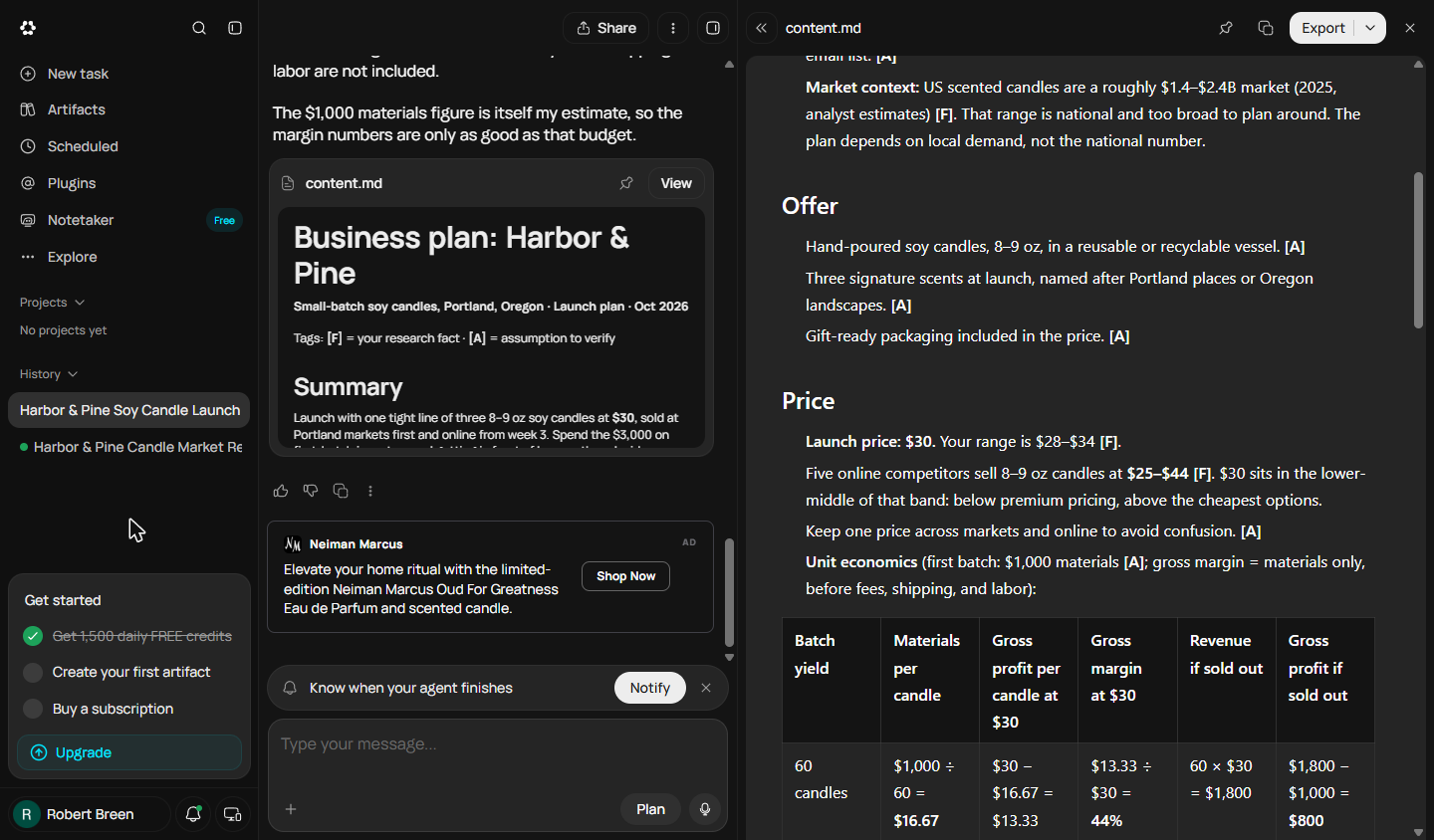
You help Maya Chen turn her Harbor & Pine research into a one-page launch plan.
You pick Report, then Business Plan, swap your research facts into the template, read the [F] and [A] tags, catch a materials cost of $9 a candle that does not match a $1,000 budget for 60 to 80 candles, and ask for the fix with the math shown. The screens are real Runable screens from the Free plan, captured October 2026.
What you need
- Nothing to start the practiceThe lesson is a practice copy built from real Runable screens. Harbor & Pine is made up.
- Your research factsThe facts from lesson 1 and the exact prompt we pasted.
- A Runable account, to do it for realThe Free plan showed 1,500 credits a day in October 2026. This plan and its fix used 14.
Concepts
Templates are layouts, not facts
The Business Plan template came with a sample prompt about a tea brand and a reference image. Runable used the image only for layout and said so. Always replace the sample prompt with your own facts.
Facts and assumptions
We asked Runable to mark anything that is an assumption. It tagged lines [F] (your research fact) and [A] (assumption to verify). AI writes both in the same confident voice, so the tags tell you which lines to check before you spend money.
Check the math by hand
The first version said about $9 of materials per candle and a 70% margin, but its own budget put $1,000 of materials into 60 to 80 candles: $12.50 to $16.67 each. Divide the numbers that drive the plan yourself, and when they disagree, ask for the fix and the math.
Do it for real
Now repeat it in your own account. Tick each step as you go.
Downloads
- Research facts and prompt (.txt)The facts from lesson 1, the prompt and the fix we asked for.
- The plan Runable wrote for us (.md)Copied from the app on 19 October 2026, with the corrected unit economics.
Quick check
3 questions to check you’ve got it.
1. The template comes with a sample prompt about another business. What do you do?
- Send it as it is
- Replace it with your own facts and sections
- Add your facts under it
Show the answer
Replace it with your own facts and sections. The template is a layout. Your facts are what the plan should stand on.
2. A line in the plan is tagged [A]. What does that mean?
- It is from your research
- It is an assumption to check before you act on it
- It is the most important line
Show the answer
It is an assumption to check before you act on it. [F] is your research fact, [A] is Runable's assumption.
3. The plan says $9 of materials per candle, but the budget is $1,000 for 60 candles. What is the real figure?
- $9
- $16.67
- $60
Show the answer
$16.67. $1,000 divided by 60 is $16.67. Runable fixed it to a 44% gross margin at $30.
Runable: Make an Instagram Launch Carousel for Your Products (and Catch the AI Typo)
The plan says markets first. Next, make an Instagram launch carousel for the three scents, and catch the typo the AI put in the image.
Start module 3 →