What is a prompt?
Updated · By Robert Breen
A prompt is the input you give an AI tool to get a response: the request itself, plus any facts, examples, files or pasted text it should work from. The AI only knows what the prompt and its settings tell it, so the prompt decides how good the answer can be.
Why it matters for a small business
Every AI tool a small business uses runs on prompts, whether you type them into ChatGPT, describe a web form to Lovable, or write one into an n8n workflow that runs a hundred times a day. The model can't see your price list, your calendar or your customer's last email unless the prompt includes them. When it lacks a fact, it fills the gap with something plausible and generic.
That is why two people can use the same tool and get very different results. A one-line prompt gets a one-size-fits-all answer that you then spend ten minutes rewriting. A prompt with your real details gets something close to usable on the first try, which is where the time savings actually come from.
In a real lesson: Prompt Writing 101: Role, Context, Task, Format
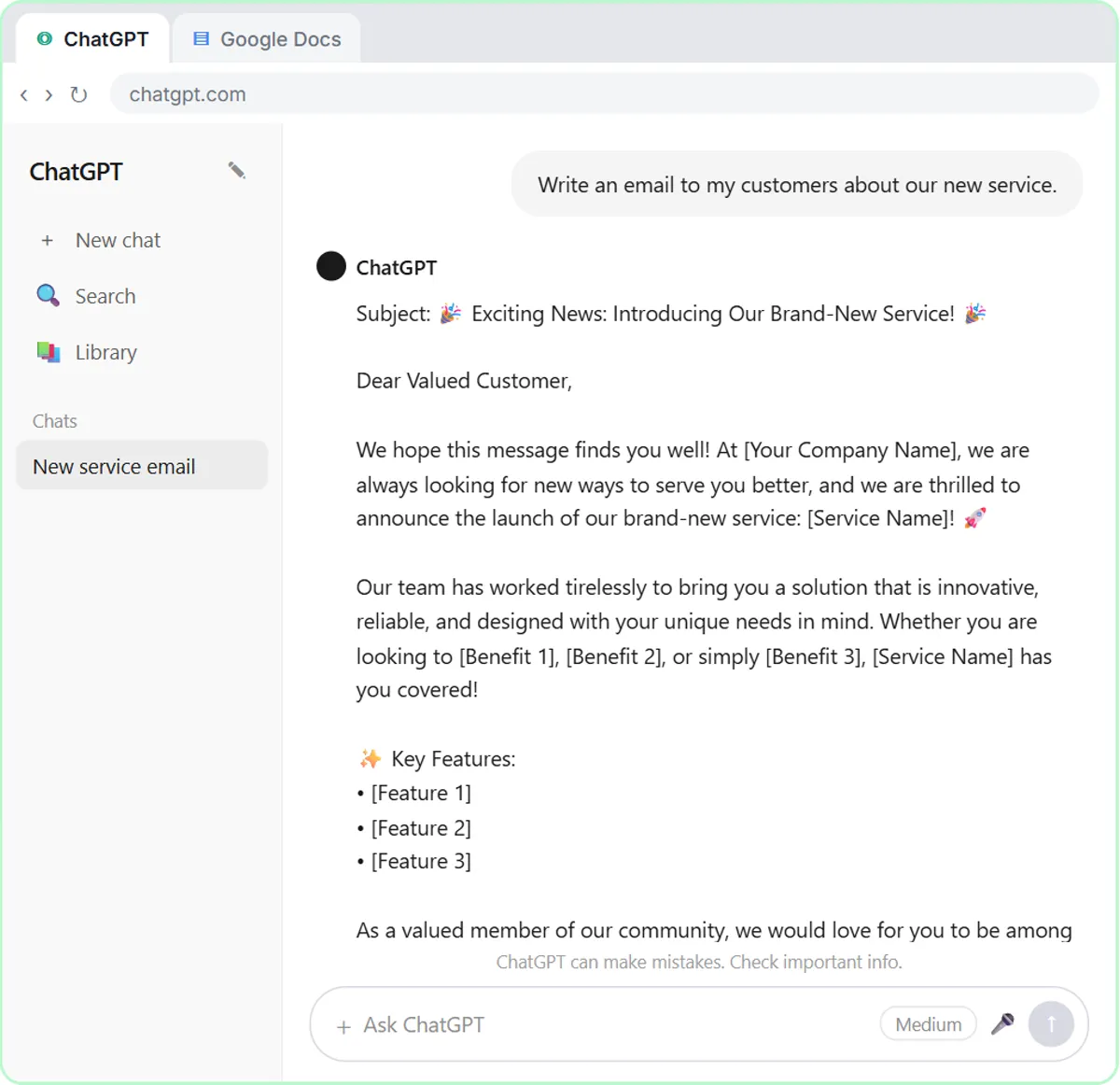
Prompt Writing 101 starts with the prompt most people type: Write an email to my customers about our new service. You click Paste prompt, then Send. The answer opens with "Dear Valued Customer", puts an emoji in the subject line and leaves blanks like [Your Company Name] everywhere. Nothing is wrong with the model; the prompt simply gave it nothing to go on.
Then you click New chat and send the same request again, this time with the details of Summit Lawn Care, the made-up lawn company in the lesson: who is writing, who the customers are, the new aeration and overseeding service, the $149 price, the dates, the call to action and a 120-word limit. The second answer uses the real name, price and dates and is ready to send. Same tool, same model; only the prompt changed.
Try this lesson free or read the step-by-step guide.
Common confusions
Prompt vs question
A prompt doesn't have to be a question. "Summarize this transcript," a pasted email thread, or an attached receipt photo with one line of text are all prompts. Anything you send the model as input counts.
Prompt vs system prompt
Your prompt is the message for this one request. A system prompt is a standing instruction set up in advance (in a Custom GPT or an n8n AI Agent) that the model reads before every message. The two are combined each time.
Is there a magic wording?
No. Phrases like "act as an expert" help far less than plain facts. The biggest gains come from saying what you need, giving the details only you know, and saying how the answer should look, which is what Role, Context, Task, Format covers.
Tips
- If the answer has placeholders in square brackets, the prompt was missing facts. Add them instead of filling the blanks by hand.
- Paste the real material (the email, the notes, the numbers) rather than describing it from memory.
- Start a new chat when you change topics, so old messages don't steer the new answer.
Related terms
Where you use it: free lessons
- Prompt Writing 101: Role, Context, Task, Format (ChatGPT, 8 min)
- Reply Faster: Turn a Messy Customer Email Thread into a Clear, Friendly Reply (ChatGPT, 9 min)
- Build a Custom GPT Social Media Assistant (ChatGPT, 8 min)
Frequently asked questions
- How long should a prompt be?
- As long as it needs to be to include the facts the AI can't guess. A few short sentences covering who, what, details and format usually beats both a one-liner and a page of vague instructions.
- Do prompts work the same in ChatGPT, Claude and Gemini?
- Mostly, yes. The tools differ in features, but a clear request with real details and a stated format works well in all of them.
- Can a prompt include a file?
- Yes. Many AI tools let you attach a document or image along with your text, and the file becomes part of the input the model reads.