Updated . Built against the tool’s current screens and checked step by step. How we check this lesson
New clients get onboarded from a spreadsheet and an inbox, and nobody can see which documents are still missing. Describe the tracker to GoSwift’s AI builder, review its plan, build it, and check the client and document-checklist records it made, without writing code.
At a glance
| Question | Answer |
|---|---|
| What you build | New clients get onboarded from a spreadsheet and an inbox, and nobody can see which documents are still missing. Describe the tracker to GoSwift’s AI builder, review its plan, build it, and check the client and document-checklist records it made, without writing code. |
| Tools | GoSwift |
| Time | About 6 minutes, 8 steps in 3 parts |
| Level | Beginner, no coding needed |
| Cost | Free |
| Ways to learn it | Practice it step by step |
The 3 parts, in short
- Describe the app: Describe what you need, Send it.
- Review the plan and build: Create the plan, Build This Solution, Let it build.
- Check what it built: Swift Objects, The client record, The document checklist.
Start here first: Turn a Client Meeting into Action Items and a Follow-Up Email (Accounting Firms) (module 1 of AI Automation for Accounting & Bookkeeping Firms)
Part of: AI for Accounting & Bookkeeping Firms (step 40 of 41). Next up: MonstarX: Turn New-Client Emails into an Intake Form and Tracker for Accounting & Bookkeeping Firms
Part of: AI Apps Worth Knowing (step 91 of 123). Next up: MonstarX: Turn New-Client Emails into an Intake Form and Tracker for Accounting & Bookkeeping Firms
What you'll build
A made-up 12-person accounting firm, Keystone Ledger Partners, signs a few new clients every month. For each one it needs an engagement letter, last year’s return and bank statements. Today that lives in a shared spreadsheet and three inboxes, so nobody knows at a glance who is waiting on what. In this lesson you describe a client onboarding tracker to Swiftly, the AI builder in GoSwift. It says back what it understood, shows a plan with every assumption, and builds the app: a record for each client and a checklist of documents for each one. Every screen is a real GoSwift screen; the firm is made up.
You described a client onboarding tracker in two sentences. Swiftly planned 1 application, 2 data objects, 3 screens and a dashboard, listed its assumptions, and built the app and its data: a Client Onboarding record (company, contact, assigned accountant, start date, status) and an Onboarding Document Checklist (document type and status, linked to the client). What it saves: the spreadsheet nobody trusts, and the "did we get their bank statements?" emails. Next: when the screens finish building, add users and launch the app for your team. GoSwift plans and trials change; check goswift.ephlux.com for what yours includes.
- Tools: GoSwift
- Time: about 6 minutes, 8 steps in 3 chapters
- Level: beginner, no coding needed
- Price: free
Practice first, then build it for real
Practice copy built from real GoSwift screens (go-swift.ephlux.com), captured 27 October 2026 in a trial workspace. Nothing here touches a GoSwift account. The firm is made up; the plan and the data objects are what GoSwift built from the description. To build it for real you need your own GoSwift account, and some services charge once you use them for real work, so check each tool's current pricing.
Try it yourself, free
Reading the steps is a start. Doing them is how it sticks. The interactive module walks you through every click in a practice copy of GoSwift, checks each step, and never touches your real accounts.
Start “GoSwift: Build a Client Onboarding Tracker by Describing It for Accounting & Bookkeeping Firms”Step by step: GoSwift: Build a Client Onboarding Tracker by Describing It for Accounting & Bookkeeping Firms
All 8 steps of the interactive module, in order. In the module you watch each one, then do it yourself in a practice copy that checks your work.
1. Describe the app
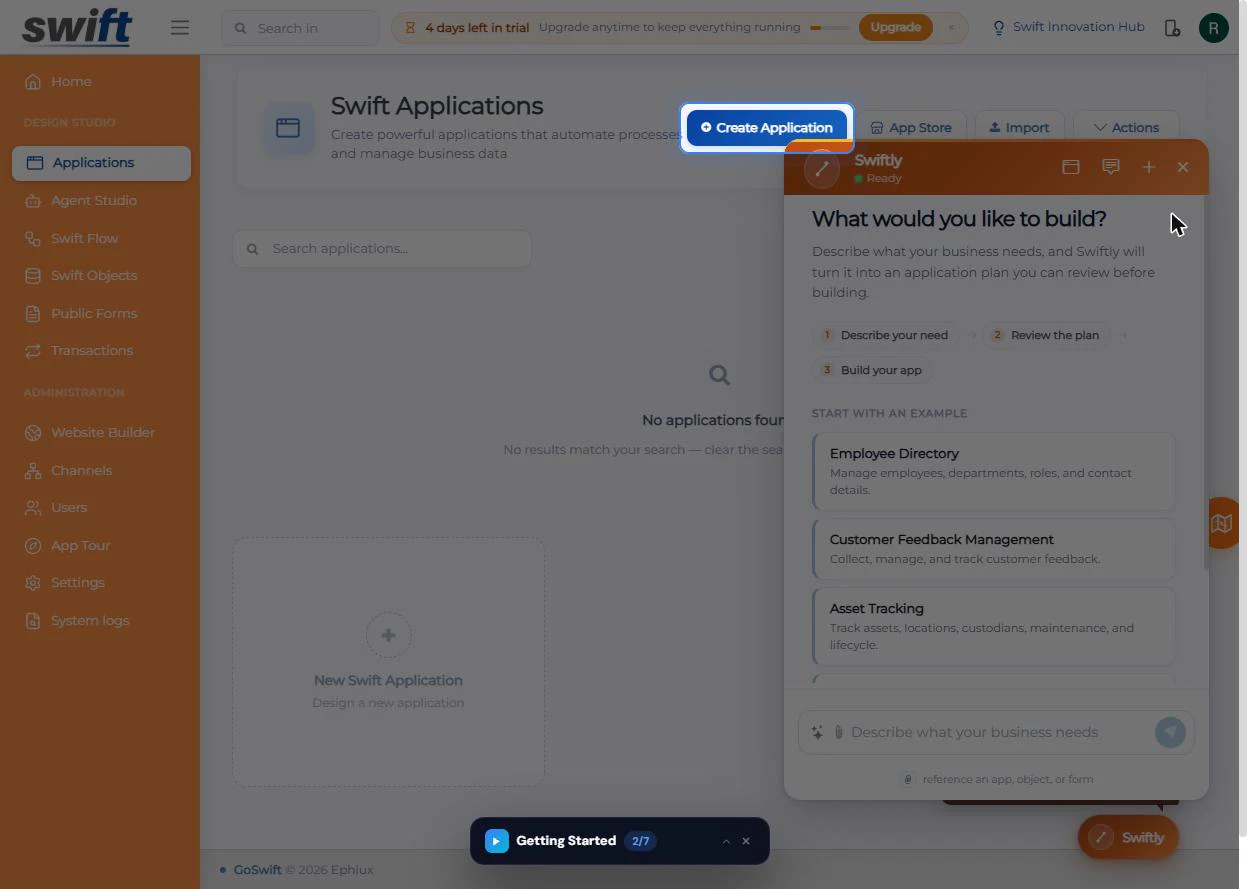
- Describe what you need. In GoSwift, click Swiftly (bottom right) to open the AI builder. It asks What would you like to build? and shows three steps: describe your need, review the plan, build your app. Type what your firm needs in plain words: what you track for each client and which documents you chase.
Describe what you need in plain words. What you track for each client, and which documents you chase.
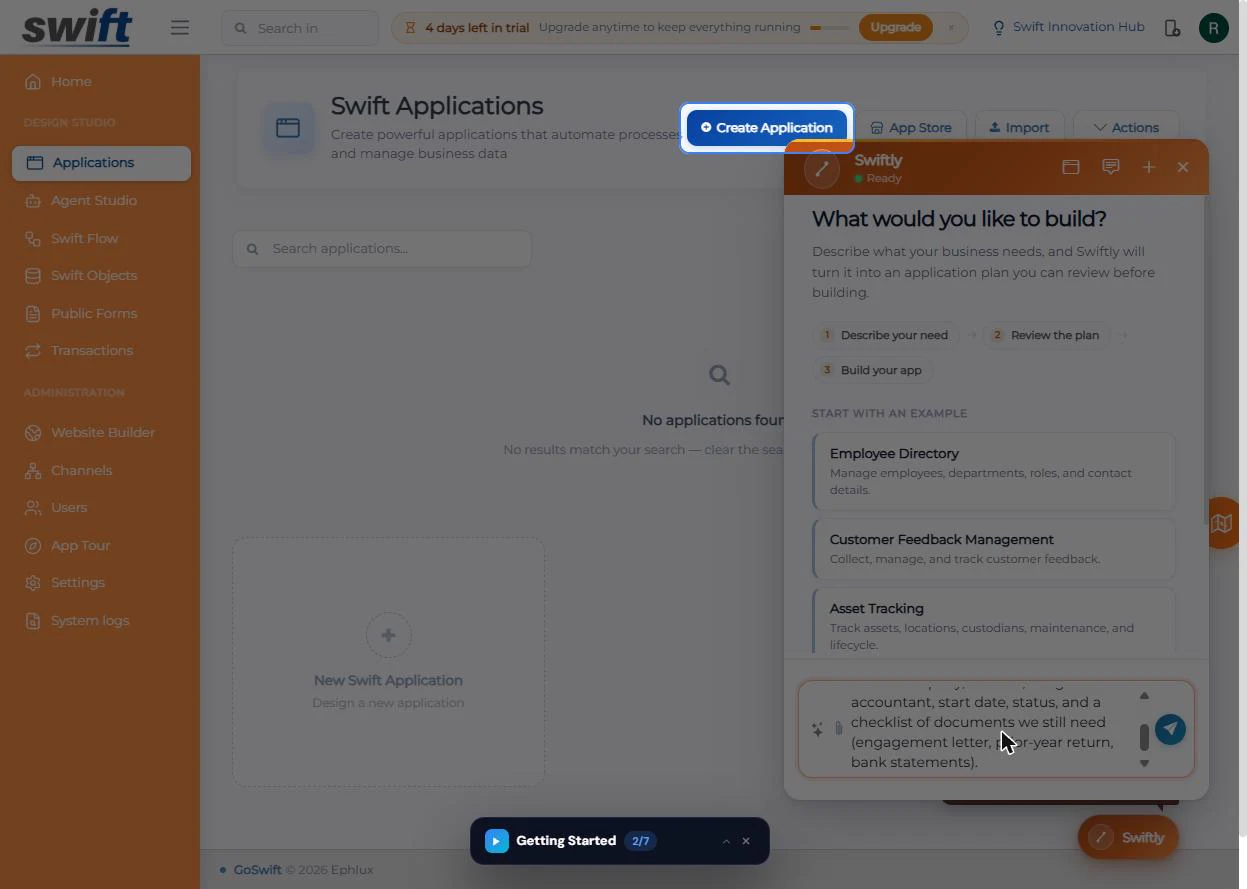
Client onboarding tracker for our 12-person accounting firm. For each new client: company, contact, assigned accountant, start date, status, and a checklist of documents we still need (engagement letter, prior-year return, bank statements).
- Send it. Click the send arrow (or press Enter). Swiftly spends a few seconds Planning your solution.
Swiftly plans the solution.
2. Review the plan and build
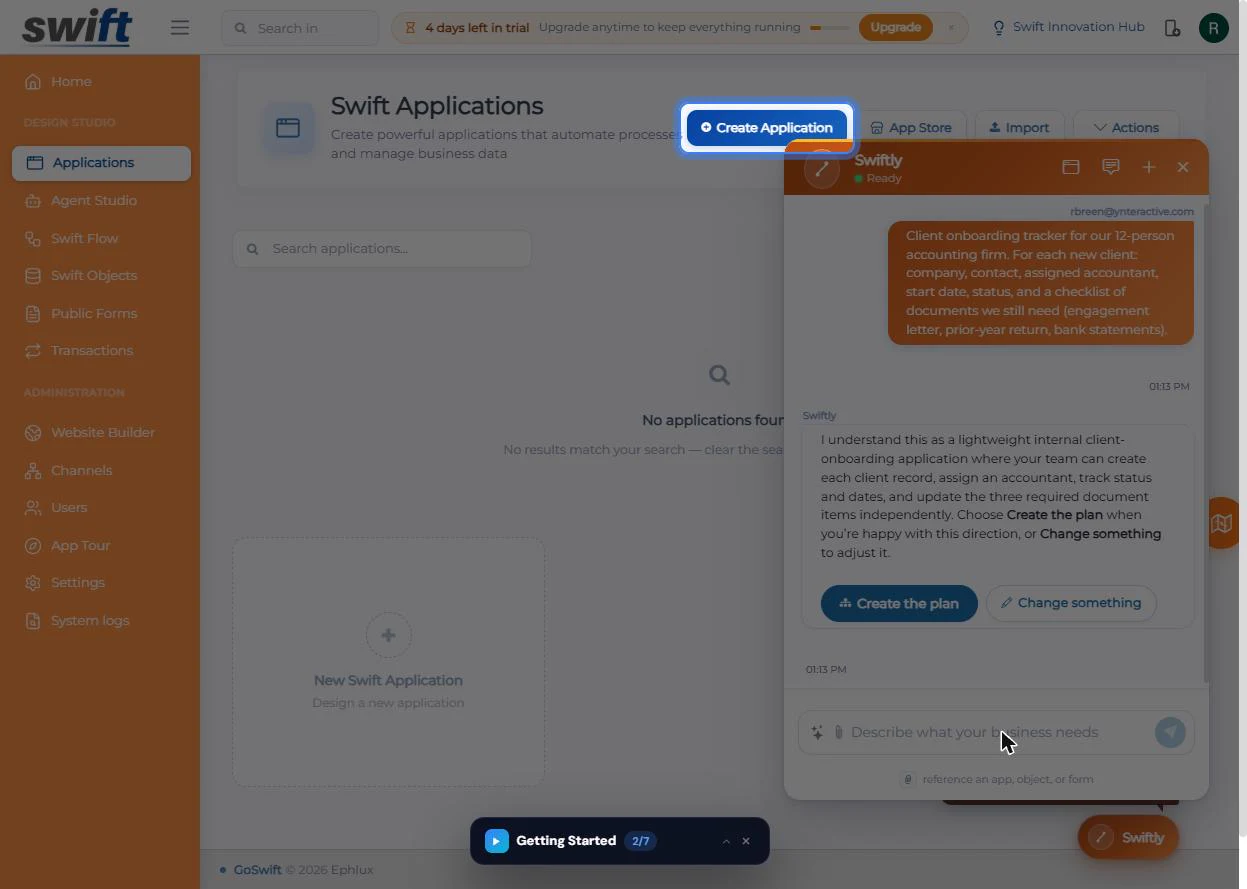
- Create the plan. Swiftly says back what it understood: an internal onboarding app where your team creates a record for each client, assigns an accountant, tracks status and dates, and updates the three documents one by one. If that is right, click Create the plan. If not, Change something.
Swiftly says back what it understood. If it is right, click Create the plan.
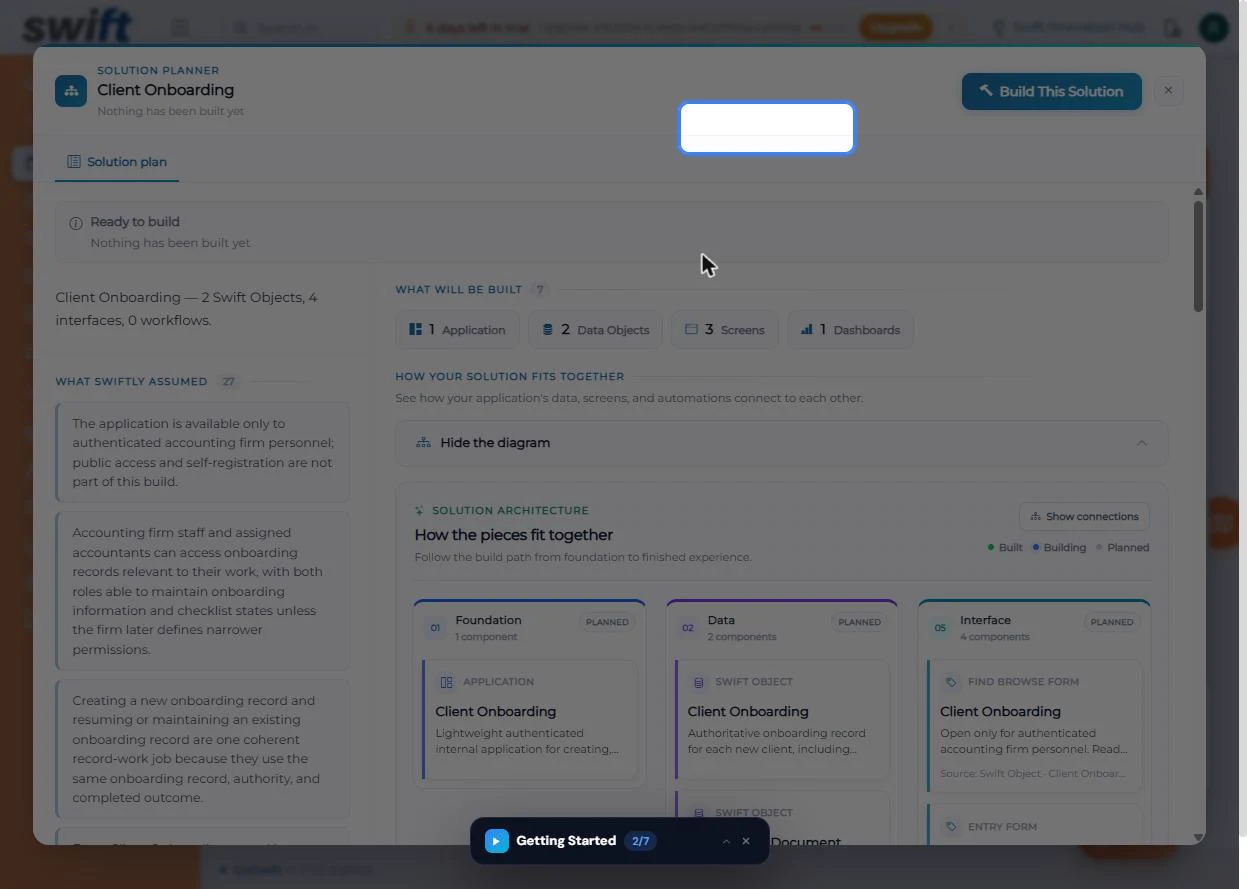
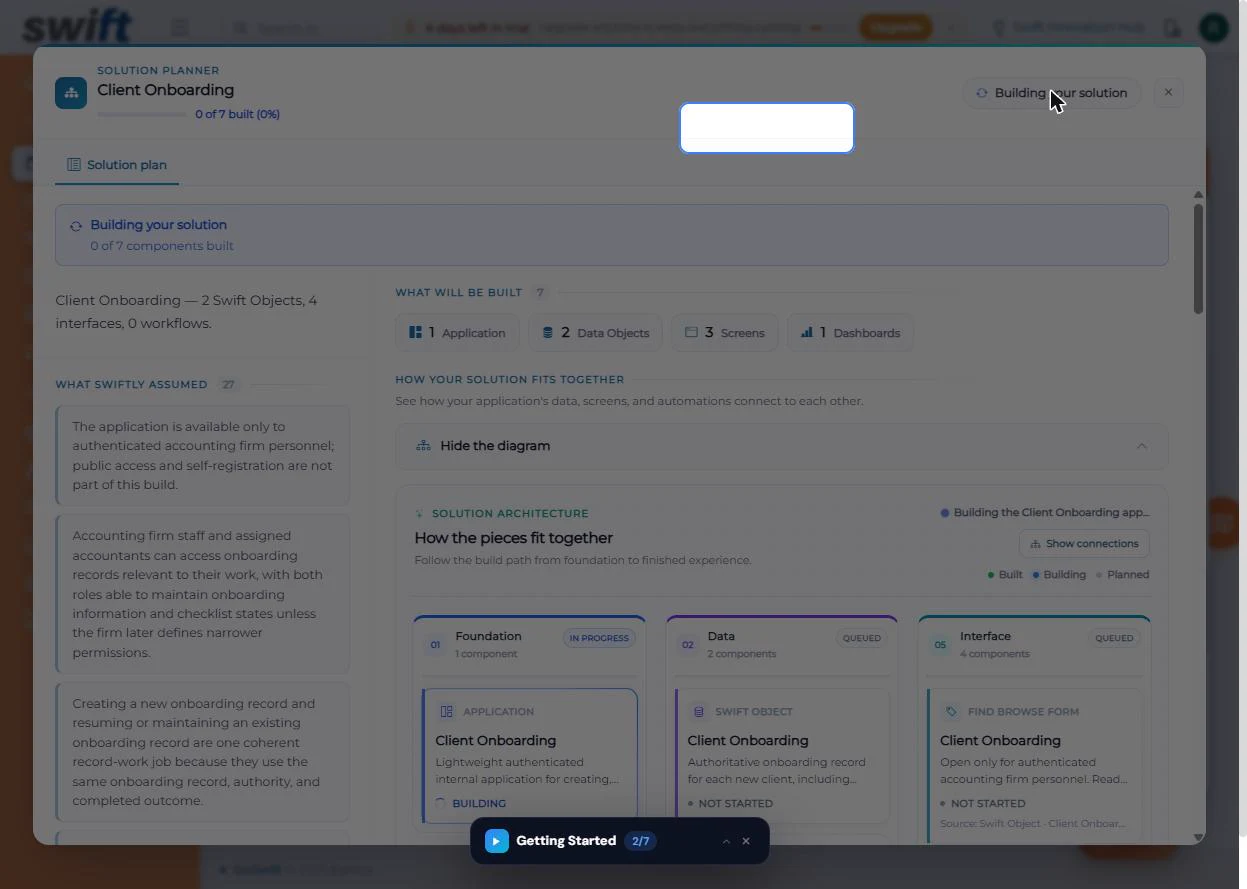
- Build This Solution. The Solution Planner lists what will be built (1 Application, 2 Data Objects, 3 Screens, 1 Dashboard) and every assumption it made, such as "only firm staff can sign in". Read the assumptions, then click Build This Solution.
The plan shows what will be built, and every assumption. Read them, then click Build This Solution.
- Let it build. GoSwift builds in order: Foundation (the app), Data (where the records live), then Interface (the screens). It takes a few minutes; you can close the planner and keep working.
GoSwift builds the app, then the data, then the screens. It takes a few minutes. You can close the planner.
3. Check what it built
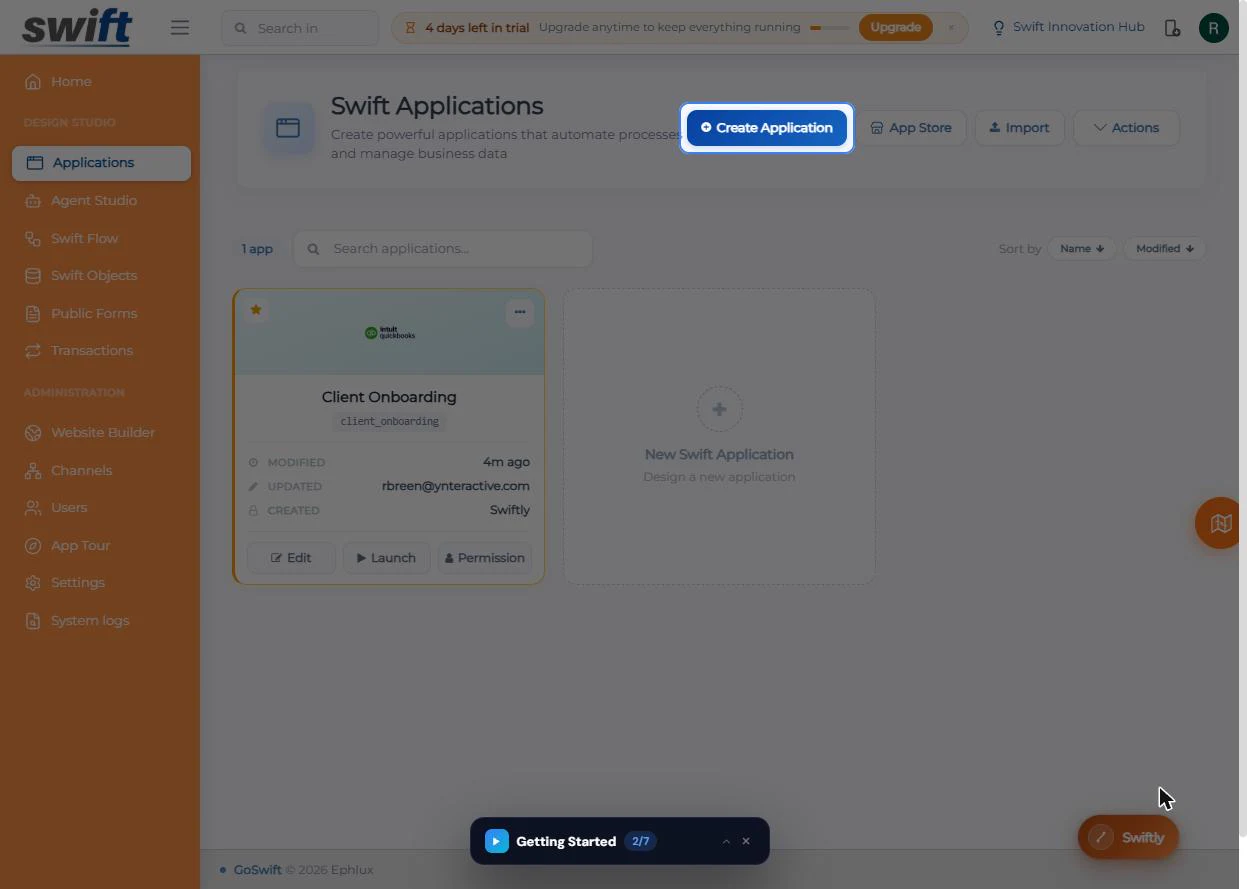
- Swift Objects. Client Onboarding is now on the Applications page, created by Swiftly. To check what it will store, open Swift Objects in the left menu.
The app is on the Applications page.
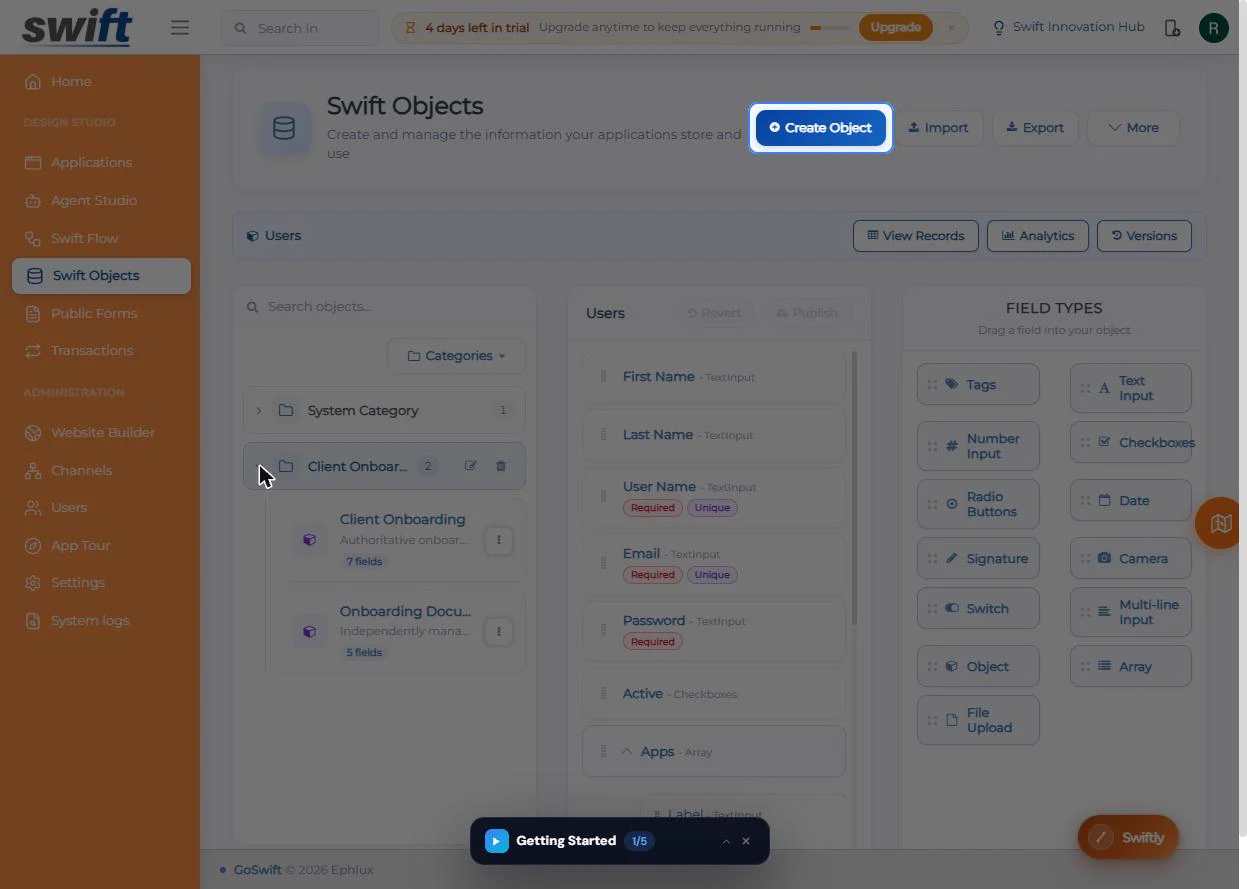
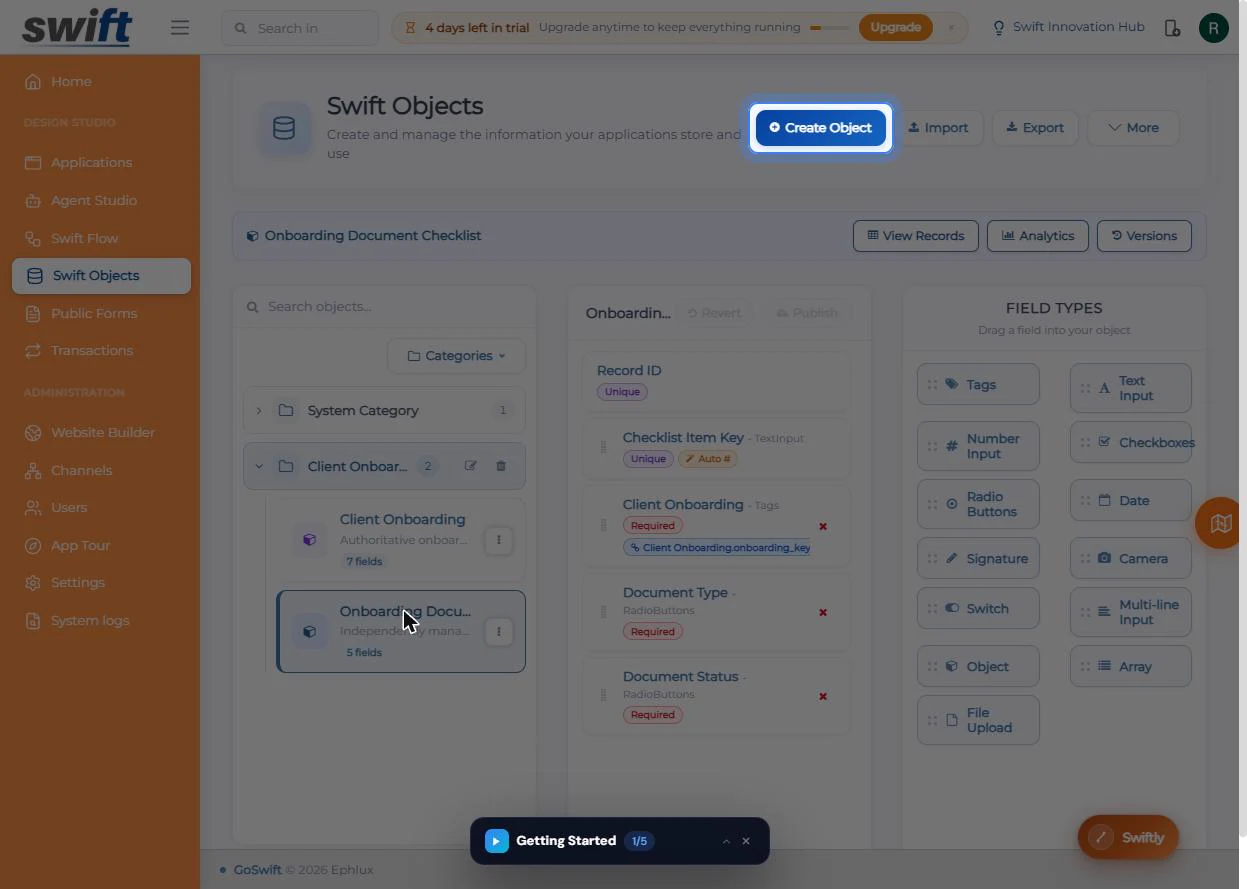
- The client record. Swiftly made a Client Onboarding category with two objects. Click Client Onboarding (7 fields).
Swiftly made two objects.
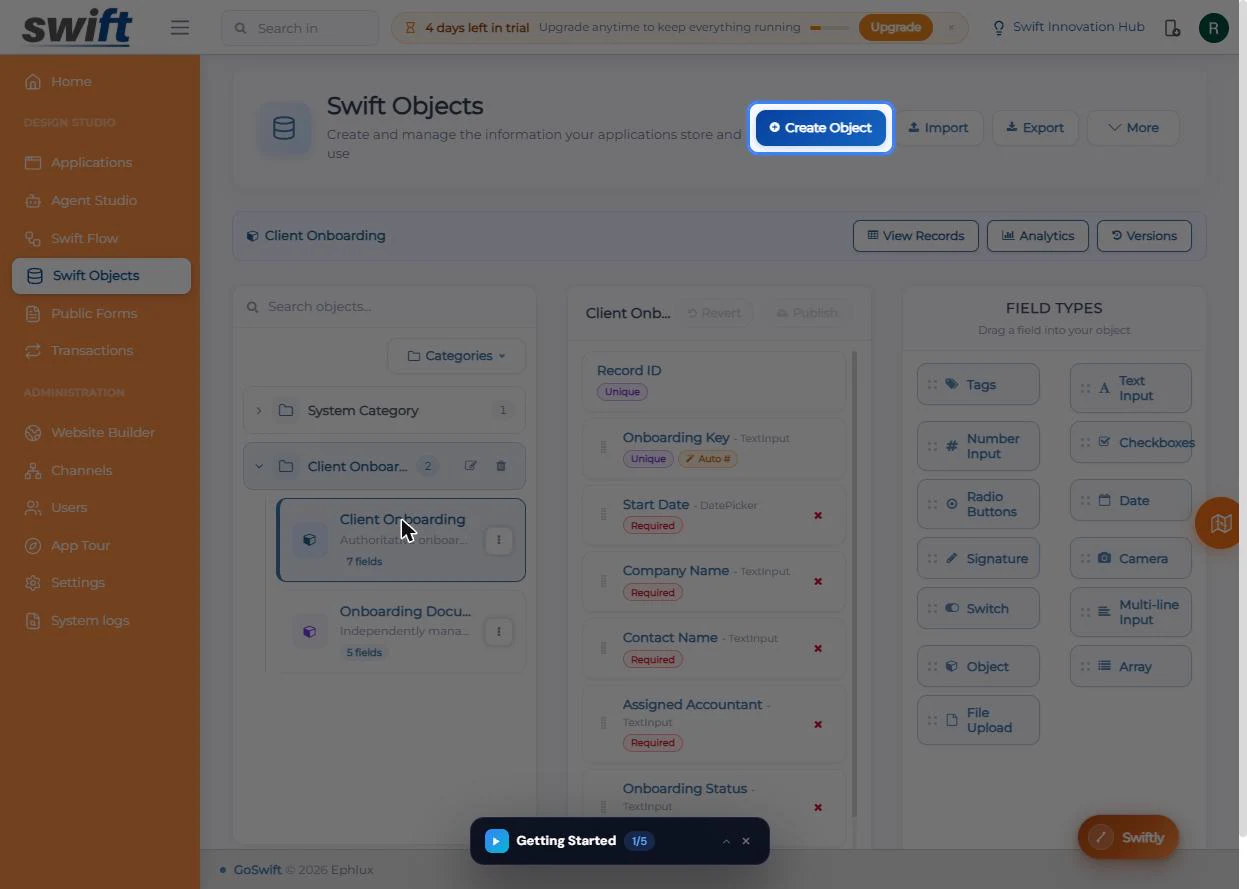
- The document checklist. Every field you described is there: Start Date, Company Name, Contact Name, Assigned Accountant and Onboarding Status, all required, plus an automatic Onboarding Key. Now click Onboarding Document Checklist.
Start date, company, contact, assigned accountant and status are all there.
Screenshots
More in AI Automation for Accounting & Bookkeeping Firms
 Turn a Client Meeting into Action Items and a Follow-Up Email (Accounting Firms)
Turn the transcript of a client's quarterly review into the decisions, an action items table with owners and due dates, and a follow-up email to the client.
Free · Live ~9 min Beginner
 Answer Refund-Date Emails Without Overpromising using ChatGPT
A client wants a refund date while two tax forms are still missing. Give ChatGPT the thread and your firm's facts, catch the date it shouldn't promise, and send a calm…
Free · Live ~10 min Beginner
 Analyze a Client's P&L Export with ChatGPT (Accounting & Bookkeeping Firms)
Upload a client's Profit and Loss Detail export to ChatGPT, catch duplicate bank-feed entries and uncategorized rows first, then get a monthly P&L summary, a chart and…
Free · Live ~11 min Beginner
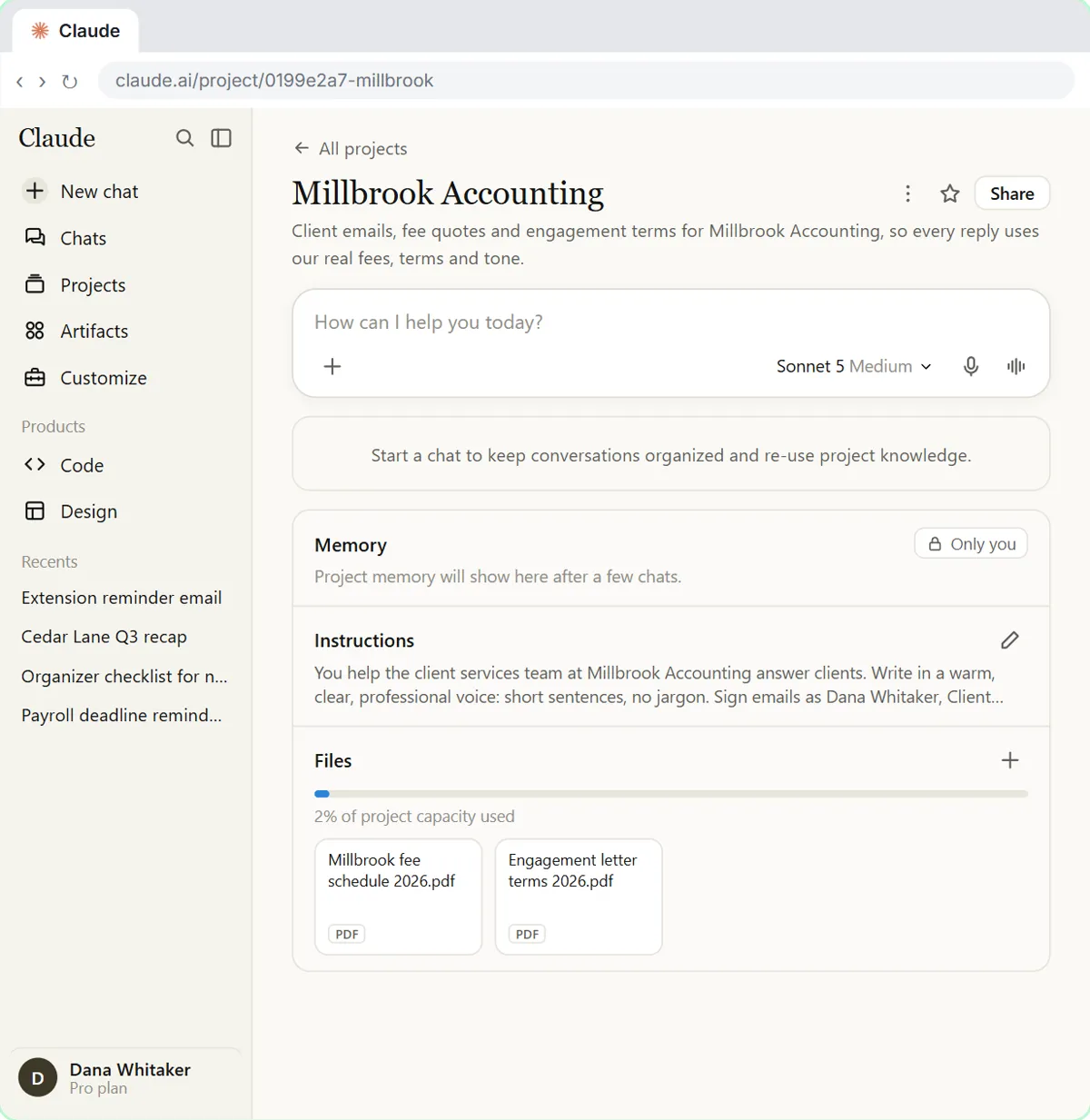 A Claude Project for Your Accounting Firm: Fee Schedule, Engagement Terms and Tone
Create a Claude project for your accounting firm, give it your tone and client policies, add your fee schedule and engagement letter terms as project knowledge, and get…
Free · Live ~9 min Beginner
◷Month-End Bank Reconciliation with ChatGPT: 20 Minutes, Not 3 HoursUpload the bank statement and the books, let ChatGPT match every row and list the exceptions, then check the answer and paste a reconciliation summary into the…
Free · Live ~12 min Beginner
◷Collect Overdue Invoices Faster using ChatGPTUpload your aging report, have ChatGPT build this week’s chase list (oldest and biggest first, disputes held back), check it against the file, then draft a friendly…
Free · Live ~12 min Beginner
All 15 modules in AI Automation for Accounting & Bookkeeping Firms
Terms in this lesson
Plain-English definitions, each with an example from a free lesson.