What is zero-shot prompting?
Updated · By Robert Breen
Zero-shot prompting means asking an AI model to do a task using only instructions, without showing it any finished examples of the output. The model relies on what it learned in training plus your description of the job, rules and format.
Why it matters for a small business
Most everyday prompts are zero-shot, and for common tasks like emails, summaries and short follow-ups, modern models handle them well. That matters because collecting good examples takes time. If clear instructions get you a usable answer, you can start today with nothing but a description of the job.
Knowing the term helps you diagnose problems. If a zero-shot prompt keeps missing a style you can recognize but struggle to describe, the fix is often not more adjectives but one or two real examples, which turns it into few-shot prompting.
In a real lesson: Build an AI Follow-Up Agent for HVAC Service Calls
In Build an AI Follow-Up Agent for HVAC Service Calls, the system prompt for Cedar Ridge Heating & Air (a made-up company) never shows a sample follow-up message. Instead it describes one: thank the customer by first name and name the work, add one practical tip that fits the job (filters, thermostat, keeping the outdoor unit clear), invite them to reply or call, and mention the Comfort Club maintenance plan only after a repair, and only once.
It adds hard rules in place of examples: keep text messages under 300 characters, use email for installs, and do not invent prices, discounts or warranty terms. Then you test it with one chat message listing three calls: Linda Morales's furnace tune-up, Tom Becker's replaced AC capacitor and Grace Chen's new heat pump install.
The agent returns two texts and an email for the install, each with a tip that fits the job, without ever having seen a finished one. That is zero-shot working well, because the instructions are specific enough to stand in for examples.
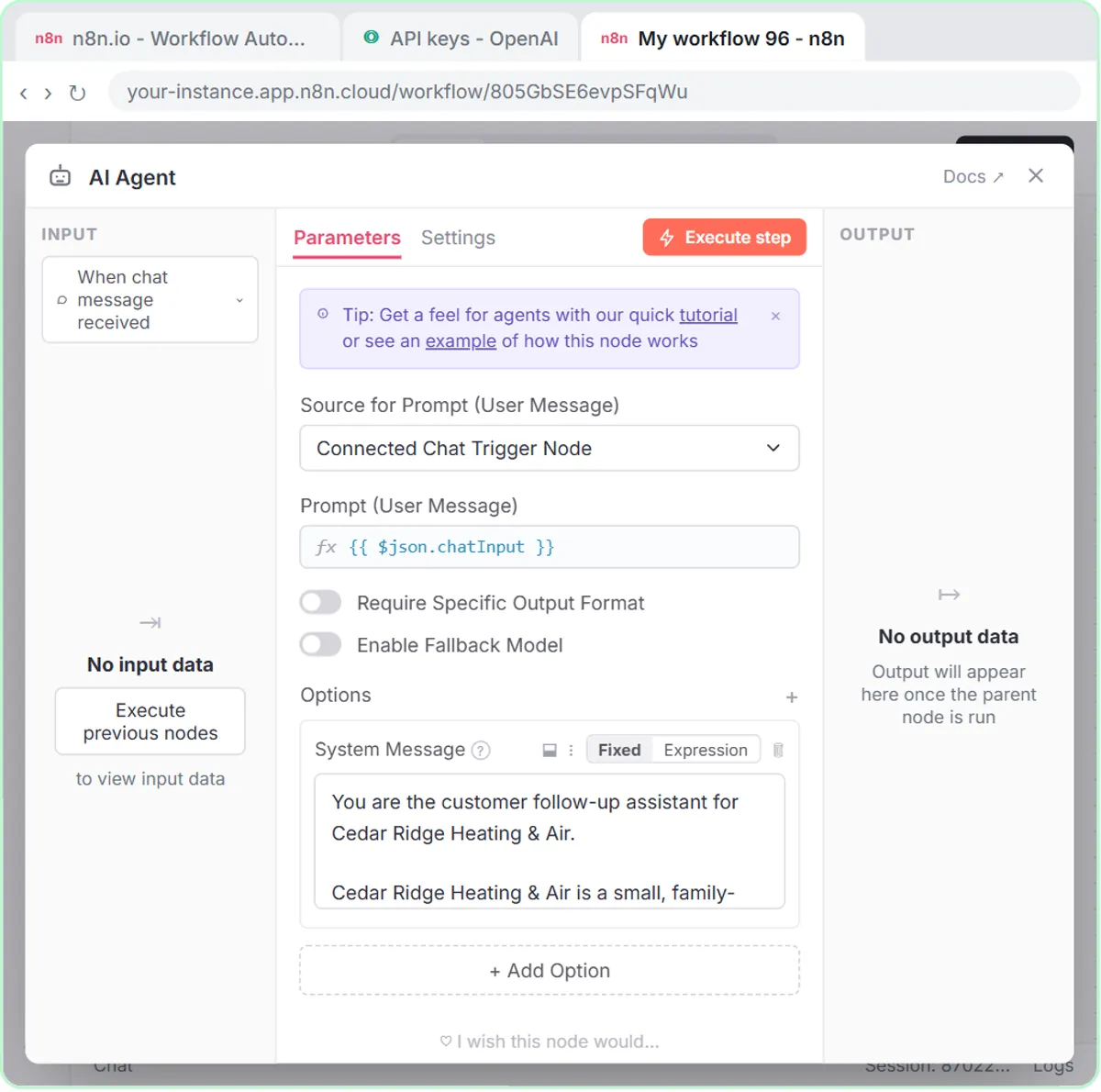
Try this lesson free or read the step-by-step guide.
Common confusions
Zero-shot vs low-effort
Zero-shot only means "no examples." A zero-shot prompt can still be detailed, like the HVAC system prompt with its rules and output fields. A vague one-liner is zero-shot too, but that is not why it fails; it fails for lack of context.
Zero-shot vs few-shot
Few-shot prompting adds a handful of sample inputs and outputs so the model can copy a pattern. Use it when the style or format is hard to explain in words.
Tips
- Try zero-shot first. Add examples only when the output keeps missing something you can point to.
- Replace examples with specific rules where you can: character limits, required parts, words to avoid.
- Test with varied inputs (a repair, a tune-up, an install) to see if the instructions hold across cases.
Related terms
Where you use it: free lessons
- Build an AI Follow-Up Agent for HVAC Service Calls (n8n, 12 min)
- Prompt Writing 101: Role, Context, Task, Format (ChatGPT, 8 min)
- Build an AI Customer Follow-Up Agent for Plumbers (n8n, 12 min)
Frequently asked questions
- Why is it called zero-shot?
- A "shot" is an example. Zero-shot means zero examples in the prompt; one-shot means one; few-shot means a handful.
- Is zero-shot less accurate than few-shot?
- Not necessarily. For common tasks with clear instructions, it often works just as well. Examples help most with unusual formats or a very particular voice.