What is speech-to-text?
Updated · By Robert Breen
Speech-to-text is software that listens to spoken audio and writes down the words as text. It is also called speech recognition or automatic transcription. It powers meeting transcripts, voicemail-to-text and dictation, and it is the "ears" of every voice agent.
Why it matters for a small business
Most of what happens in a small business is said out loud: a team meeting, a client call, a voicemail from a customer with a leak. Speech-to-text turns that into words you can search, copy and hand to an AI model. Once a conversation is text, ChatGPT can summarize it, pull out action items or draft the follow-up email.
It also sets a ceiling on everything downstream. If the transcript hears "fifteen" as "fifty" or spells a customer's name wrong, the summary, the email and the spreadsheet row will carry that mistake forward with full confidence. Knowing what speech-to-text tends to get wrong is how you know what to check.
In a real lesson: Summarize a Meeting Transcript with ChatGPT
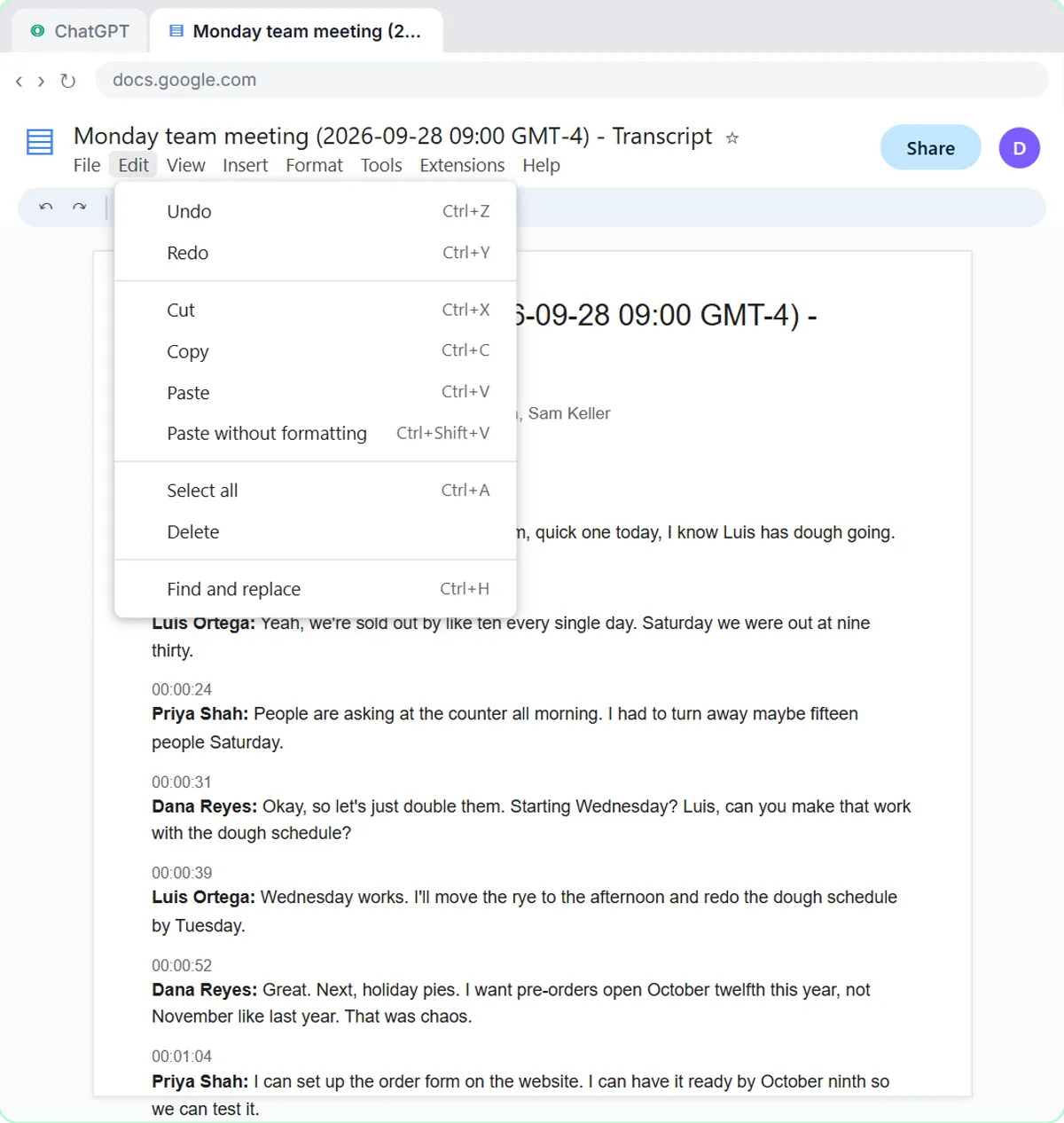
In the Summarize a Meeting Transcript lesson, the starting point is speech-to-text output: the transcript Google Meet saved after Monday's team meeting at Harbor Street Bakery, a made-up bakery. You can see the shape speech recognition produces. Every line has a timestamp like 00:00:04, a speaker label like Dana Reyes:, and the words as spoken, filler included: "Um, quick one today, I know Luis has dough going."
Notice the numbers. The transcript says "sold out by like ten" and "out at nine thirty" and "sixty pies a day," spelled out the way people talk. Spoken dates come through the same way: "October twelfth." That is normal for speech-to-text and one reason the lesson's request tells ChatGPT to "Only use what's in the transcript" and write Not stated when an owner or date is missing, instead of filling gaps with a guess.
The lesson starts from a finished transcript, so you don't run speech recognition yourself. But the checking habit it teaches, reading the action items table for owners and dates before anything is sent, is exactly the check speech-to-text output needs.
Try this lesson free or read the step-by-step guide.
Common confusions
Speech-to-text vs text-to-speech
They run in opposite directions. Speech-to-text turns a voice into words on a page. Text-to-speech turns words on a page into a voice. A voice agent uses both: one to hear the caller and one to answer.
Transcript vs summary
A transcript is everything that was said, in order, ums included. A summary is a short version someone (or an AI) wrote from it. Keep the meeting transcript as the record and treat the summary as a draft.
Tips
- Check names, numbers, dates and dollar amounts first. Those are the words speech recognition gets wrong most often and the ones that cause real problems.
- Good audio beats any setting: one person talking at a time and a decent microphone make a bigger difference than switching tools.
- Recording and transcribing calls can require consent. Check the rules where you and the other person are before you record.
Related terms
Where you use it: free lessons
- Summarize a Meeting Transcript with ChatGPT (ChatGPT, 9 min)
- Turn a Client Meeting into Action Items and a Follow-Up Email (Accounting Firms) (ChatGPT, 9 min)
- Turn an Interview Debrief into a Scorecard and a Candidate Follow-Up (Recruiting & HR) (ChatGPT, 9 min)
Frequently asked questions
- Is speech-to-text accurate enough for business use?
- For clear audio it is usually good enough to work from, but not good enough to send without checking. Read the names, numbers and dates against what you remember before you act on them.
- Where do I get a transcript of my meetings?
- Many meeting tools, including Google Meet, can save a transcript for you, depending on your plan and settings. You can paste that text into ChatGPT or upload the file, as the meeting summary lesson shows.