What is a self-check prompt?
Updated · By Robert Breen
A self-check prompt asks an AI to review its own output against a standard you supply, usually your facts or rules, and to flag anything that doesn't match. A good one asks for a claim-by-claim comparison, not a general "is this correct?"
Why it matters for a small business
AI drafts can sound careful and still promise too much. A reply might confirm a delivery date you never offered or call a product safe when your facts say otherwise. Reading for that yourself is tiring, and fluent writing makes errors easy to miss. A self-check turns the draft into a list you can scan in seconds.
It is cheap insurance for anything a customer will read. The check takes one message, and it catches the kind of mistake that costs a refund, an apology or trust.
In a real lesson: Reply Faster: Turn a Messy Customer Email Thread into a Clear, Friendly Reply
In Reply Faster: Customer Emails, Jess at Cedar Lane Bakery (a made-up shop) is answering Dana, whose birthday cake order went wrong. The first draft looks good, but the allergy line calls the cake completely nut-free, and the numbered facts say the kitchen also bakes with nuts.
You click Paste check, which asks ChatGPT to check the reply against the facts, make a table of every promise or claim next to the fact that backs it up, and flag anything the facts don't support. The table shows five of six claims matched; the allergy line is flagged, with safer wording suggested.
The lesson adds one important caution in the voice-over: still compare the table with your own facts, since you know the business. The self-check narrows where to look; it doesn't replace your final read before you click Send in Gmail.
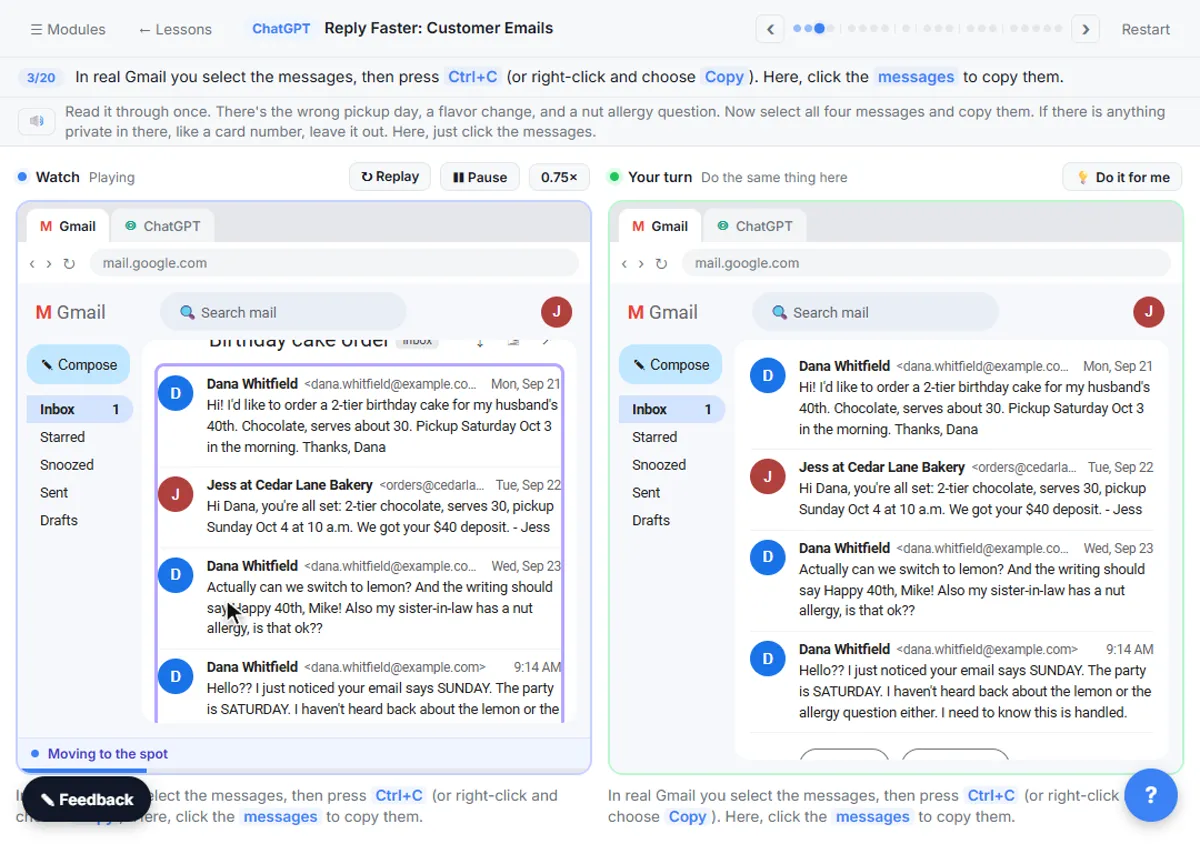
Try this lesson free or read the step-by-step guide.
Common confusions
Self-check vs "is this right?"
Asking "is this correct?" usually gets a yes. A useful self-check names the standard (my numbered facts) and asks for evidence per claim, so unsupported lines have nowhere to hide.
Can the AI check its own work reliably?
Partly. It is good at matching statements to a list you give it, and weaker at catching errors when there is nothing to compare against. That is why the check works best with grounding facts, and why a person still reads the result.
Tips
- Number your facts in the original prompt so the check can point to them.
- Ask for a table: claim, supporting fact, supported yes or no.
- Run the check in the same chat so it can see both the draft and the facts.
- Save the check as a reusable prompt, like the check reply promises prompt.
Related terms
Where you use it: free lessons
- Reply Faster: Turn a Messy Customer Email Thread into a Clear, Friendly Reply (ChatGPT, 9 min)
- Reply Faster to Clients Chasing Their Refund: ChatGPT for Tax and Bookkeeping Firms (ChatGPT, 10 min)
- Reply Faster to a Client Asking for a Case Update: ChatGPT for Small Law Firms (ChatGPT, 10 min)
Prompt templates that use it
Visual guide
Self-check prompt in a few slides, with the same guide written out as text.
Frequently asked questions
- Does a self-check prompt catch every mistake?
- No. It catches many unsupported claims, but it can miss things or flag the wrong line. Treat it as a second pair of eyes, not the last one.
- Can I use a self-check without a facts list?
- You can ask it to check against rules (word limit, tone, required parts), but it is far more useful when it has specific facts to compare with.