What is the Role, Context, Task, Format prompt framework?
Updated · By Robert Breen
Role, Context, Task, Format is a simple way to structure a prompt in four parts: who the AI is writing as (Role), the facts it can't guess (Context), exactly what to produce (Task), and the length, tone and layout of the answer (Format).
Why it matters for a small business
The framework works because it is a checklist for the questions an AI would otherwise answer by guessing. Leave out the role and you get a generic corporate voice. Leave out the context and you get blanks and made-up details. Leave out the task and the email has no clear next step. Leave out the format and you trim a long, emoji-filled answer by hand.
It also makes weak answers easy to diagnose. Instead of rewording the whole prompt, you ask which of the four parts was thin, add to it, and send again. That is faster to teach a team than a list of prompt tips.
In a real lesson: Prompt Writing 101: Role, Context, Task, Format
Prompt Writing 101 builds the prompt one part at a time in a fresh chat. Paste role adds: "You are the owner of Summit Lawn Care, a small family-run lawn company in Harrisburg, PA." (Summit Lawn Care is the made-up business in the lesson.) That single line sets the voice.
Paste context adds the facts ChatGPT cannot know: the customers are Harrisburg homeowners who already get weekly mowing, and the new fall service is core aeration and overseeding at $149 for most yards, done between September 29 and October 17. Paste task asks for a short announcement email with one call to action: reply to book a date. Paste format says under 120 words, friendly and plain, no emoji, subject line first.
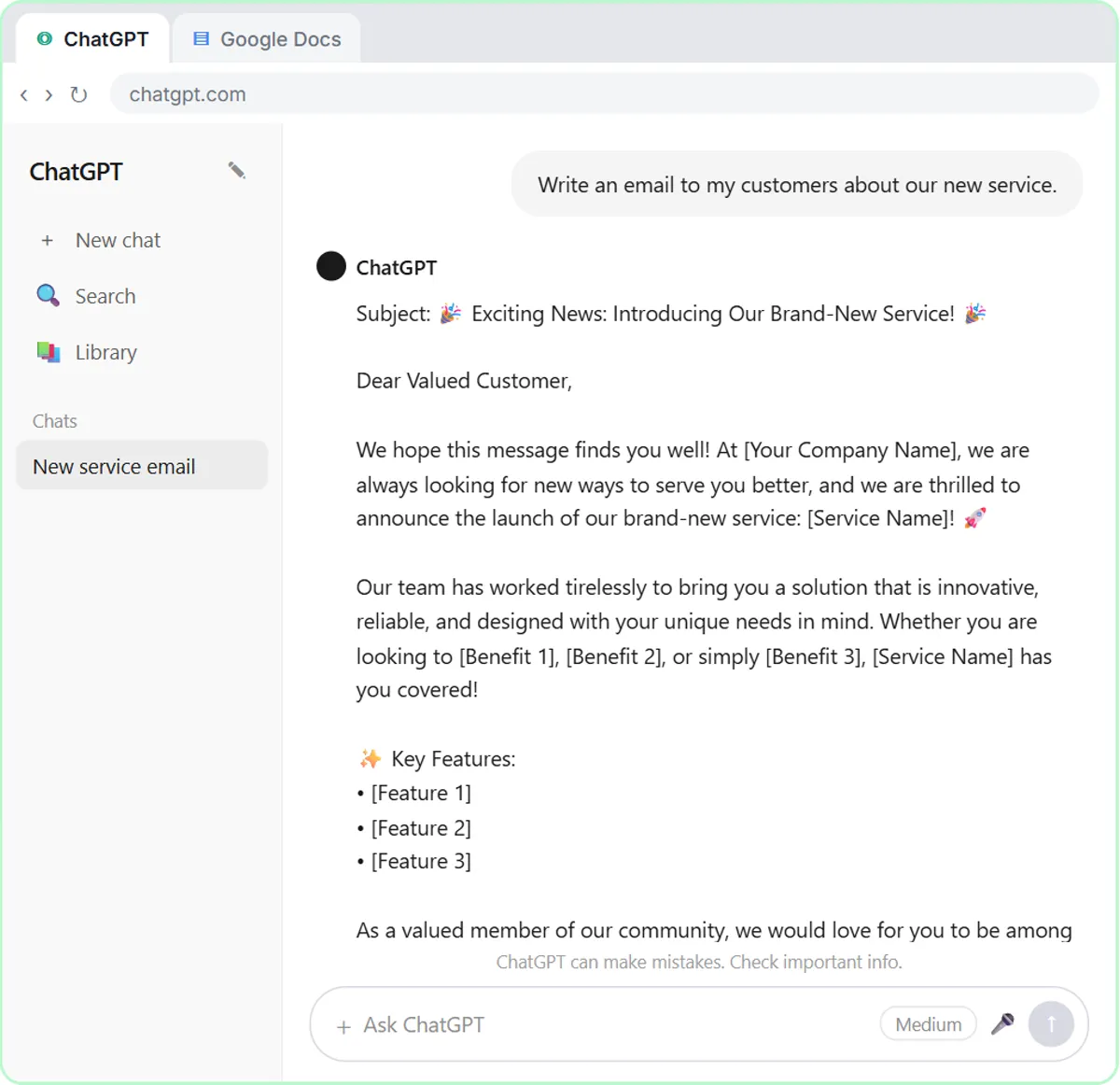
When you click Send, the answer uses the real name, price and dates and ends with one next step. Compared with the vague version earlier in the lesson, every improvement traces back to one of the four parts.
Try this lesson free or read the step-by-step guide.
Common confusions
Do the four parts need labels?
No. You can write them as four plain sentences, as the lesson does, or label them "Role:", "Context:" and so on, which helps when you save the prompt as a template. The model cares about the content, not the headings.
Role vs context
Role is who is speaking and in what voice ("the owner of a family lawn company"). Context is the information the answer depends on (customers, service, price, dates). A role with no context still produces blanks.
Is it the only framework?
No. Other frameworks use different names for similar ideas. What matters is covering the same ground: who, what facts, what job and what shape.
Tips
- Context is the part people skip and the part that fixes placeholders. Put real numbers and dates in it.
- Put rules you would otherwise fix by hand ("no emoji", "under 120 words") in Format.
- The same structure works inside n8n system messages and Custom GPT instructions, not just one-off chats.
Related terms
Where you use it: free lessons
- Prompt Writing 101: Role, Context, Task, Format (ChatGPT, 8 min)
- Summarize a Meeting Transcript with ChatGPT (ChatGPT, 9 min)
- Reply Faster: Turn a Messy Customer Email Thread into a Clear, Friendly Reply (ChatGPT, 9 min)
More free tutorials
Prompt templates that use it
Frequently asked questions
- Does the order of Role, Context, Task and Format matter?
- Not much. That order reads naturally, but the important thing is that all four are present in the same message.
- Can I use this framework for things other than emails?
- Yes. It works for social posts, ads, replies to customers, summaries and agent instructions. Only the details inside each part change.