What is iterative prompting?
Updated · By Robert Breen
Iterative prompting means improving an AI's answer over several rounds: you read what came back, then send a follow-up that asks for a specific change, and repeat until the result is right. The model keeps the earlier conversation in view, so each request builds on the last.
Why it matters for a small business
Almost no first draft is final, from a person or an AI. The skill is in the follow-up. "Make it better" gives the model nothing to aim at and often changes things you liked. A targeted request, like "use this wording for the rental line and keep every other fact the same", fixes the problem without breaking the rest.
Iterating in the same chat is also faster than starting over. The model already has the thread, the facts and the earlier draft, so a one-line follow-up can do what would take a full new prompt.
In a real lesson: Reply Faster to Claim-Status Emails: ChatGPT for Independent Insurance Agencies
In Reply Faster to Claim-Status Emails, Tom at Stonebridge Insurance Agency (a made-up agency) answers Denise, whose car hit a deer and who wants to know when she'll be paid, whether a rental is covered and whether her rate will go up. The first draft sounds great, but the rental and rate lines say more than the agency can promise.
After a check shows six of eight claims supported, the follow-up is precise: Paste fix says to use both suggested wordings, give each of her three questions its own short paragraph so the answers are easy to find, keep it warm, stay under 200 words, keep every other fact exactly the same, and reply with just the email.
The final version answers each question in its own paragraph, says Harbor Mutual (the carrier) decides payment timing and rates, and gives the rental limit from her policy. Notice what the follow-up protects: "keep every other fact exactly the same" stops the revision from quietly changing the deductible or the inspection date.
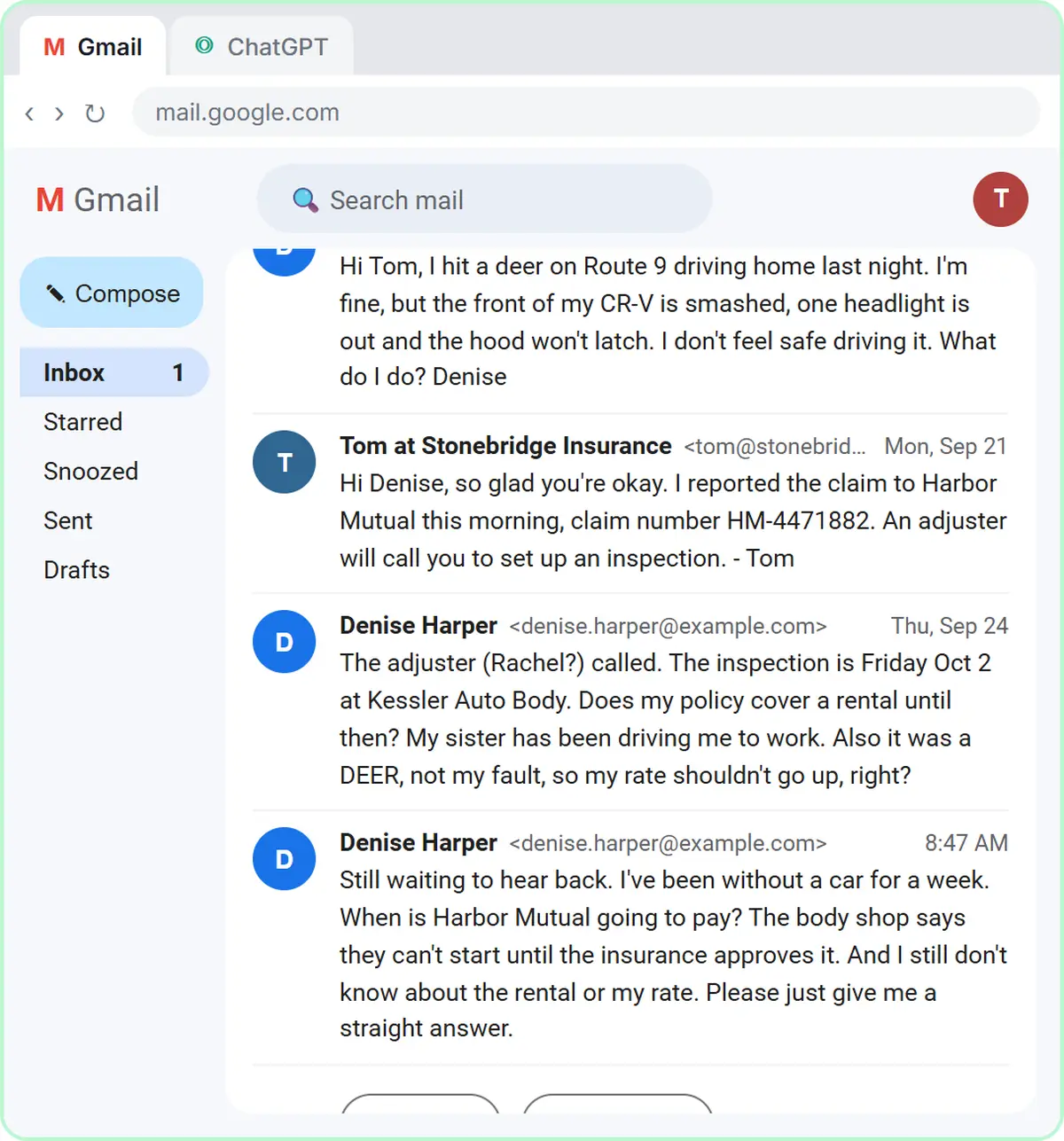
Try this lesson free or read the step-by-step guide.
Common confusions
Iterative prompting vs prompt chaining
Prompt chaining is a planned sequence of steps decided before you start. Iteration is responsive: what you ask next depends on what you just read. Real work often mixes both.
Iterate or start a new chat?
Iterate when the draft is close and the facts are right. Start a new chat with a better prompt when the answer went off in the wrong direction, or when old messages keep pulling it back to a mistake.
Tips
- Name the exact change and what must stay the same in every follow-up.
- Change one or two things per round so you can see what each request did.
- When a fix works, fold it into your original prompt or template for next time.
Related terms
Where you use it: free lessons
- Reply Faster to Claim-Status Emails: ChatGPT for Independent Insurance Agencies (ChatGPT, 10 min)
- Reply Faster: Turn a Messy Customer Email Thread into a Clear, Friendly Reply (ChatGPT, 9 min)
- Summarize a Meeting Transcript with ChatGPT (ChatGPT, 9 min)
Prompt templates that use it
Visual guides
Iterative prompting in a few slides, with the same guide written out as text.
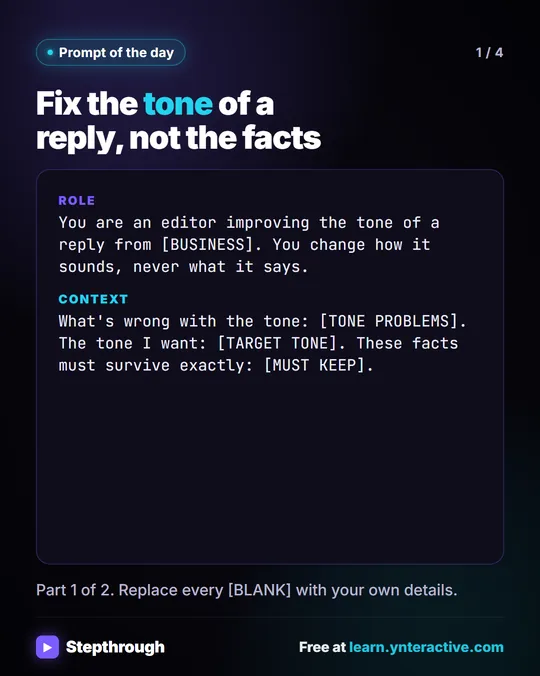 Prompt of the Day: Fix the Tone of a Reply
A visual prompt card: fix a reply that sounds stiff, defensive or long, while every fact, number and "we can't" stays exactly as it was.
Prompt to copy 4 slides
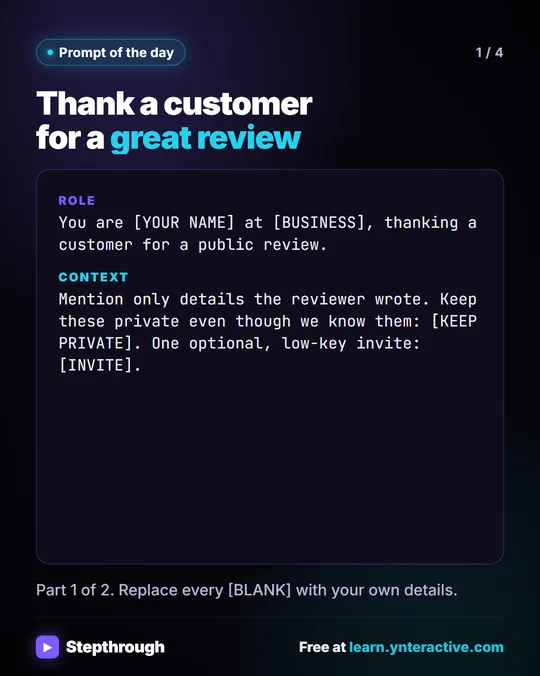 Prompt of the Day: Thank a Customer for a Review
A visual prompt card: three short, specific thank-you replies to a good review, using only what the reviewer wrote and nothing private you know.
Prompt to copy 4 slides
Frequently asked questions
- How many rounds should iterating take?
- Usually one to three. If you are past five rounds, the original prompt is probably missing context; rewrite it and start fresh.
- Does ChatGPT remember earlier drafts in the same chat?
- Yes, within the conversation it can see earlier messages, which is why short follow-ups work. Very long chats can lose track of early details, so restate key facts if needed.