What is grounding in AI?
Updated · By Robert Breen
Grounding means tying an AI model's answer to specific, trusted information, such as facts you provide, a document or search results, so it states what the source supports instead of what merely sounds right. A grounded answer can be checked claim by claim against its source.
Why it matters for a small business
An ungrounded model writes from general patterns. Asked when a client's tax refund will arrive, it may offer a reassuring "by the end of October" because that is what helpful replies tend to say. A grounded model writes from your facts, and if the facts say no one can promise a date, neither does the reply.
For any message a customer or client will rely on, grounding is the difference between a draft you can send after a quick read and a draft you have to rewrite. It also gives you a way to check the work: every claim should point back to a fact. Anything that does not is a red flag.
In a real lesson: Reply Faster to Clients Chasing Their Refund: ChatGPT for Tax and Bookkeeping Firms
In the tax firm reply lesson, Greg Alvarez wants a refund date from Northgate Tax & Bookkeeping, a made-up firm, but two forms are still missing. After pasting his thread, you click Paste facts: eight numbered facts, including what arrived on Sep 13, the 1099-INT and consolidated 1099 still outstanding, the policy of finishing within 5 business days of getting every document, and fact 5, that the firm cannot promise a refund date because the IRS decides.
The instructions add the grounding rule: "Don't invent details or promise anything that isn't in the facts." Even so, the first draft promises a refund by the end of October. Paste check asks for a table of every claim and the fact behind it. Five of seven match; the refund date does not, and neither does a line saying the return will be filed within 5 business days, since filing waits until Greg and Lena e-sign.
Paste fix swaps in wording the facts support. The numbering is what makes grounding checkable: each sentence in the reply can be traced to fact 1 through 8.
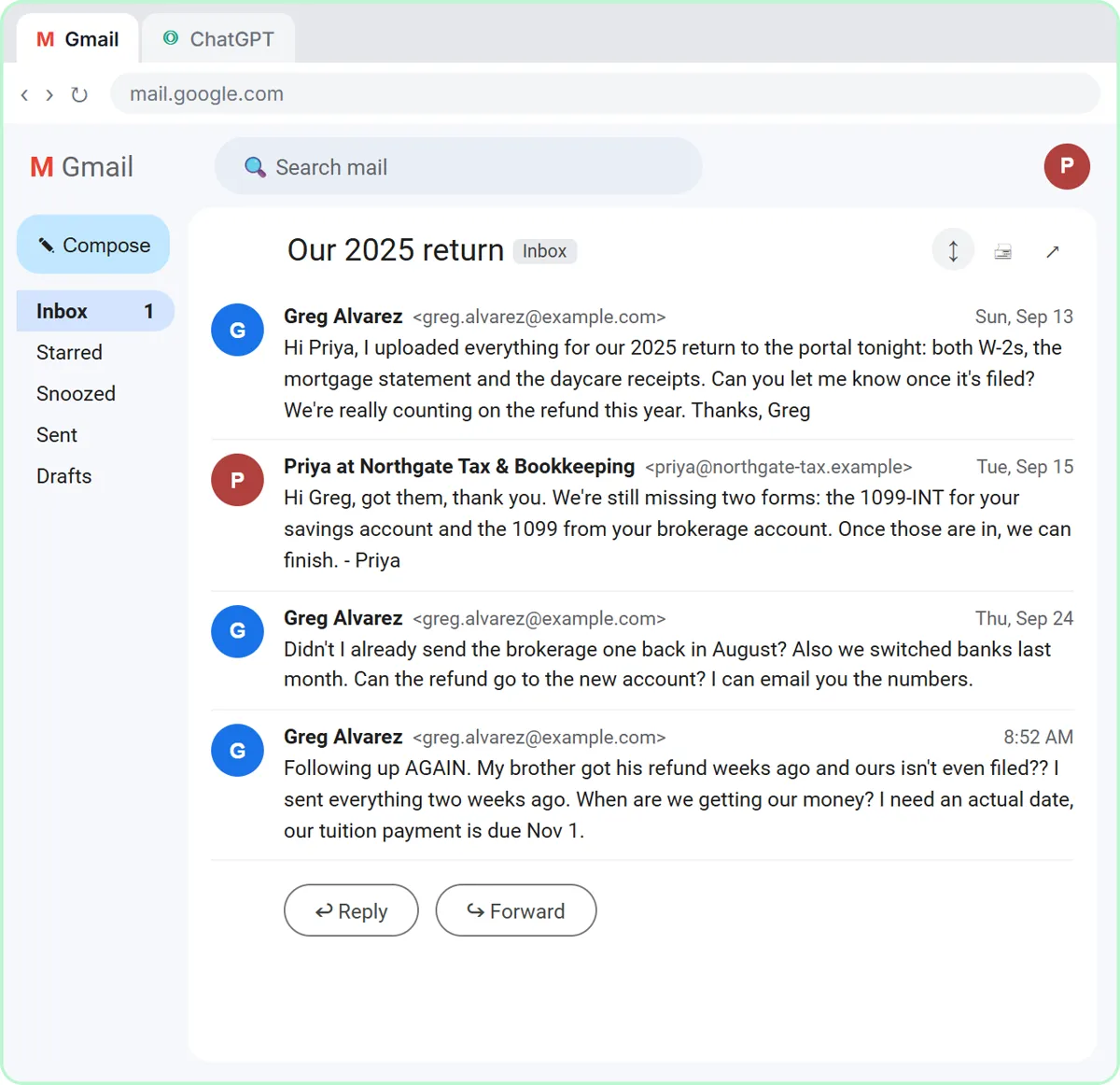
Try this lesson free or read the step-by-step guide.
Common confusions
Grounding vs RAG
Grounding is the goal: answers tied to trusted sources. RAG is one way to get there, by retrieving documents automatically. Pasting a numbered facts list, as in the reply lessons, is grounding done by hand.
Grounded vs guaranteed correct
Grounding narrows what the model draws on, but it can still misstate a fact or stretch one. That is why the lessons add a check step and a final human read.
Tips
- Number your facts so each claim can be traced to one.
- Include the things you cannot promise as facts too, like "We can't promise a refund date."
- Ask for a claim-by-claim check table before you send anything important.
Related terms
Where you use it: free lessons
- Reply Faster to Clients Chasing Their Refund: ChatGPT for Tax and Bookkeeping Firms (ChatGPT, 10 min)
- Reply Faster: Turn a Messy Customer Email Thread into a Clear, Friendly Reply (ChatGPT, 9 min)
- Reply Faster to Claim-Status Emails: ChatGPT for Independent Insurance Agencies (ChatGPT, 10 min)
Prompt templates that use it
Visual guides
Grounding in a few slides, with the same guide written out as text.
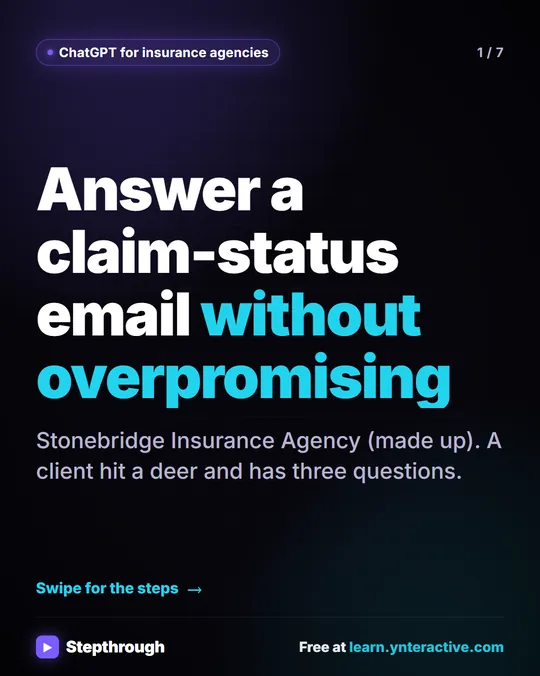 5 Steps to Answer a Claim-Status Email Without Overpromising
A visual guide for insurance agencies: answer a client's claim-status email with ChatGPT, then check every claim against your facts before you send.
Step-by-step guide 7 slides
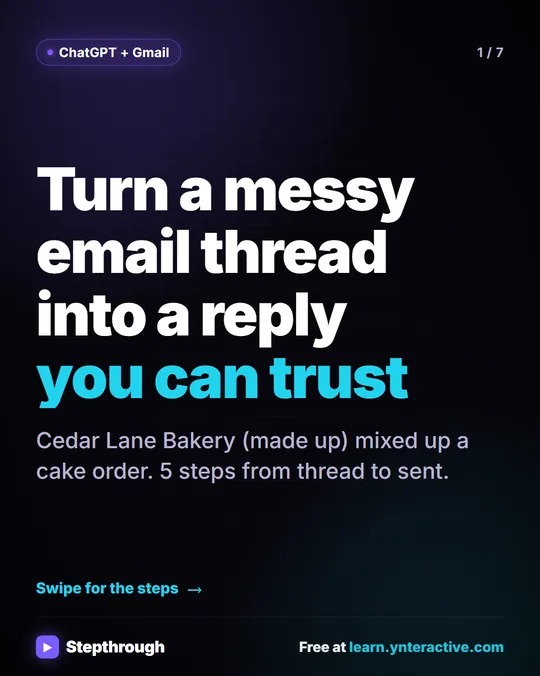 5 Steps to Turn a Messy Email Thread into a Clear Reply
A visual guide: paste a customer thread with numbered facts, check every promise in ChatGPT's draft, fix it and send it from Gmail.
Step-by-step guide 7 slides
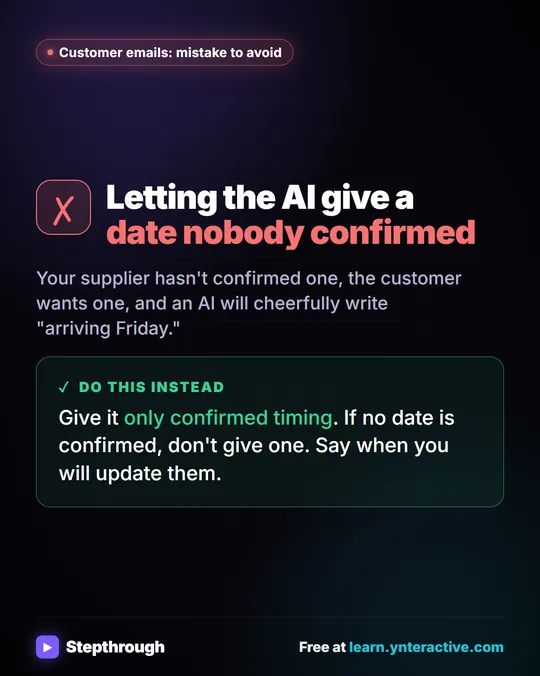 Mistake to Avoid: Promising a Date Nobody Confirmed
A visual tip for late orders: give the AI only timing you have confirmed. If there is no date yet, say when you will update the customer.
Mistake to avoid One graphic
Frequently asked questions
- How do I ground ChatGPT in my own facts?
- Paste a short numbered list of what is true and what you can promise, tell it not to go beyond those facts, and ask it to check its draft against the list.
- Is grounding only for customer emails?
- No. It helps anywhere accuracy matters: summaries that should use only the transcript, estimates that should use only your price list, and agents that should answer only from your documents.