What is a canned response (saved reply)?
Updated · By Robert Breen
A canned response, also called a saved reply or email template, is a pre-written message you reuse for questions that come up again and again, such as opening hours, a return process or a booking link. You insert it, tweak a line or two and send.
Why it matters for a small business
Most support and sales inboxes answer the same ten questions all week. Retyping each answer wastes time and invites small differences, such as one person quoting an old price. A saved reply gives a quick, consistent answer, which is also easier to keep accurate because you fix it in one place.
The danger is sounding like a robot. A reply that ignores what the person actually asked feels worse than a slow one. The best saved replies are short, leave room for a personal first line and are reviewed every few months so they stay correct. For anything unusual, such as a complaint or an exception, write a fresh reply instead of pasting a template.
In a real lesson: Prompt Writing 101: Role, Context, Task, Format
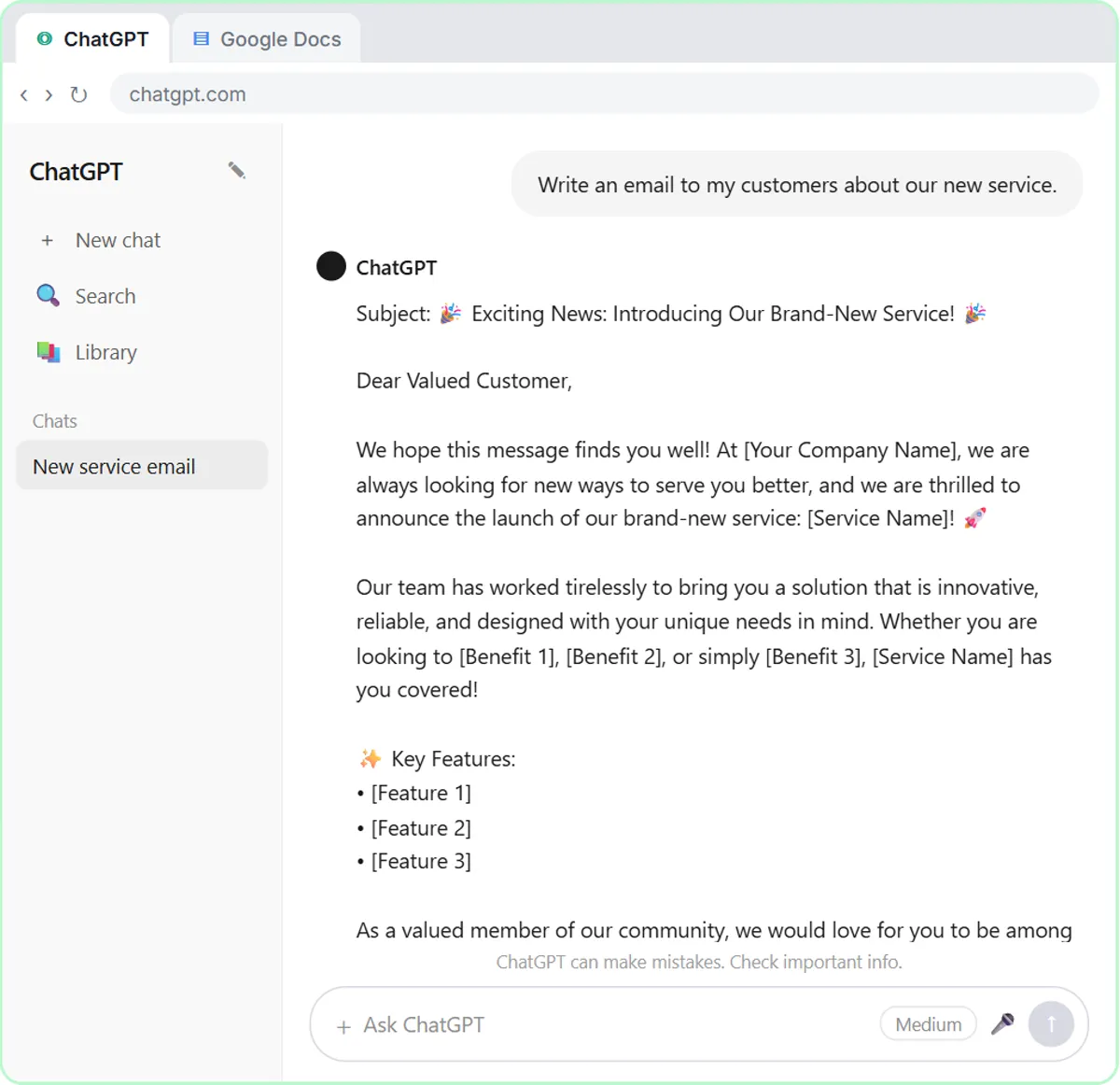
The Prompt Writing 101 lesson shows a modern cousin of the canned response. You ask ChatGPT for a customer email twice. The vague request returns a generic answer full of placeholders. The second request uses four parts, Role, Context, Task and Format, and returns a short, ready-to-send email for Summit Lawn Care, a made-up lawn company.
You then save the structure in a Google Doc called Prompt Templates, with blanks such as [BUSINESS], [SERVICE] and [DETAILS]. The Task line asks for "one clear call to action," and the Format line sets under 120 words, friendly and plain, no emoji. Next time you only fill in the blanks.
A traditional canned response stores the finished message. This approach stores the instructions for writing it, so each reply can be tailored to the situation. It is also less fixed, which means you must read the result every time. The lesson does not turn it into an automatic reply.
Try this lesson free or read the step-by-step guide.
Common confusions
Canned response vs autoresponder
A canned response is something a person chooses and sends. An autoresponder sends automatically when a trigger happens, like a sign-up. Use canned replies where a human should still pick the moment.
Canned response vs prompt template
A canned response is the finished text. A prompt template is a reusable request that makes an AI write the text. Templates adapt better to each situation, but need more checking.
Tips
- Start with your five most common questions and write one short reply for each.
- Leave the first line open for a personal greeting that mentions what the person actually asked.
- Put a review date on every saved reply, so out-of-date prices and policies do not linger.
Related terms
Where you use it: free lessons
- Prompt Writing 101: Role, Context, Task, Format (ChatGPT, 8 min)
- Reply Faster: Turn a Messy Customer Email Thread into a Clear, Friendly Reply (ChatGPT, 9 min)
Frequently asked questions
- Where can I store canned responses?
- Many email tools have a built-in saved reply or template feature. A shared document works too, as long as the whole team knows where to find the current version.
- Should I use AI instead of canned responses?
- Use each where it fits. Saved replies suit identical questions, and AI drafting suits messages that need tailoring. Check every draft, because AI can add claims you did not intend.