What is an AI receptionist?
Updated · By Robert Breen
An AI receptionist is an AI assistant that answers a business's incoming calls or messages the way a front desk would: it greets the customer, collects their details, figures out what they need, answers routine questions and passes urgent or complex requests to a person.
Why it matters for a small business
For a service business, the front desk is where jobs are won or lost. Calls come in while techs are on a job, after hours and on weekends. An AI receptionist can answer every one, capture the name, address and problem, sort it (emergency, repair, quote request) and log it, so nothing sits on a voicemail until Monday.
What it should not do matters just as much. It should not quote prices you didn't give it, promise an arrival time, or give safety advice beyond a script you wrote. The rules you write are the job description, and the first version is never complete: you will keep adding cases as real calls come in.
In a real lesson: Build an AI Service Request Form for Your HVAC Company
Stepthrough's voice lessons aren't live yet, so there is no lesson that answers a phone. The closest practice is the intake and sorting logic an AI receptionist runs, built on a web form in the AI Service Request Form lesson for HVAC. You build a form for Cedar Ridge Heating & Air, a made-up HVAC company, with Name, Email, What do you need? and Phone, and connect it to an n8n AI Agent.
The system message reads like a receptionist's training card: "Sort each request into one job type: Repair, Maintenance, Install, or Emergency. No heat, no cooling in extreme heat, or water leaking from the system counts as Emergency." It also has a safety script: "If they mention a gas smell, tell them to leave the house and call the gas company from outside."
When you submit the test request, a furnace blowing cold air in a cold house, the agent tags it Emergency, saves a row to Google Sheets and emails a confirmation through Gmail. An AI receptionist on the phone would apply the same rules, with speech-to-text in front and a spoken reply at the end.

Try this lesson free or read the step-by-step guide.
Common confusions
AI receptionist vs answering service
A traditional answering service is people taking messages for you. An AI receptionist is software following your written rules. It is always available, but it only knows what you told it, so an unusual call needs a clear path to a person.
AI receptionist vs voice agent
A voice agent is the general technology. An AI receptionist is a voice (or chat) agent given one specific job: front-desk intake and routing for your business.
Tips
- Write your sorting rules as concrete examples ("no heat" counts as Emergency), not adjectives ("urgent issues").
- Decide what happens to an emergency after hours: who gets the text, and what the caller is told.
- Review a week of logged requests and tighten the rules where the AI sorted something wrong.
Related terms
Where you use it: free lessons
- Build an AI Service Request Form for Your HVAC Company (Lovable and n8n, 15 min)
- Build an AI Emergency Request Form for Your Plumbing Company (Lovable and n8n, 15 min)
More free tutorials
Prompt templates that use it
Visual guide
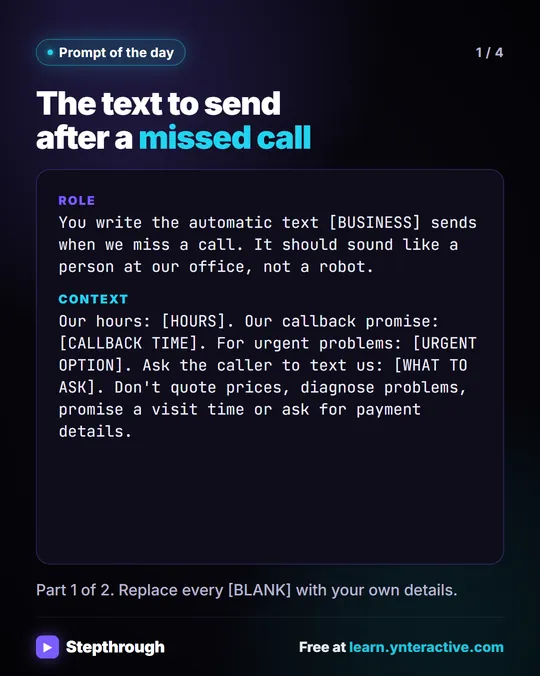
AI receptionist in a few slides, with the same guide written out as text.
Frequently asked questions
- Can an AI receptionist book appointments?
- It can if it is connected to your scheduling tool and allowed to use it. Without that connection it can only collect details and pass them on.
- Should an AI receptionist give safety instructions?
- Only a short script you have written and checked, like the gas smell line in the HVAC lesson. Anything beyond that should go to a person or an emergency service.