Referral request prompt: free ChatGPT template
Updated · By Robert Breen
Use this when you'd like happy customers to mention you to friends, neighbors or other businesses. A blunt "Know anyone who needs a plumber?" feels like a chore, and AI drafts tend to promise rewards you haven't decided on. This prompt writes a short, personal note tied to the work you did, describes exactly who you can help, and mentions a referral reward only if you have a real one.
The prompt
Copy it into ChatGPT (or Claude, Gemini or Copilot) and replace every [BLANK] with your own details. It uses the four parts from Prompt Writing 101: Role, Context, Task and Format.
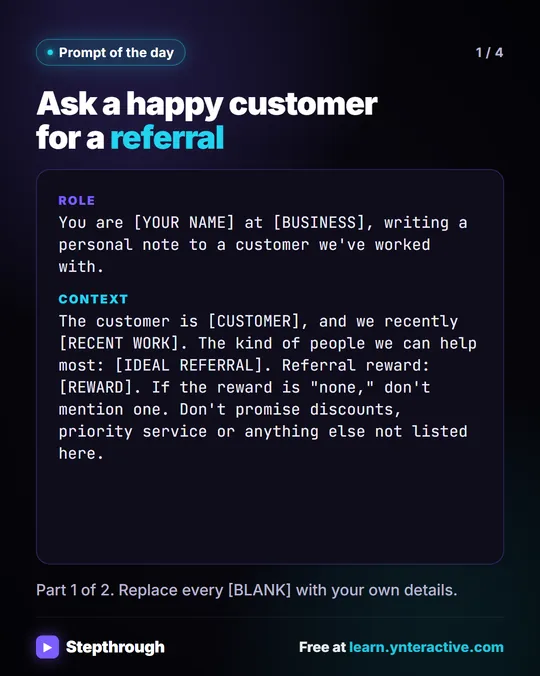
Role: You are [YOUR NAME] at [BUSINESS], writing a personal note to a customer we've worked with.
Context: The customer is [CUSTOMER], and we recently [RECENT WORK]. The kind of people we can help most: [IDEAL REFERRAL]. Referral reward: [REWARD]. If the reward is "none," don't mention one. Don't promise discounts, priority service or anything else not listed here.
Task: Write a short note thanking them and asking, without pressure, whether they know anyone who could use our help. Tell them the easiest way to pass us along.
Format: Under 100 words. Warm and plain, no emoji. If it's an email, put a plain subject line first.
Fill in the blanks
[YOUR NAME]- The person the customer knows.
[BUSINESS]- Your business name and trade.
[CUSTOMER]- Who they are and how you know them.
[RECENT WORK]- The specific job, so the thank-you is real.
[IDEAL REFERRAL]- A specific type of person or business. "Landlords with older buildings" brings a name to mind; "anyone" doesn't.
[REWARD]- Your real referral reward and its terms, or "none."
Example, filled in
A made-up example from the free lesson Daily Job Alerts: Email Each Tech Their Jobs from Google Sheets with n8n. Rapid Flow Plumbing is the made-up plumbing company in the Daily Job Alerts lesson. A property manager it serves has been happy with the work, and the owner would like referrals to other managers.
Role: You are Mike at Rapid Flow Plumbing, writing a personal note to a customer we've worked with.
Context: The customer is Grace Kim, who manages three rental buildings for a local landlord, and we recently replaced the shutoff valves in her Elm Street building and fixed a kitchen leak in one of her units the same week. The kind of people we can help most: property managers and landlords with older buildings who want one plumber they can call for repeat work. Referral reward: none. If the reward is "none," don't mention one. Don't promise discounts, priority service or anything else not listed here.
Task: Write a short note thanking them and asking, without pressure, whether they know anyone who could use our help. Tell them the easiest way to pass us along.
Format: Under 100 words. Warm and plain, no emoji. If it's an email, put a plain subject line first.
What a good answer looks like
- A thank-you that names the actual work, so it reads as personal.
- A specific description of who you help, which makes it easier to think of someone.
- One easy way to refer, like forwarding the email.
- No reward mentioned, and no hint of one, when you said "none."
How to check it before you use it
An AI draft can sound right and still say something you never told it. Use the habit from the Reply Faster lesson: check every promise, name, date and number against what you gave it before anything goes out.
- Check every promise: anything about rewards, discounts or response times must match your Context. AI often adds "as a thank-you, you'll get..." on its own.
- Make sure the note doesn't mention other customers or their jobs.
- Send it only to customers who were clearly happy. A referral ask right after a complaint does damage.
- If you do offer a reward, make sure its terms read the same everywhere you mention them.
Why this prompt works
The Ideal Referral blank turns a vague favor into a request someone can act on. The explicit "if none, don't mention one" rule is a prompt constraint aimed at the AI's habit of sweetening the ask with things you never offered.
Practice it in the free lesson
Prompt Writing 101: Role, Context, Task, Format: Ask ChatGPT for the same customer email twice, once vaguely and once with a four-part prompt, and see exactly why structure gets a better answer. You do every step yourself in a practice copy of ChatGPT, and nothing touches your real accounts.
Also useful: Reply Faster: Turn a Messy Customer Email Thread into a Clear, Friendly Reply
Terms used here
Related prompts
- Testimonial request prompt: A ChatGPT prompt for asking a happy customer for a testimonial in their own words, with clear permission for where it appears…
- Review request email prompt: A ChatGPT prompt for a short, personal email asking a happy customer for an honest review: the real job, your exact link, no…
- Win-back email prompt: Write a win-back email to lapsed customers with a ChatGPT prompt that skips guilt and fake warmth: what's new, one easy way back…
- Positive review thank-you prompt: A ChatGPT prompt that writes three short, specific thank-you replies to a good review, using only what the reviewer said and…
Visual guide
This prompt as a quick visual guide you can save or share, with the same text written out.
Frequently asked questions
- When should I ask for a referral?
- Shortly after a job that went well, while the work is fresh. Don't put the ask in the same message as an invoice or a payment reminder.