Updated . Built against the tool’s current screens and checked step by step. How we check this lesson
An intake call covers a lot in a few minutes: what the prospective client needs, every relative, co-owner and lender who might matter, and what happens next. In this free, interactive lesson you hand the call transcript to ChatGPT with one clear request and get back a short summary, the decisions, an action items table with an owner and a due date, the open questions, every person and business named on the call for your conflict check, and a follow-up email you check before it goes out.
At a glance
| Question | Answer |
|---|---|
| What you build | Turn a new-client intake call into a summary, the engagement next steps with owners and dates, the names for your conflict check, and a follow-up email to the prospective client. |
| Tools | ChatGPT |
| Time | About 9 minutes, 24 steps in 5 parts |
| Level | Beginner, no coding needed |
| Cost | Free |
| Ways to learn it | Practice it step by step |
The 5 parts, in short
- Copy the transcript: Open the Edit menu, Select all, Open the Edit menu again, Copy it.
- Ask for a summary: Switch to ChatGPT, Click the message box, Paste your request, Paste the transcript, and 1 more step.
- Check the details: Check the action items, Click the message box, Fill in the gaps, Send it.
- Write the follow-up: Click the message box, Ask for the follow-up email, Send it, Copy the email.
- Or upload the file: Start a new chat, Open the plus menu, Add photos & files, Pick the transcript, and 3 more steps.
Start here first: Summarize a Meeting Transcript with ChatGPT. This Law Firms version follows the same build with its own example business.
The example: an estate and business-succession intake
You work with the transcript of a video call at Alder & Quinn Law, a made-up small firm that handles estate planning and small-business work. Rachel, the attorney, and Nate, who runs intake, talk with Denise Carter, a prospective client. Her will is from 2011, before she remarried, and she wants to start planning to hand her half of the family flooring company to her son. Her late husband's brother owns the other half, there is a 2014 operating agreement and a bank line of credit, her daughter is executor under the old will, and her son's wife keeps the books.
Like a real intake, the facts come out in no particular order, and nobody says when the engagement letter goes out or when the meeting gets booked. You'll see ChatGPT flag those gaps instead of inventing dates.
Who this lesson is for
This is for attorneys, paralegals, intake coordinators and office managers at small and solo practices where one call brings in a lot of names and next steps. If your calls run on Google Meet, Zoom or Microsoft Teams with transcripts turned on, you already have the raw material. No technical skills or ChatGPT account are needed to practice here.
It is the first module in the AI Automation for Law Firms block.
Why it matters in a law firm
A conflict check is only as good as the names that go into it. The client and the other side are easy; the in-law who keeps the books, the executor in an old will or the bank holding a line of credit are the ones that get missed. Asking ChatGPT for every person and business named, with their role, gives whoever runs the check a complete list to start from.
ChatGPT only organizes that list. It doesn't search your conflicts database, and it doesn't decide whether a conflict exists or whether the firm can take the matter. Those calls stay with the attorney, under your firm's own procedure. The request also says not to draw legal conclusions, so questions like whether the co-owner has to be told stay open items for the attorney.
The "Not stated" rule matters just as much: without it, a model may fill a gap with a plausible date nobody agreed to, and in an email to a prospective client that becomes a promise.
Ways to use it after the lesson
- Intake calls in any practice area: the facts, the next steps, and every name for the conflict check.
- Client meetings on open matters: decisions, who owes which document, what is undecided.
- Internal case meetings: assignments and deadlines, with the gaps flagged.
Confidentiality and AI tools
What a prospective client tells you on an intake call is confidential even if they never hire you (ABA Model Rule 1.18 covers duties to prospective clients). Before you paste a real transcript into any AI tool, check your firm's policy and your state bar's guidance on generative AI; the ABA's Formal Opinion 512 (2024) is a good place to start. Use a business plan such as ChatGPT Business or Enterprise, which OpenAI doesn't use to train its models by default, and take out anything the recap doesn't need. The practice copy in this lesson sends nothing anywhere.
Try it yourself, free
Reading the steps is a start. Doing them is how it sticks. The interactive module walks you through every click in a practice copy of ChatGPT, checks each step, and never touches your real accounts.
Start “Turn a Client Intake Call into Next Steps and a Conflict-Check List (Law Firms)”Step by step: Turn a Client Intake Call into Next Steps and a Conflict-Check List (Law Firms)
All 24 steps of the interactive module, in order. In the module you watch each one, then do it yourself in a practice copy that checks your work.
1. Copy the transcript
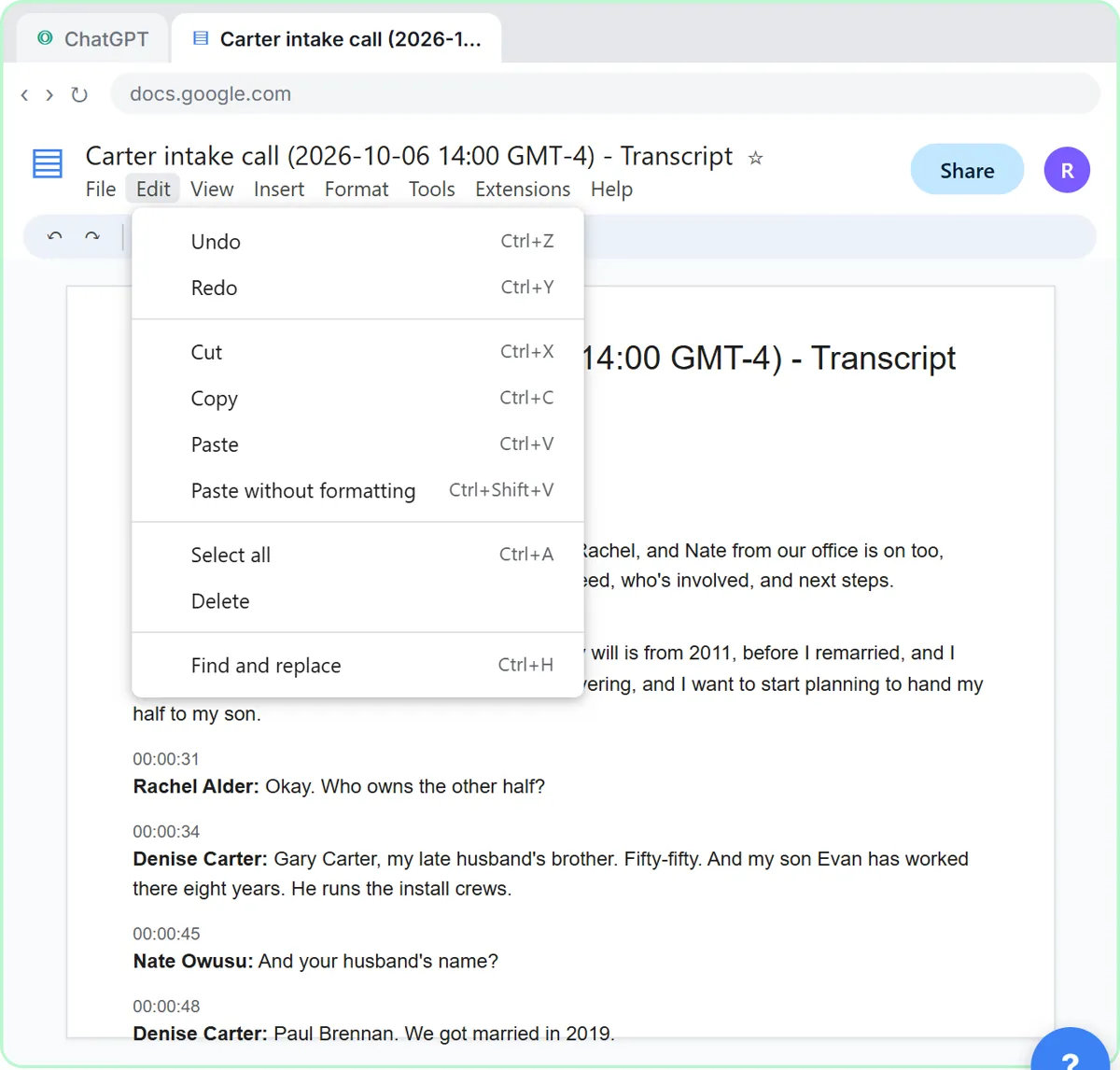
- Open the Edit menu. This is the transcript Google Meet saved after this afternoon's intake call with a prospective client, Denise Carter. Click Edit in the menu bar.
Here's the transcript from this afternoon's intake call at Alder and Quinn Law, a small estate and business law firm. A prospective client, Denise Carter, wants to update her will and plan for her share of the family business. Google Meet saved the call as a Google Doc. Let's copy the whole thing.
- Select all. Click Select all.
On a keyboard, that's Control A.
- Open the Edit menu again. The whole transcript is highlighted. Click Edit again.
The whole transcript is highlighted.
- Copy it. Click Copy.
That's Control C. The transcript is now on your clipboard.
2. Ask for a summary
- Switch to ChatGPT. Click the ChatGPT tab at the top.
Now switch over to ChatGPT.
- Click the message box. Click the message box.
Before you paste the transcript, tell ChatGPT what you want out of it. Otherwise you'll just get a vague recap.
- Paste your request. Paste in the request. It asks for five things: a short summary, the decisions, an action items table with owner and due date, open questions, and a conflict check list of every person and business named.
Here's the request. It asks for five things: a three sentence summary, the decisions, a table of action items with an owner and a due date, any open questions, and a conflict check list of every person and business named on the call. The last line matters most: only use what's in the transcript, and write not stated when something is missing. That stops ChatGPT from guessing.
You're the intake assistant at Alder & Quinn Law. Below is the transcript of today's intake call with a prospective client, Denise Carter. Give me:
1. A three-sentence summary
2. The decisions we made
3. The action items as a table: task, owner, due date
4. Open questions
5. Conflict check: every person and business named on the call, with their role
Don't draw legal conclusions. Just organize what was said.
Only use what's in the transcript. If an owner or date isn't said, write "Not stated".
- Paste the transcript. Now paste the transcript under the request. Paste in the transcript. (In real ChatGPT, press Shift+Enter for a new line first, then Ctrl+V. Plain Enter would send the message.)
In real ChatGPT, press Shift and Enter to start a new line first, because Enter on its own sends the message. Then Control V to paste.
00:00:02
Rachel Alder: Hi Denise, thanks for calling in. I'm Rachel, and Nate from our office is on too, taking notes. This is just the intake call: what you need, who's involved, and next steps.

00:00:14
Denise Carter: Great. So, um, two things really. My will is from 2011, before I remarried, and I want to update it. And I own half of Carter Floor Covering, and I want to start planning to hand my half to my son.

00:00:31
Rachel Alder: Okay. Who owns the other half?

00:00:34
Denise Carter: Gary Carter, my late husband's brother. Fifty-fifty. And my son Evan has worked there eight years. He runs the install crews.

00:00:45
Nate Owusu: And your husband's name?

00:00:48
Denise Carter: Paul Brennan. We got married in 2019.

00:00:53
Rachel Alder: Is there an operating agreement for the company?

00:00:57
Denise Carter: There is, from 2014. Gary's lawyer wrote it, I think.

00:01:02
Rachel Alder: I'll need to read that before we talk about any options for your share. Can you send me a copy, and your current will?

00:01:11
Denise Carter: Yes. I'll scan both this week.

00:01:15
Rachel Alder: One more thing. Gary may be on the other side of some of this, so we'd represent you only, not Gary and not the company. Nate will run everyone's names through our conflict check before we go any further.

00:01:29
Nate Owusu: I'll run it today. Is anyone else involved? A loan on the business, maybe?

00:01:35
Denise Carter: We have a line of credit with Ridgeway Community Bank. Oh, and Evan's wife, Marisol, does the books part-time.

00:01:45
Rachel Alder: Got it. So, if the conflict check clears, Nate sends you our engagement letter. We'd handle the will and the business planning as two separate matters, and the will is a flat fee. Then we meet in person once I've read the agreement.

00:02:02
Denise Carter: That works. Does Gary need to know I'm doing this?

00:02:06
Rachel Alder: Fair question. I'd rather answer it after I've read the agreement.

00:02:11
Denise Carter: Okay. Um, and my daughter Hannah is my executor right now, but she lives in Denver. I'm not sure she should stay executor.

00:02:20
Rachel Alder: Let's put that on the list for the meeting. Nate, can you find a time the week of the nineteenth? Thanks, Denise.
- Send it. Click Send.
Request on top, transcript below.
3. Check the details
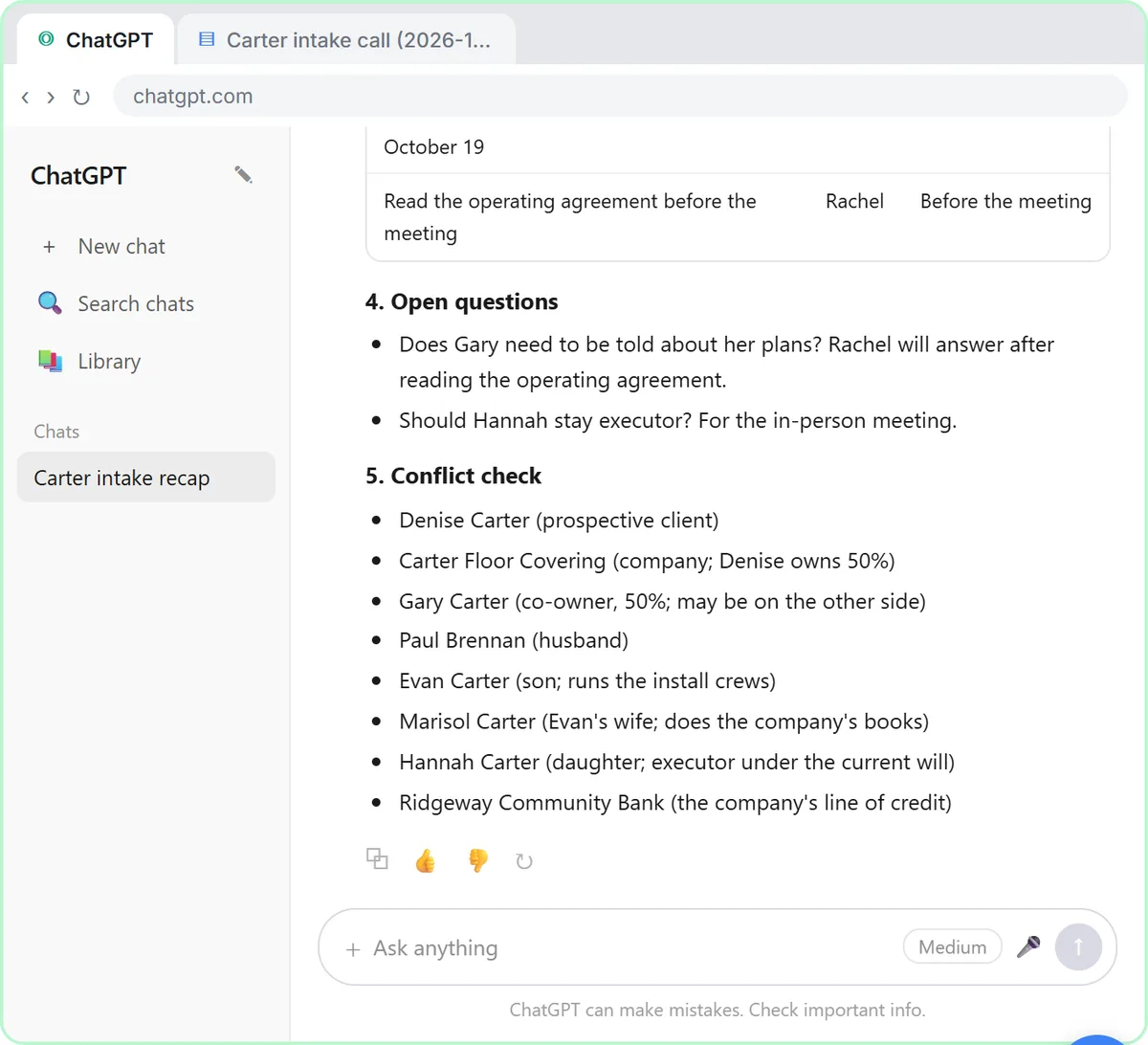
- Check the action items. Read the summary, the decisions and the names for the conflict check. Then click the action items table: two due dates say Not stated. (Real ChatGPT may fill in "week of October 19" for booking the meeting, so yours may show only one. That’s fine: still add both dates.)
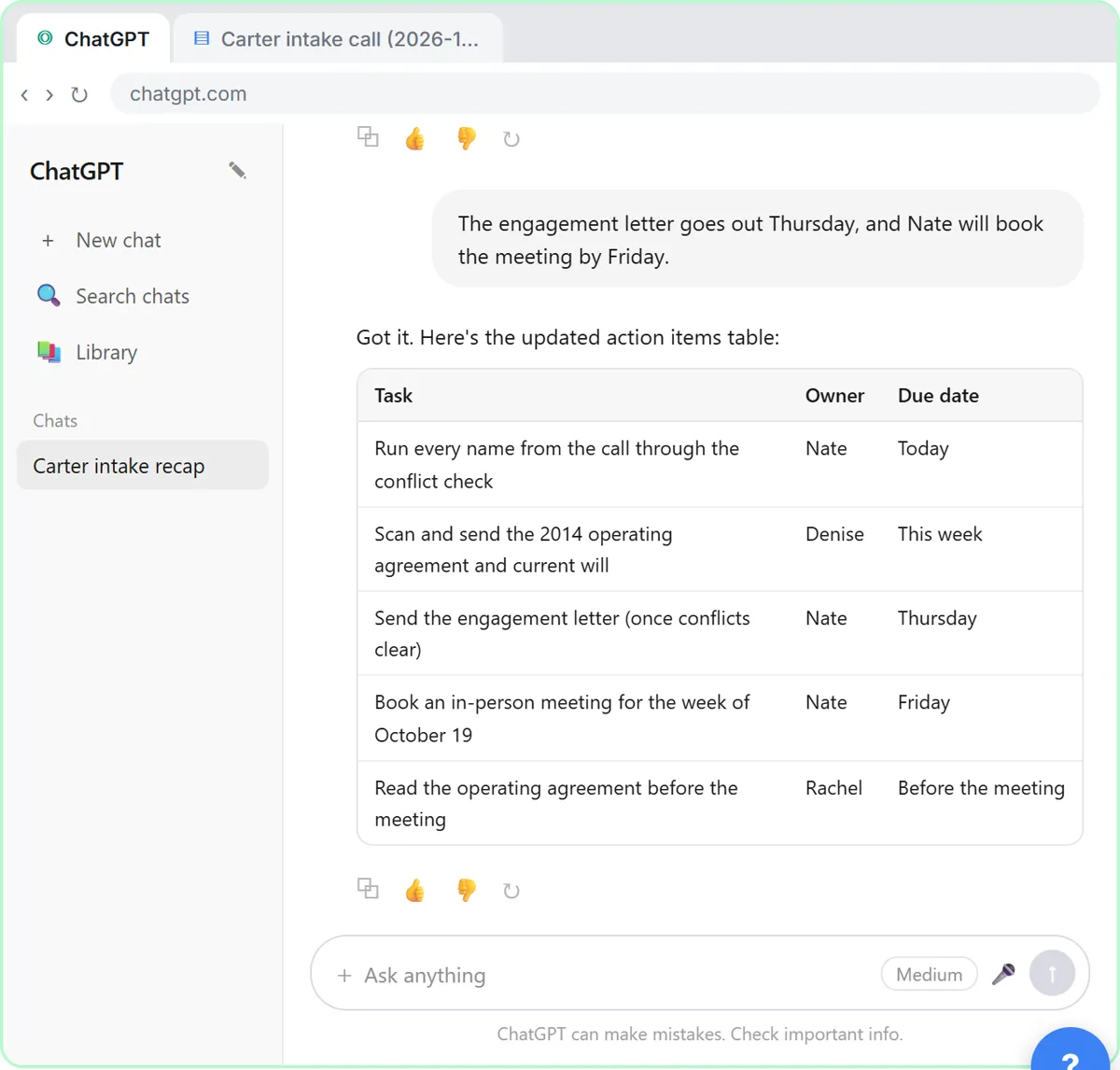
An intake call, boiled down to a summary, three decisions, five action items, two open questions and every name for the conflict check. That list only gathers who was mentioned; running the check is still the firm's job. Now look at the action items table. Two due dates say not stated. That's right: nobody said when the engagement letter goes out or when the meeting gets booked.
- Click the message box. You know the missing dates. Click the message box to tell ChatGPT.
You were in the meeting, so you can fill in the gaps.
- Fill in the gaps. Type the missing dates (or Paste in the dates): The engagement letter goes out Thursday, and Nate will book the meeting by Friday.
Tell it the missing dates: the engagement letter goes out Thursday, and Nate will book the meeting by Friday.
- Send it. Click Send.
4. Write the follow-up
- Click the message box. Every action item has an owner and a date now. Click the message box.
Now every task has an owner and a date. Because ChatGPT still has the whole meeting in this chat, you don't need to paste anything again. Just ask for the next thing.
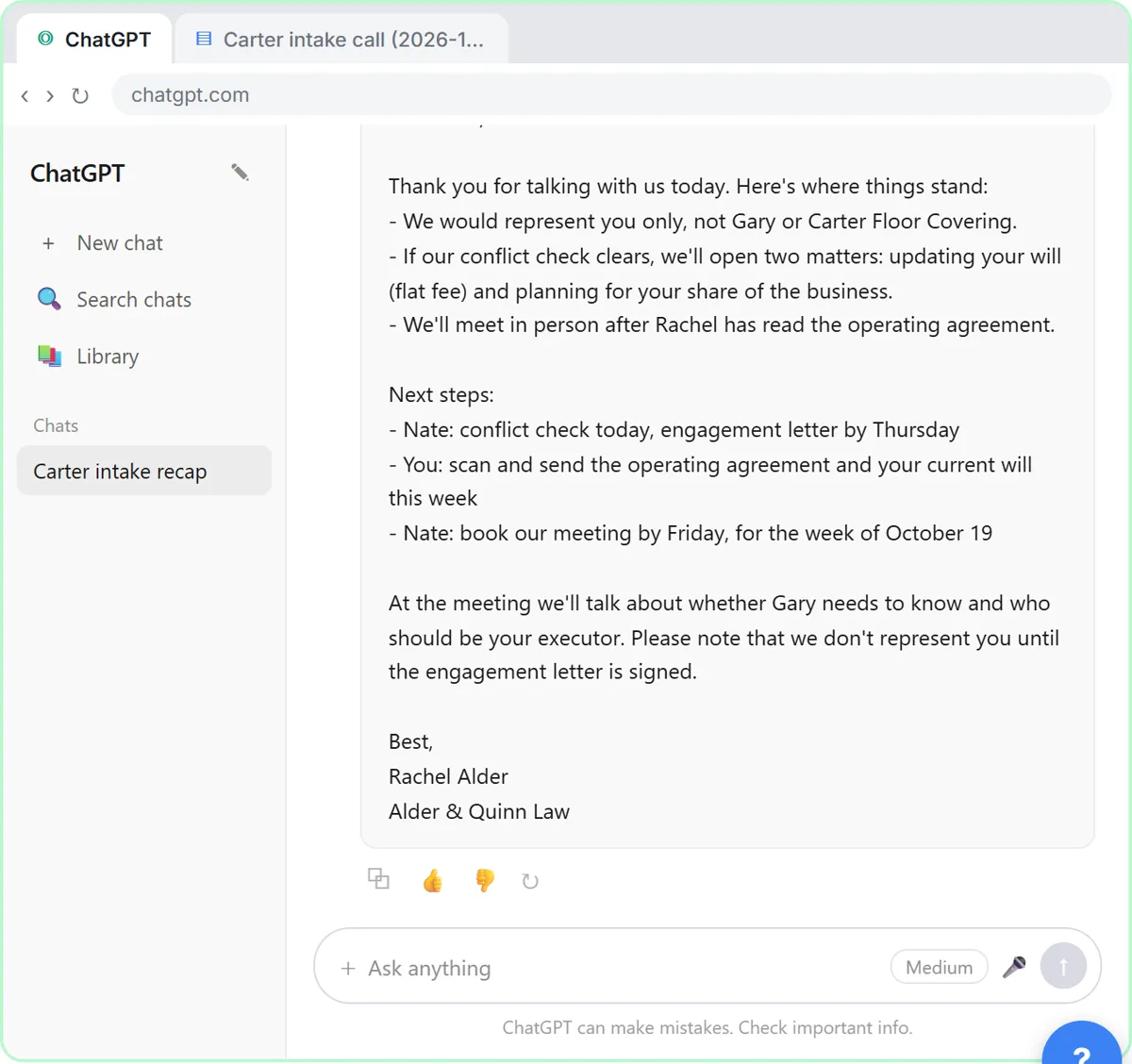
- Ask for the follow-up email. Paste in the request to ask for a short follow-up email to Denise.
Ask for a short, friendly follow-up email to Denise, with what you agreed and the next steps.
- Send it. Click Send.
- Copy the email. Read the email. Then click the Copy button under it.
There's your recap email: the decisions, who's doing what and by when, and what's still open. Read it once, change anything that doesn't sound like you, then click the copy button under it and paste it into your email.
5. Or upload the file
- Start a new chat. Next time the transcript might be a file. Click New chat.
Sometimes the transcript comes as a file instead, like a Word document someone emailed you. You don't have to open it and copy it. Start a new chat.
- Open the plus menu. Click the + button on the left of the message box.
- Add photos & files. Click Add photos & files.
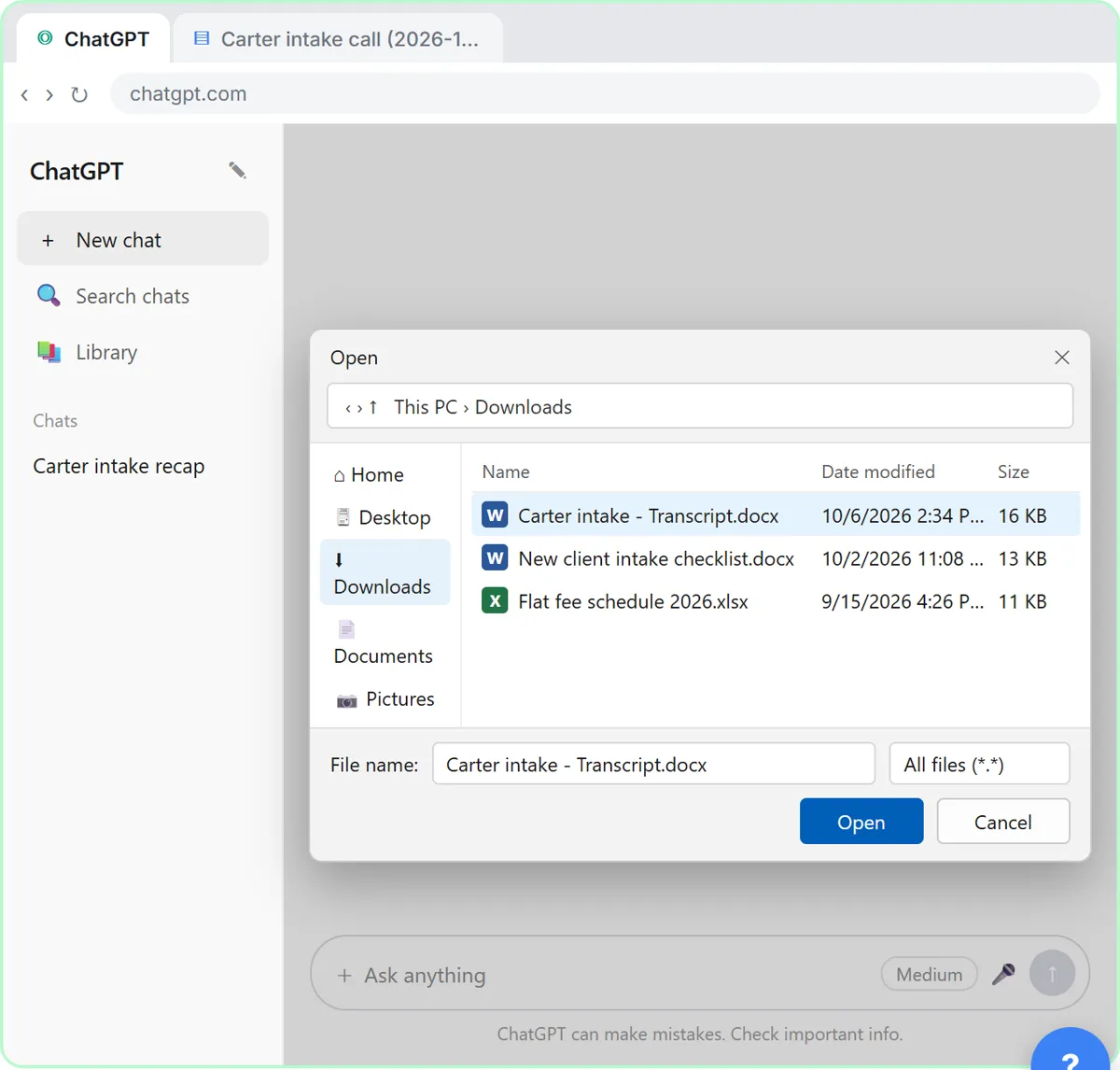
- Pick the transcript. Click Carter intake - Transcript.docx.
Your file browser opens.
- Open it. Click Open.
The file attaches to the message box. You can also just drag a file onto the chat.
- Ask for the summary. Paste in the request: the same four things, in one line.
Now the same request as before, in one line.
Summarize this intake call: decisions, action items with owner and due date, open questions, and every name for our conflict check. If an owner or date isn't said, write "Not stated".
- Send it. Click Send.
Either way, always check the owners and dates before you send the recap.
Screenshots
Frequently asked questions
- Can ChatGPT run a conflict check for my law firm?
- No. It can pull every person and business named in an intake call into a list, with their role, so nobody gets missed. Running those names through your conflicts system and deciding whether there is a conflict is still the firm's job.
- Is it safe to put client intake calls into ChatGPT?
- Follow your firm's policy and your state bar's guidance first. Business and Enterprise plans are not used to train OpenAI's models by default, and on any plan, leave out what the summary doesn't need.
- Will ChatGPT give legal advice from the call?
- It shouldn't, and this lesson tells it not to. The request only asks it to organize what was said. Legal questions from the call stay on the open questions list for the attorney.
- How do I stop ChatGPT from inventing dates in the follow-up email?
- Tell it to use only what is in the transcript and to write "Not stated" when an owner or due date is missing. Then check the action items table and fill in the gaps yourself before the email goes out.
- Is this lesson free?
- Yes. Stepthrough is completely free and the practice copy needs no accounts. To do it for real you need your own ChatGPT account.
More in AI Automation for Law Firms
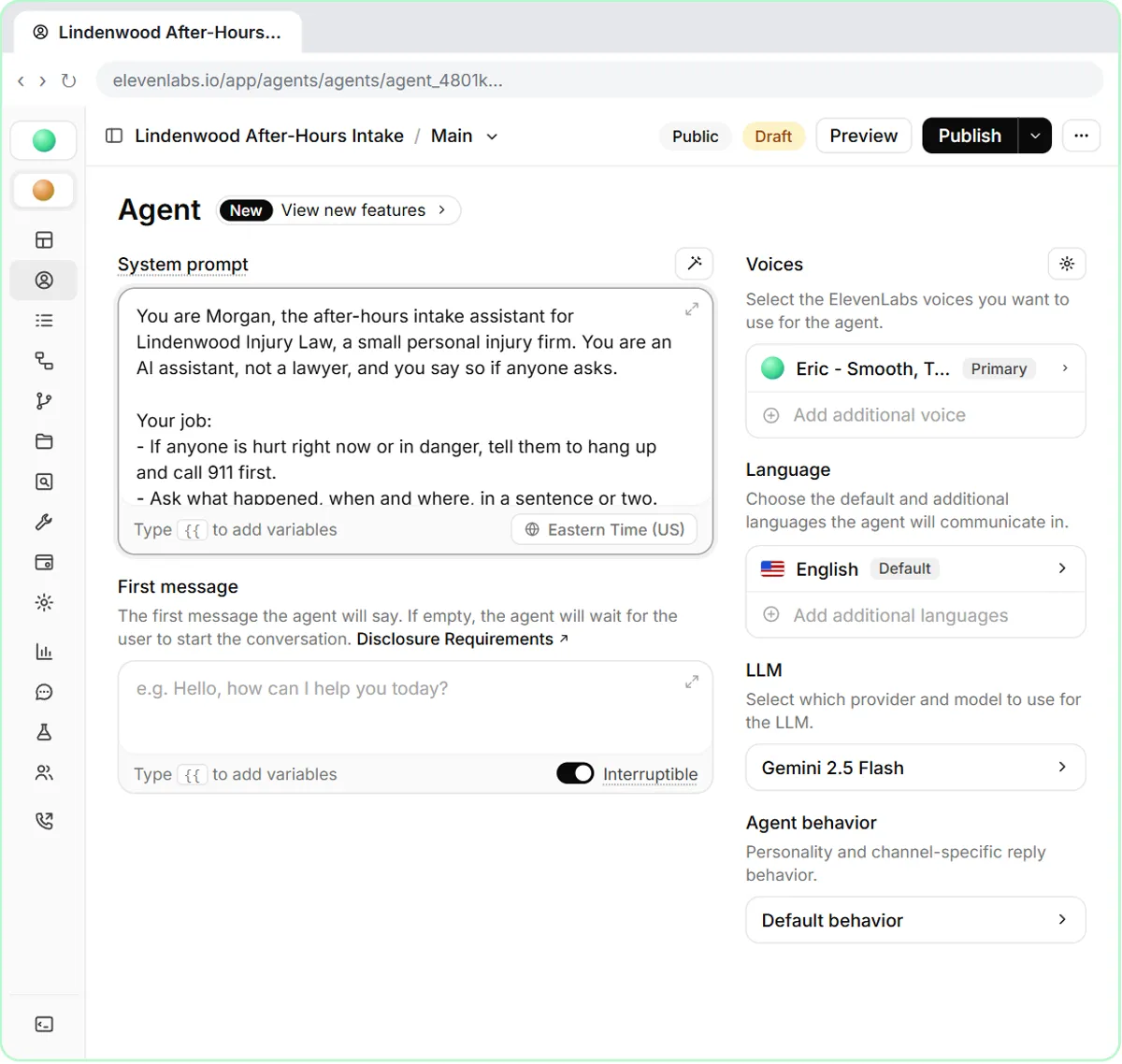 Build an After-Hours Intake Voice Agent for a Law Firm (ElevenLabs)
Build an after-hours intake agent for a small personal injury firm in ElevenLabs: it says it's AI and not a lawyer, takes the details for a callback and the conflict…
Free · Live ~9 min
◷Jotform AI Agents: An Agent That Answers Client QuestionsCreate a Jotform AI Agent for a small law office, teach it an answer, test it in the preview chat and find the code that puts it on your website.
Free · Live ~7 min
All 4 modules in AI Automation for Law Firms
More ChatGPT tutorials
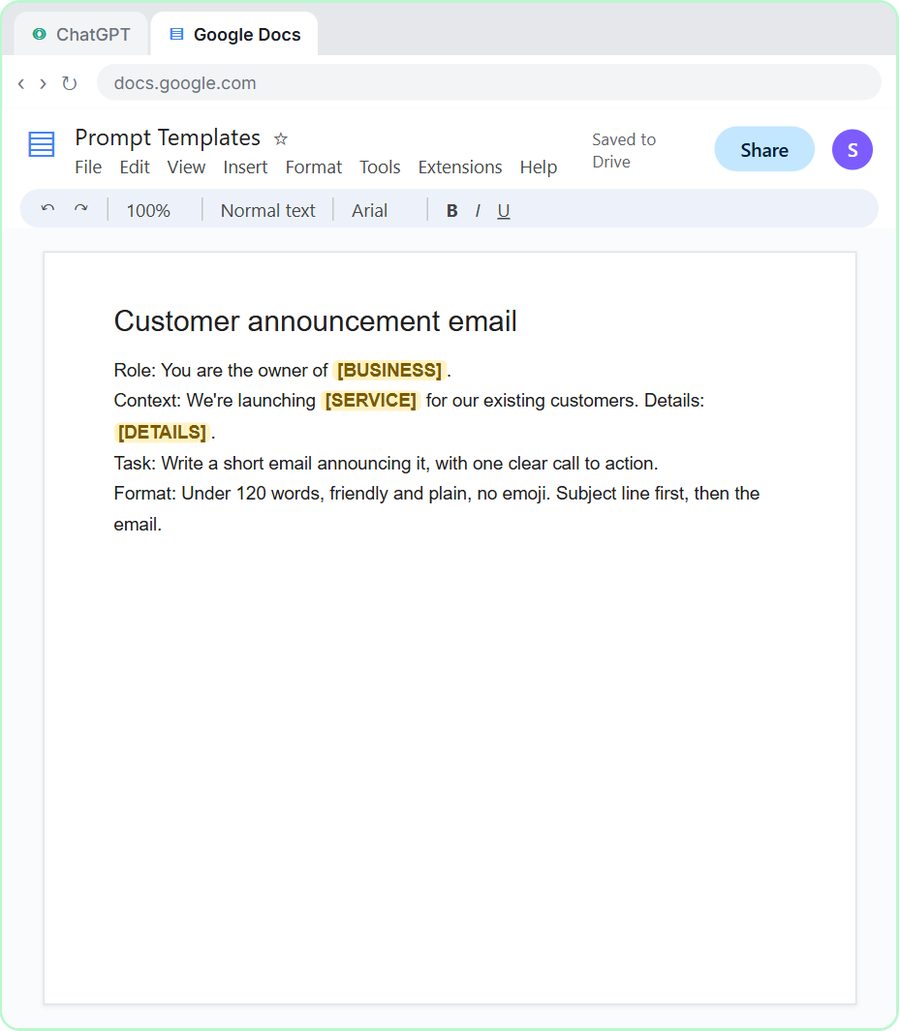 Prompt Writing 101: Role, Context, Task, Format
Ask ChatGPT for the same customer email twice, once vaguely and once with a four-part prompt, and see exactly why structure gets a better answer.
Free · Live ~8 min
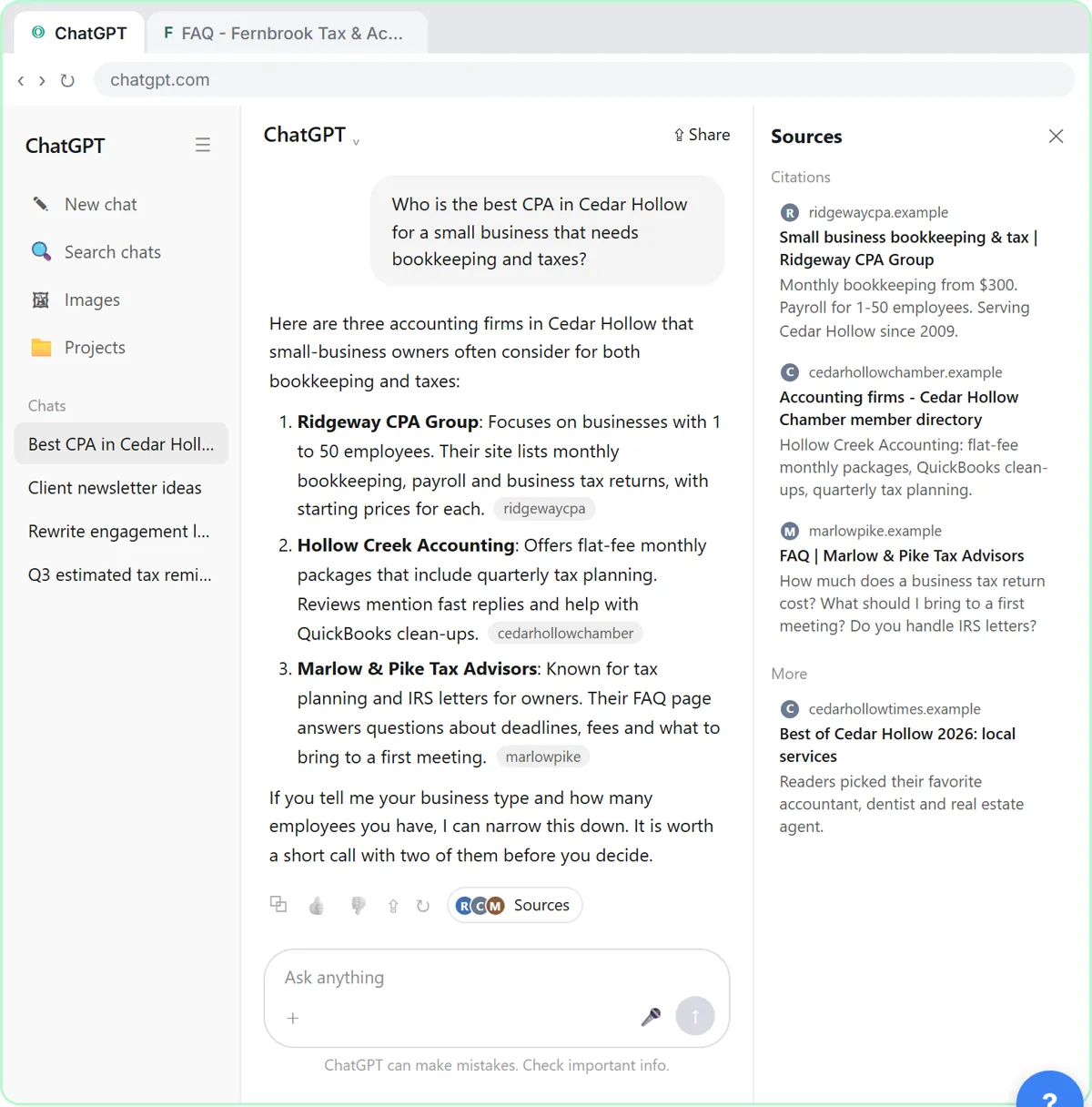 Get Your Business Recommended by ChatGPT
Ask ChatGPT who it recommends in your town, see which pages it trusts, then use it to write an FAQ page and Business Profile copy that answer real customer questions.
Free · Live ~10 min
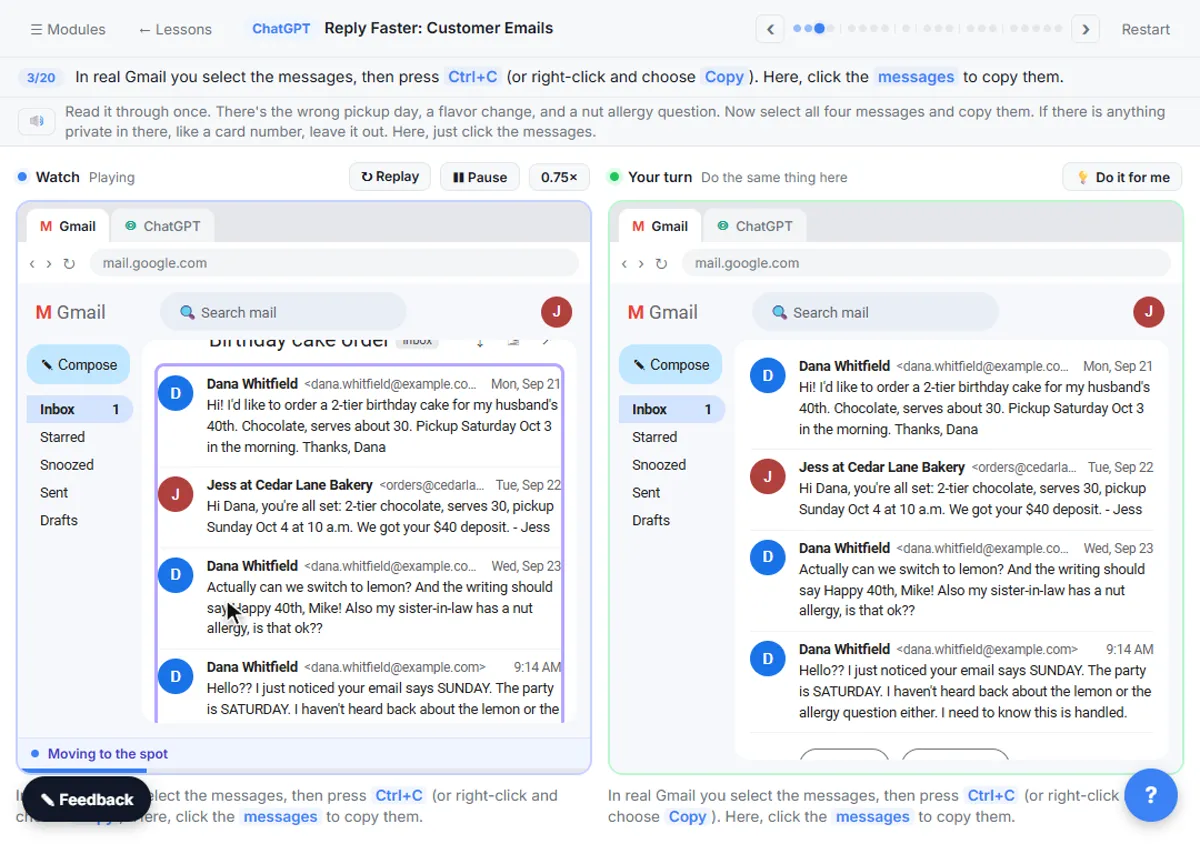 Reply Faster: Turn a Messy Customer Email Thread into a Clear, Friendly Reply
Turn a messy customer email thread into a clear, friendly reply: give ChatGPT the thread and your facts, check every promise, fix the tone, and send it from Gmail.
Free · Live ~9 min
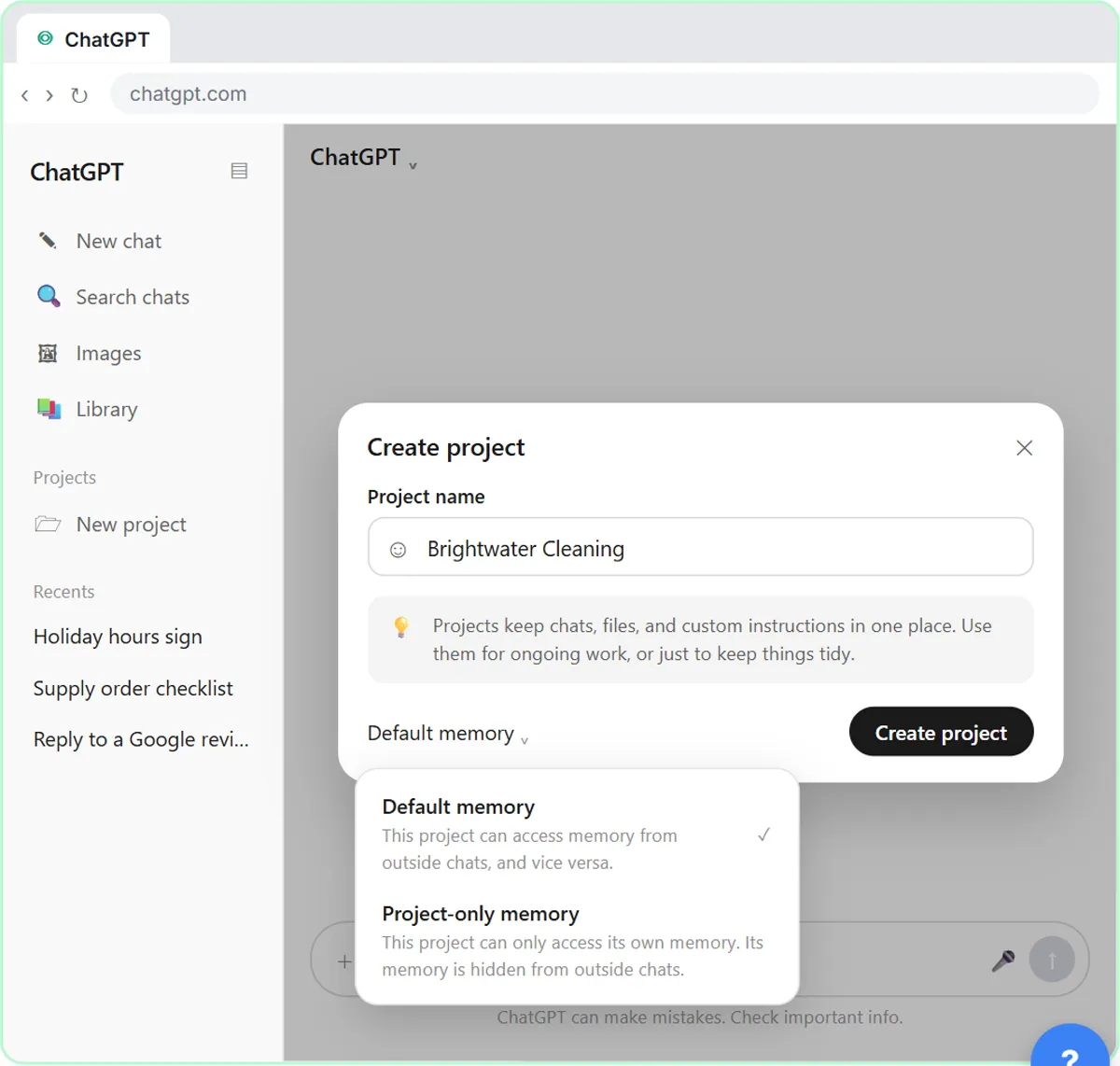 ChatGPT Projects: Keep Your Brand Voice, Files and Instructions in One Place
Set up a ChatGPT Project with your brand voice instructions, your price list and your style guide, so every new chat already knows your business.
Free · Live ~9 min
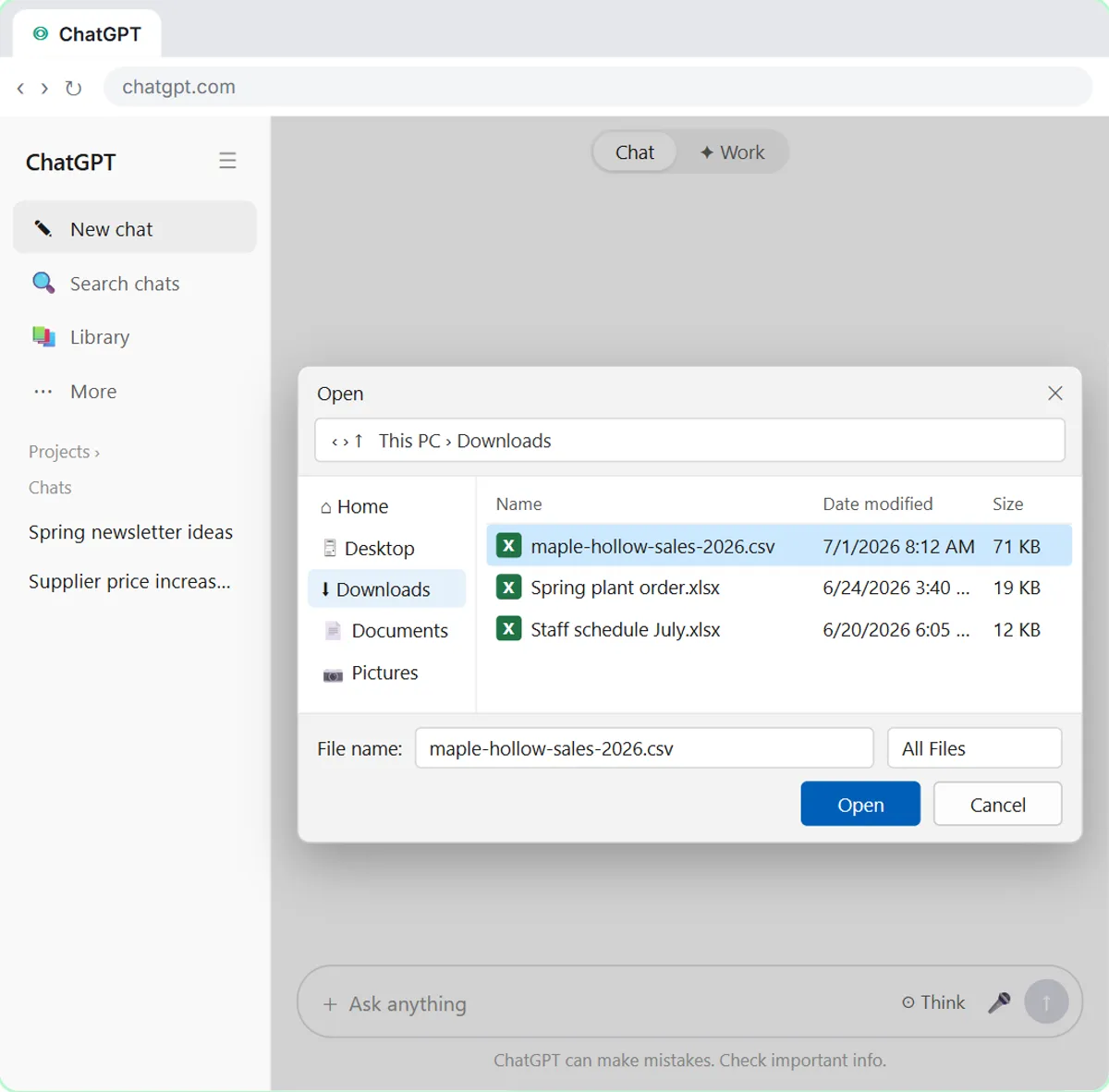 Analyze a Spreadsheet with ChatGPT: Upload a CSV, Get a Chart and Three Takeaways
Upload a CSV of sales to ChatGPT, have it check the data first, ask your questions, get a chart you can download, and finish with the three takeaways that matter.
Free · Live ~10 min
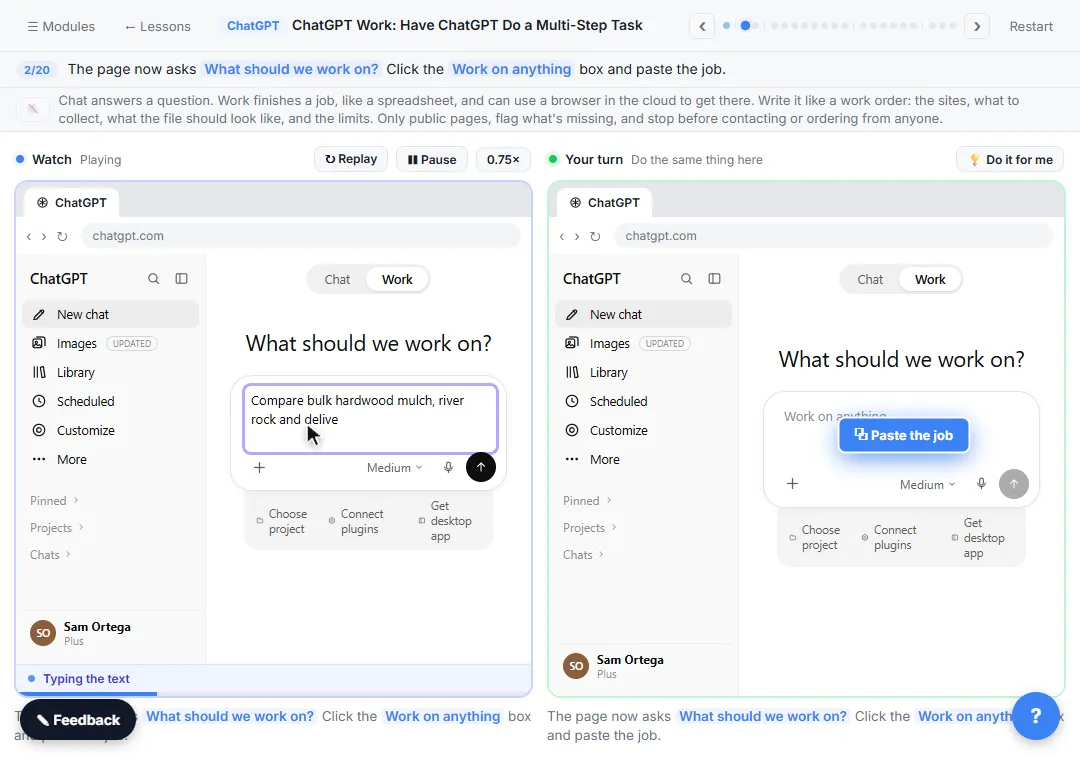 ChatGPT Work: Have ChatGPT Do a Multi-Step Task
Switch ChatGPT to Work, hand it a real job (compare three suppliers into a spreadsheet), approve the sites it opens, skip a login, answer its question, check the file…
Free · Live ~8 min
Visual guides
This lesson’s key ideas as quick visual guides: swipe through the slides, or read the same guide as text.
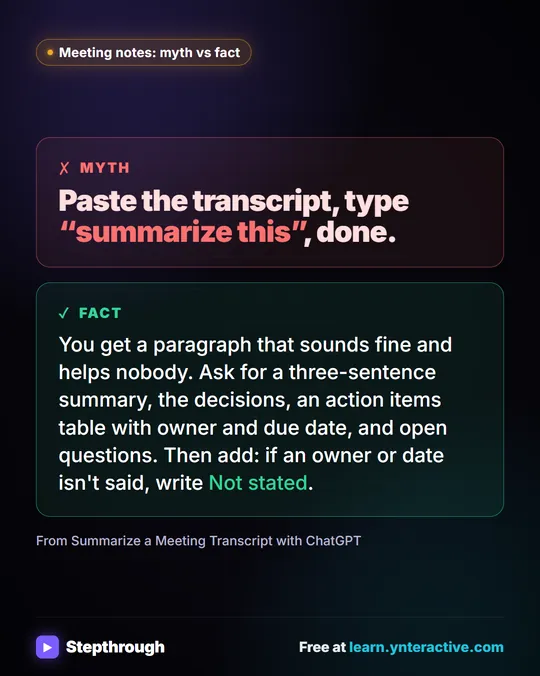 Meeting notes myth: “summarize this” is all ChatGPT needs
Myth: paste a transcript, type “summarize this”, done. Fact: ask for the decisions, an action items table with owners and dates, and open questions.
Myth vs fact One graphic
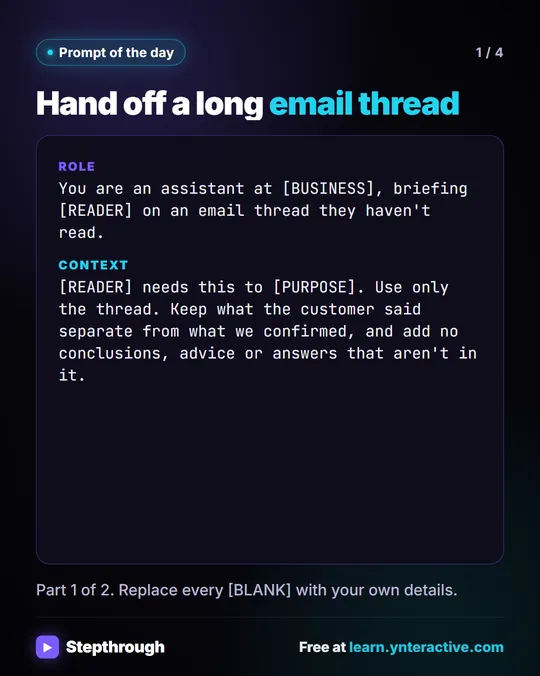 Prompt of the Day: Summarize an Email Thread for a Handoff
A visual prompt card: turn a long email thread into a short handoff with the situation, what was promised and each question marked Answered or Open.
Prompt to copy 4 slides
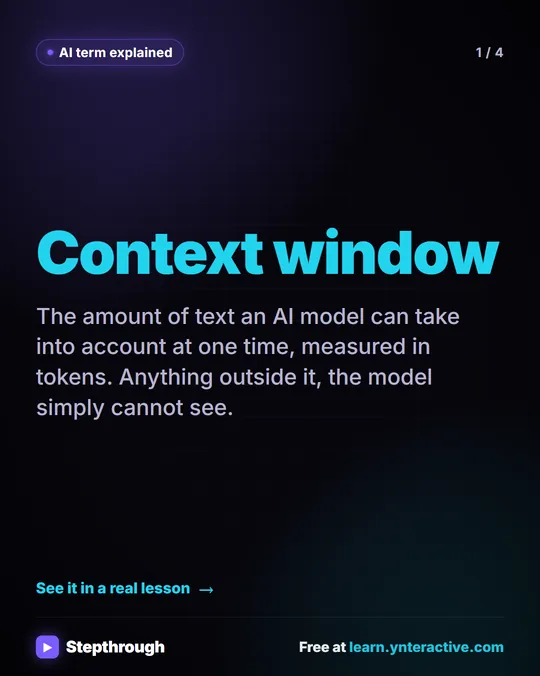 What Is a Context Window? A Visual Guide
A visual guide to the context window: how much text an AI model can see at once, shown with a real ChatGPT meeting summary lesson.
AI term explained 4 slides
Free cheat sheets
Print it or save the PDF: the key steps and checks from this lesson on one page, free.
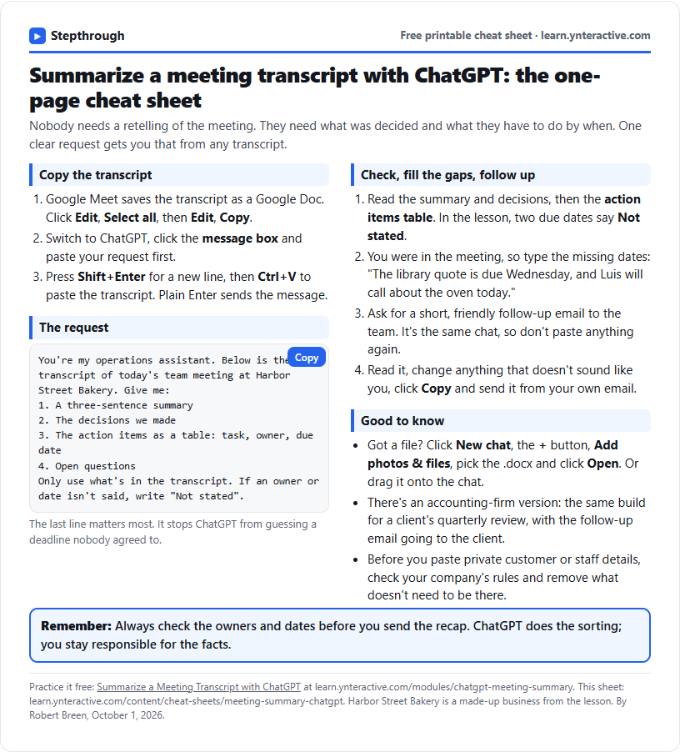 Summarize a Meeting with ChatGPT Cheat Sheet
A free one-page cheat sheet: turn a meeting transcript into decisions, an action items table with owners and dates, and a follow-up email.
Lesson cheat sheet Free PDF
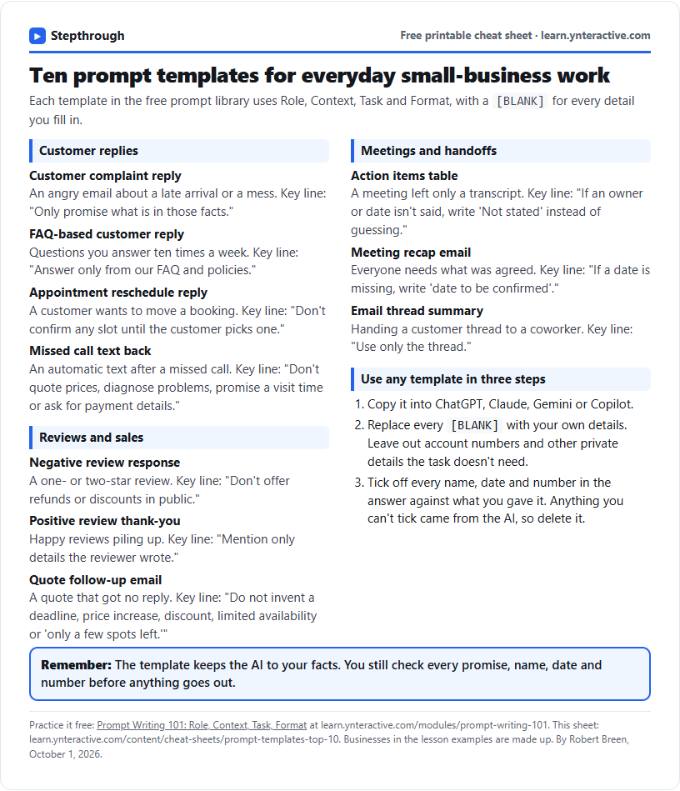 Top 10 Prompt Templates for Small Business: Cheat Sheet
A free one-page cheat sheet of ten copy-ready AI prompt templates: customer replies, reviews, quote follow-ups, meeting recaps and handoffs.
Topic cheat sheet Free PDF
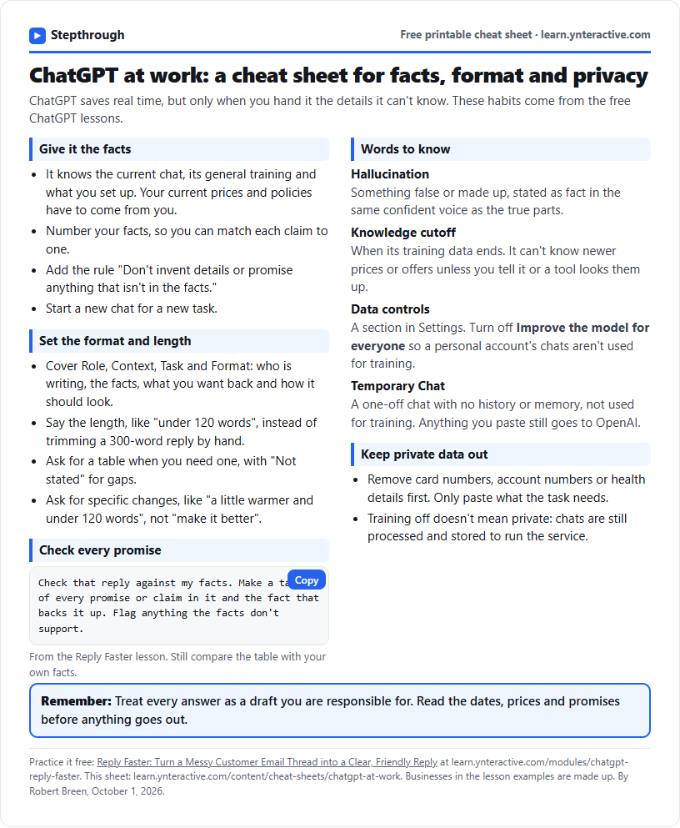 ChatGPT at Work Cheat Sheet: Facts, Format, Privacy
A free one-page cheat sheet for ChatGPT at work: give it facts, set the format and length, check every promise and keep private data out.
Tool cheat sheet Free PDF
All free printable cheat sheets
Terms in this lesson
Plain-English definitions, each with an example from a free lesson.
Related prompts
- Action items table prompt: Paste a meeting transcript or rough notes and get a table of every task, owner and due date, with "Not stated" wherever nobody…
- Feedback conversation script prompt: Plan a short, direct feedback talk with a teammate: the specific moment, why it mattered, a question to hear their side and one…
- Meeting agenda prompt: Turn a list of topics into a timed meeting agenda where every item has an owner, a question to settle and minutes that add up to…
- Project risk register prompt: List what could go wrong with a project from your notes: each risk with likelihood, impact, an early warning sign, a response…