AI Prompts for Project Managers: 11 Copy-Ready Templates
Updated · By Robert Breen
Project managers spend a large part of every week turning conversations into documents: the status report, the action list after a meeting, the risk log, the change request. The thinking is yours, but the formatting and first drafts are repetitive, and that is where an AI assistant gives back hours.
The prompts below work from what you paste in (notes, transcripts, plans) and ask for owners and dates only when they were actually stated. That one rule matters: a status report that invents an owner is worse than one that shows a gap. You review, fill the gaps and send.
For hands-on practice, run a weekly ops review where every task has an owner, then turn meeting notes into tasks automatically with n8n.
How do you use these prompts?
Copy a prompt into ChatGPT, Claude, Gemini or Copilot and replace every [BLANK] with your own details. Where a prompt says PASTE, paste your notes, email or document there. Each prompt follows the four parts from Prompt Writing 101: a Role, the Context, the Task and the Format you want back. Then check every name, date, number and promise in the answer before you use it.
Planning
1. Turn a project brief into a work breakdown
You are a project manager at [COMPANY]. Here is the brief for [PROJECT NAME]:

[PASTE BRIEF]

Break the work into phases and tasks, note dependencies between tasks, and list the assumptions you made so I can check them. Do not estimate durations unless I give you a basis: [ESTIMATING BASIS OR "NONE"].

Format: a table with Phase, Task, Depends on, Notes, then an Assumptions list.
2. Draft a RACI chart
Act as a project manager. Project: [PROJECT NAME]. People and roles: [NAMES AND ROLES]. Main deliverables: [DELIVERABLES].

Suggest a RACI chart (Responsible, Accountable, Consulted, Informed) for each deliverable, with exactly one Accountable person per row. Flag any row where the notes do not make the owner clear, instead of picking one at random.

Format: a table with deliverables as rows and people as columns, then the flagged rows.
3. Build a risk register
You are a project manager running [PROJECT NAME], due [DEADLINE], with [TEAM AND BUDGET CONSTRAINTS]. Here are the concerns raised so far:

[PASTE CONCERNS]

Turn them into a risk register: risk, cause, impact, likelihood and impact (High, Medium, Low), a mitigation and an owner if one was named. Add up to three risks that commonly affect projects like this, clearly marked "Suggested".

Format: a table, sorted with the highest combined rating first.
Meetings and updates
4. Pull action items out of a meeting
You are the project manager for [PROJECT NAME]. Here is the transcript or notes from [MEETING] on [DATE]:

[PASTE TRANSCRIPT]

List every decision and every action item. For each action, give the owner and due date only if they were said in the meeting; otherwise write "Not stated". Then list open questions.

Format: Decisions (bullets), an Actions table (Action, Owner, Due), Open questions (bullets).
5. Write a weekly status update
Act as a project manager writing the weekly update for [PROJECT NAME] to [AUDIENCE]. This week's facts:

Done: [COMPLETED]
In progress: [IN PROGRESS]
Blocked: [BLOCKERS]
Next week: [NEXT]
Overall status: [GREEN, AMBER OR RED] because [REASON]

Write a short update that leads with the status and the one thing leadership needs to know. Do not soften a blocker.

Format: a one-line headline, then the four sections as bullets, under 200 words.
6. Write a meeting agenda with outcomes
You are a project manager planning a [LENGTH]-minute meeting on [TOPIC] with [ATTENDEES]. We need to leave with: [DECISIONS NEEDED].

Draft an agenda where each item has a time, an owner and the outcome it should produce (decision, input or update). Put the decisions first while people are fresh, and add a pre-read list.

Format: a numbered agenda, then Pre-read.
Scope and stakeholders
7. Reply to a scope change request
You are the project manager for [PROJECT NAME] for [CLIENT OR STAKEHOLDER]. They asked for: [REQUEST]. It is outside the agreed scope because [REASON]. Options I can offer: [OPTIONS WITH COST OR TIME IMPACT].

Write a friendly reply that acknowledges the request, explains plainly that it is a change, lays out the options and asks them to choose. Do not agree to anything not in my options.

Format: under 180 words with the options as a short list.
8. Explain a delay to stakeholders
Act as a project manager. [MILESTONE] will slip from [OLD DATE] to [NEW DATE] because [CAUSE]. What we are doing about it: [ACTIONS]. Impact on other milestones: [IMPACT].

Write a short message that states the new date in the first sentence, explains the cause without blame, and says what we need from stakeholders, if anything: [ASK].

Format: under 150 words.
9. Write a handoff document
You are handing [PROJECT OR WORKSTREAM] to [NEW OWNER] on [DATE]. Here are my notes:

[PASTE NOTES, LINKS, CONTACTS, OPEN ITEMS]

Write a handoff document: current status, key contacts and what each one cares about, open items with deadlines, known risks, where files live and the first three things the new owner should do. Mark anything my notes do not cover as "To confirm".

Format: headed sections, under 450 words.
Closing
10. Run a blameless retrospective
You are facilitating a retrospective for [PROJECT NAME]. Here are the team's comments:

[PASTE COMMENTS]

Group them into What went well, What did not go well and What to try next time. Phrase everything about the process, not individuals, and remove names. Then suggest three specific changes for the next project, each with how we would know it worked.

Format: three headed lists, then the three changes.
11. Write a project closeout summary
Act as a project manager closing [PROJECT NAME]. Facts: original goal [GOAL], delivered [WHAT WAS DELIVERED], dates [PLANNED VS ACTUAL], budget [PLANNED VS ACTUAL], open items handed to [OWNER].

Write a closeout summary for [AUDIENCE] covering outcome, variance from plan with the reasons I give, lessons learned and who owns what is left. Use only these facts.

Format: headed sections, under 300 words.
How do you adapt these prompts to your own work?
- Paste the transcript, not your memory of the meeting. Owners and dates are only reliable when they come from what was actually said.
- Keep one project's context in one place. A ChatGPT or Claude project with the brief, the plan and the RACI saves you pasting it every week. See Claude Projects.
- If your updates go to people outside the team, ask for a second version "for executives, under 80 words".
Where can you practice these skills for free?
These free Stepthrough lessons practice the same jobs step by step, with a made-up business and practice copies of the real tools, so nothing touches your real accounts.
Turn a weekly operations and vendor review into the decisions, the next steps with owners and dates, the risks to watch and a team recap, without turning a vendor's…
Free · Live ~7 min Beginner
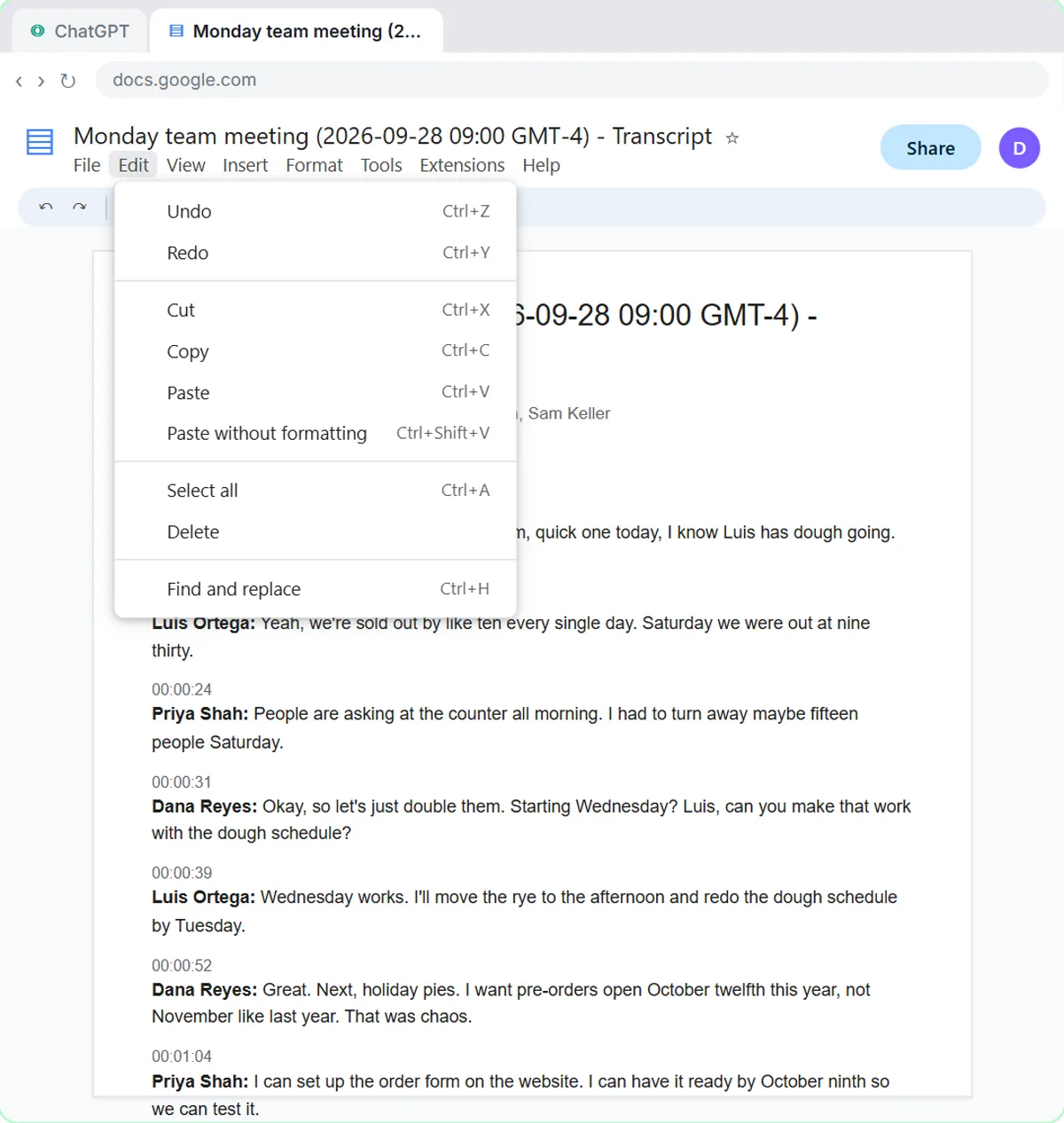 Summarize a Meeting Transcript with ChatGPT
Paste a long meeting transcript into ChatGPT and get the decisions, an action items table with owners and due dates, and a follow-up email ready to send.
Free · Live ~9 min Beginner
◷Meeting to Action: Recap, Tracker Rows and a Kickoff Deck (ChatGPT, n8n, Gamma)Turn rough meeting notes into a checked recap in ChatGPT, four action-item rows in a Google Sheet through n8n, and a five-slide kickoff deck in Gamma.
Free · Live ~14 min Intermediate
◷Turn an Office Move Call into a Checklist for OperationsTurn the transcript of an office-move planning call into the decisions, an action items table with owners and due dates, and a recap email to everyone involved.
Free · Live ~9 min Beginner
◷Handle Scope Creep Without Losing the Client using ChatGPTA client asks for "one small extra" and a new language, and wants the launch date to hold. Give ChatGPT the thread and the project facts, catch the free work and the…
Free · Live ~9 min Beginner
Which free courses fit this job?
- AI for Operations Teams: SOPs, meeting recaps and weekly reviews done in minutes, then requests that route themselves.
- Master ChatGPT for Work: Go from safe first chats to ChatGPT that knows your job, reads your files and runs multi-step work: data controls, memory, prompts, meeting minutes…
- ChatGPT for Everyday Work: Answer emails, recap meetings, read spreadsheets and write SOPs in a fraction of the time.
- AI for Meetings: Prepare for every meeting in minutes, get live help on the call, and walk out with minutes, owners and the follow-up already written.
New to AI at work? Start with AI for Project Managers: Where to Start (Free Path), a short path of free lessons in order.
Practice it free, step by step
Run a Weekly Ops Review Where Every Task Has an Owner using ChatGPT. Turn a weekly operations and vendor review into the decisions, the next steps with owners and dates, the risks to watch and a team recap, without turning a vendor's "should" into a promise. You do every step yourself in a practice copy of ChatGPT, it checks your work as you go, and “Do it for me” finishes any step you get stuck on. Free, and nothing touches your real accounts.
Start the free lessonMore templates for this job
Single prompts from the prompt library, each with a filled-in example and a checklist for the answer.
- Project status update prompt: Write an honest project status update: On track, At risk or Off track with the reason, what's done, what's next, blockers and…
- Project risk register prompt: List what could go wrong with a project from your notes: each risk with likelihood, impact, an early warning sign, a response…
- RACI chart from project notes prompt: Turn meeting notes or a project plan into a RACI chart: who does each task, who signs off, who's asked and who's told, with gaps…
- Project retrospective prompt: Turn your notes on a finished project into a lessons-learned review: what worked, what slipped, why, and three changes to try on…
Prompts for other roles
Frequently asked questions
- Can AI replace a project management tool?
- No. It drafts the documents and summaries; your project tool still holds the tasks and dates. Some teams connect the two with an automation, such as the n8n meeting-to-tasks lesson.
- How do I keep AI from inventing owners and dates?
- Tell it to use only what is in the notes and to write "Not stated" otherwise, as every prompt here does. Then fill the gaps yourself.