AI Prompts for Copywriters: 11 Copy-Ready Templates
Updated · By Robert Breen
For a copywriter, the blank page is rarely the expensive part. The expensive parts are research, the fifth round of headline options, reworking a draft for a new length or audience, and checking every claim before it ships. AI assistants are useful helpers for exactly those jobs, as long as the voice and the final call stay yours.
These prompts use the assistant as a research aide, a sparring partner and an editor rather than a ghostwriter. They ask for options with reasons, edits with explanations and claim lists you can verify, so your craft is what reaches the client.
To sharpen the core technique, try few-shot prompts that copy your style and Catch Made-up Facts Before They Reach Customers.
How do you use these prompts?
Copy a prompt into ChatGPT, Claude, Gemini or Copilot and replace every [BLANK] with your own details. Where a prompt says PASTE, paste your notes, email or document there. Each prompt follows the four parts from Prompt Writing 101: a Role, the Context, the Task and the Format you want back. Then check every name, date, number and promise in the answer before you use it.
Research and briefs
1. Interview me for a brief
You are a senior copywriter starting a project for [CLIENT] on [DELIVERABLE]. Before anything is written, ask me up to ten questions, one at a time, to understand the audience, the one message, the proof, the objections, the tone, the call to action and what the client has disliked before.

When I have answered, summarize everything as a one-page creative brief for my approval.

Format: questions first; the brief as headed bullets.
2. Pull the customer's own words from reviews
Act as a copy researcher. Here are customer reviews and comments about [PRODUCT OR SERVICE]:

[PASTE REVIEWS]

Pull out the exact phrases customers use for: the problem before they bought, what they were afraid of, what changed after and how they describe the product. Quote word for word and do not paraphrase.

Format: four headed lists of quotes.
Drafting
3. Generate headline options with angles
You are a copywriter. The page is for [PRODUCT OR OFFER] aimed at [AUDIENCE]. The main benefit: [BENEFIT]. The main objection: [OBJECTION].

Write 12 headline options across four angles (benefit, problem, proof, curiosity), three each. Under each headline, write one line on why it might work and one risk. Keep each headline under [NUMBER] words.

Format: four headed groups.
4. Draft a landing page structure
Act as a conversion copywriter. Offer: [OFFER]. Audience: [AUDIENCE]. Proof we can use: [PROOF, TESTIMONIALS WITH PERMISSION, NUMBERS WITH SOURCES]. Call to action: [CTA].

Draft the landing page section by section: hero (headline, subhead, CTA), problem, solution, how it works, proof, objections and answers, final CTA. Use only the proof I gave; leave "[PROOF NEEDED]" where a section needs more.

Format: labeled sections with draft copy.
5. Write in a client's voice from examples
You are writing for [CLIENT]. Here are three samples of their writing:

[PASTE SAMPLES]

First, describe their voice in five bullet points (sentence length, vocabulary, humor, formality, how they address the reader). Then write [DELIVERABLE] about [TOPIC] in that voice, around [LENGTH] words.

Format: Voice notes, then the draft.
6. Write product descriptions from specs
Act as an e-commerce copywriter for [BRAND]. Here are the product specs:

[PASTE SPECS]

Write a product description that leads with what the buyer gets, turns the three most important specs into benefits and keeps the full spec list at the end. Do not add features or claims that are not in the specs.

Format: a one-line hook, a short paragraph, three benefit bullets, then Specs. Under [NUMBER] words.
Editing
7. Cut a draft to length without losing the point
You are an editor. Here is my draft, currently [CURRENT LENGTH] words:

[PASTE DRAFT]

Cut it to [TARGET LENGTH] words. Keep the main message, the strongest proof and the call to action. Then list what you removed so I can put anything back.

Format: the edited draft, then a "Removed" list.
8. Get a tough line edit
Act as a demanding copy editor. Here is my draft for [AUDIENCE]:

[PASTE DRAFT]

Do not rewrite it. Instead, list the ten edits that would most improve it: vague phrases, buried points, weak verbs, jargon, repetition and sentences that are too long. For each, quote the original and suggest a fix.

Format: a table with Original, Problem, Suggested fix.
9. Rewrite for a different audience
You are a copywriter. This piece was written for [ORIGINAL AUDIENCE]:

[PASTE COPY]

Rewrite it for [NEW AUDIENCE], who care most about [WHAT THEY CARE ABOUT] and know [WHAT THEY ALREADY KNOW]. Keep every fact the same and change emphasis, examples and vocabulary only.

Format: the rewritten copy, then three bullets on what changed and why.
Checks
10. List every claim that needs a source
Act as a fact-checker. Here is the final draft:

[PASTE DRAFT]

List every factual claim: numbers, dates, names, quotes, comparisons, superlatives and promises. For each, say what kind of source would confirm it and flag any that look risky to publish without one. Do not judge whether the claims are true.

Format: a table with Claim, Source needed, Risk (High, Medium, Low).
11. Read it as a skeptical customer
You are a skeptical [CUSTOMER TYPE] who has been burned by [COMMON BAD EXPERIENCE]. Read this copy:

[PASTE COPY]

Tell me the three places you stopped believing it, the questions it left unanswered and what would have made you click [CTA]. Be blunt.

Format: three short sections.
How do you adapt these prompts to your own work?
- Give the assistant examples, not adjectives. "Write like this sample" beats "write in a friendly, punchy voice" every time.
- Use AI for options and edits, then write the final version yourself. Clients pay for your judgment about which option is right.
- Check your client contract for rules on AI use before you start, and never paste confidential briefs into a tool your client has not approved.
Where can you practice these skills for free?
These free Stepthrough lessons practice the same jobs step by step, with a made-up business and practice copies of the real tools, so nothing touches your real accounts.
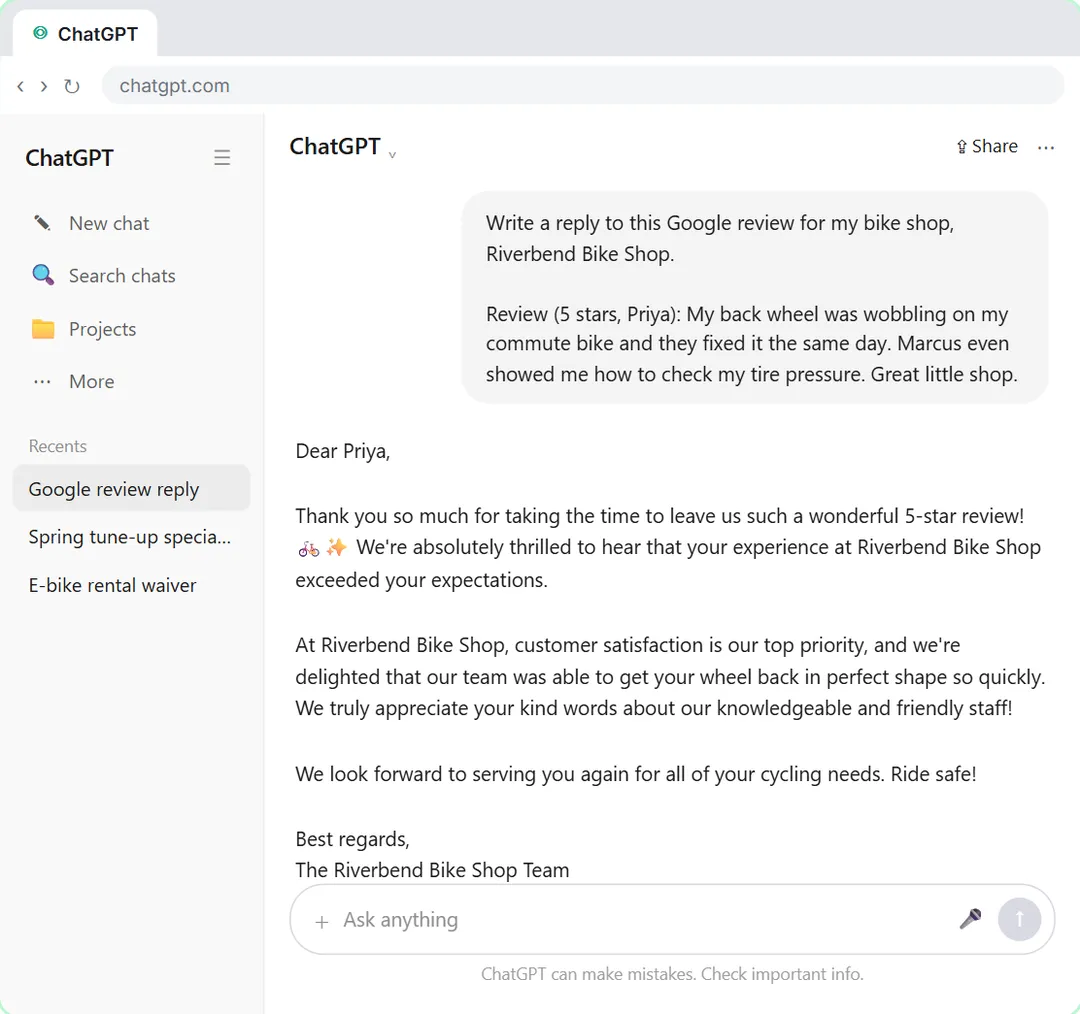 Give Examples: Few-Shot Prompts That Copy Your Style
Paste three of your real past replies into ChatGPT and get new Google review replies that sound like you, not like a template.
Free · Live ~6 min Beginner
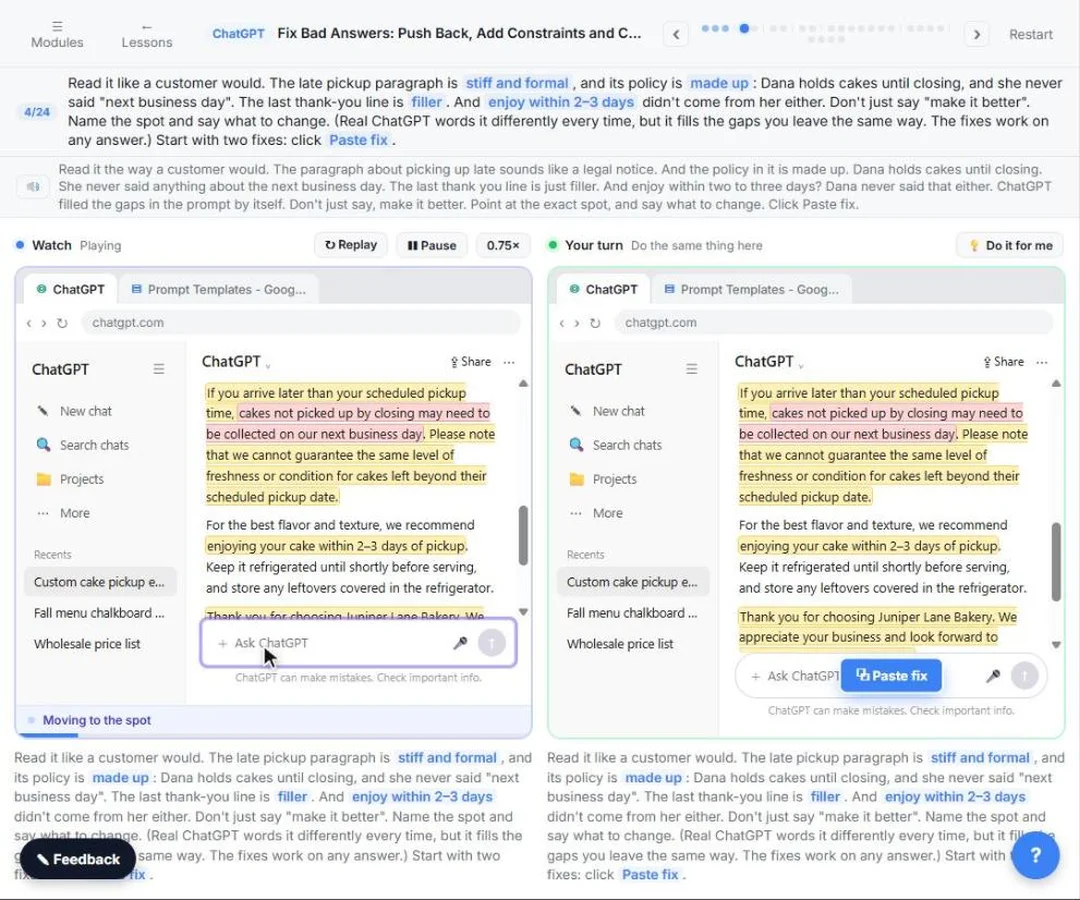 Catch Made-up Facts Before They Reach Customers using ChatGPT
Leave gaps in a prompt and ChatGPT fills them: a stiff paragraph, a made-up policy and a made-up fact. Point at the exact problem, add constraints, ask what it assumed…
Free · Live ~7 min Beginner
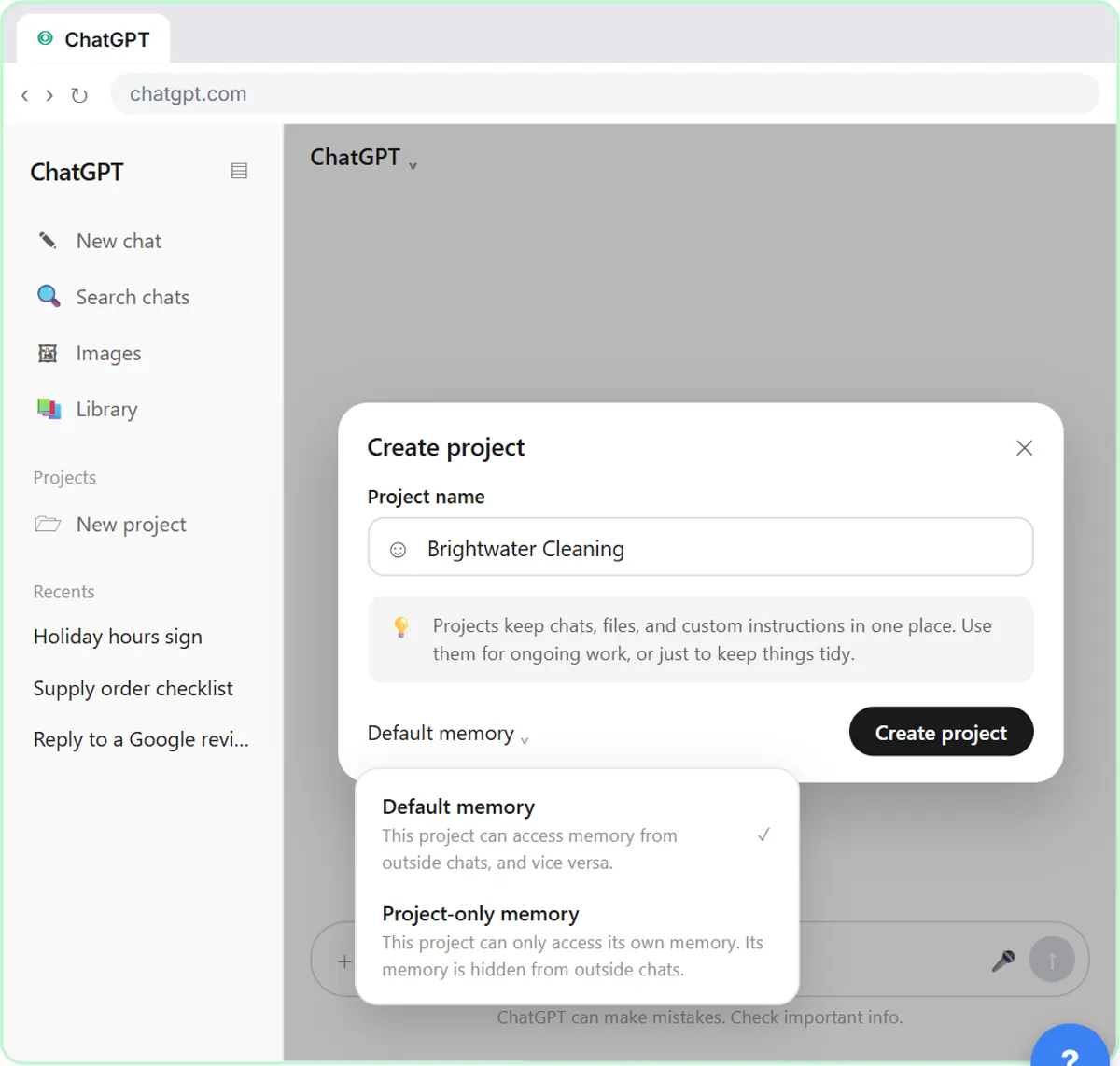 ChatGPT Projects: Keep Your Brand Voice, Files and Instructions in One Place
Set up a ChatGPT Project with your brand voice instructions, your price list and your style guide, so every new chat already knows your business.
Free · Live ~9 min Beginner
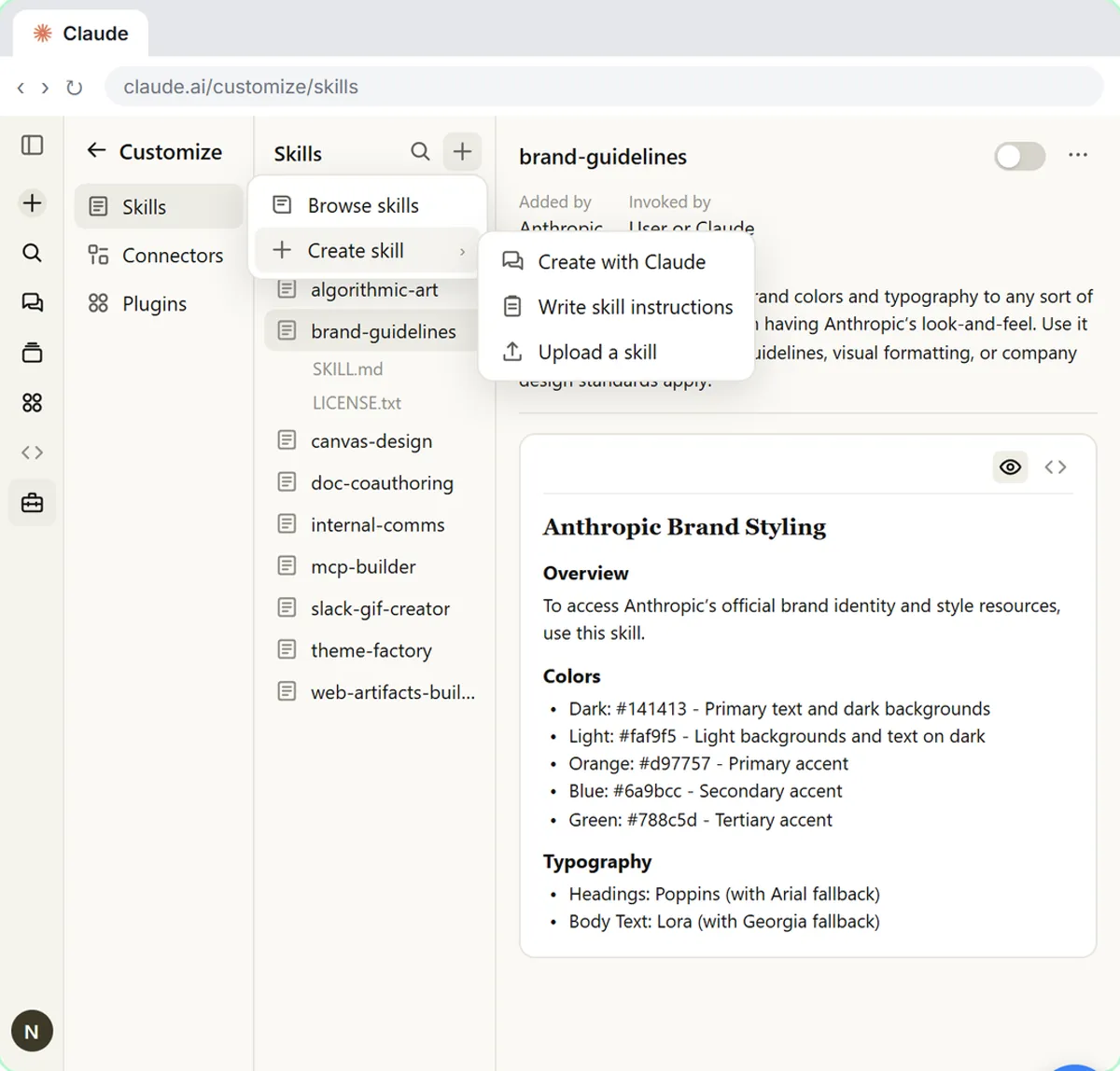 Make Every Claude Document On-Brand with a Brand Guidelines Skill
Build a brand skill for a small flower shop by chatting with Claude: colors, fonts, logo placement and voice. Then ask for a proposal and a social post and watch both…
Free · Live ~7 min Beginner
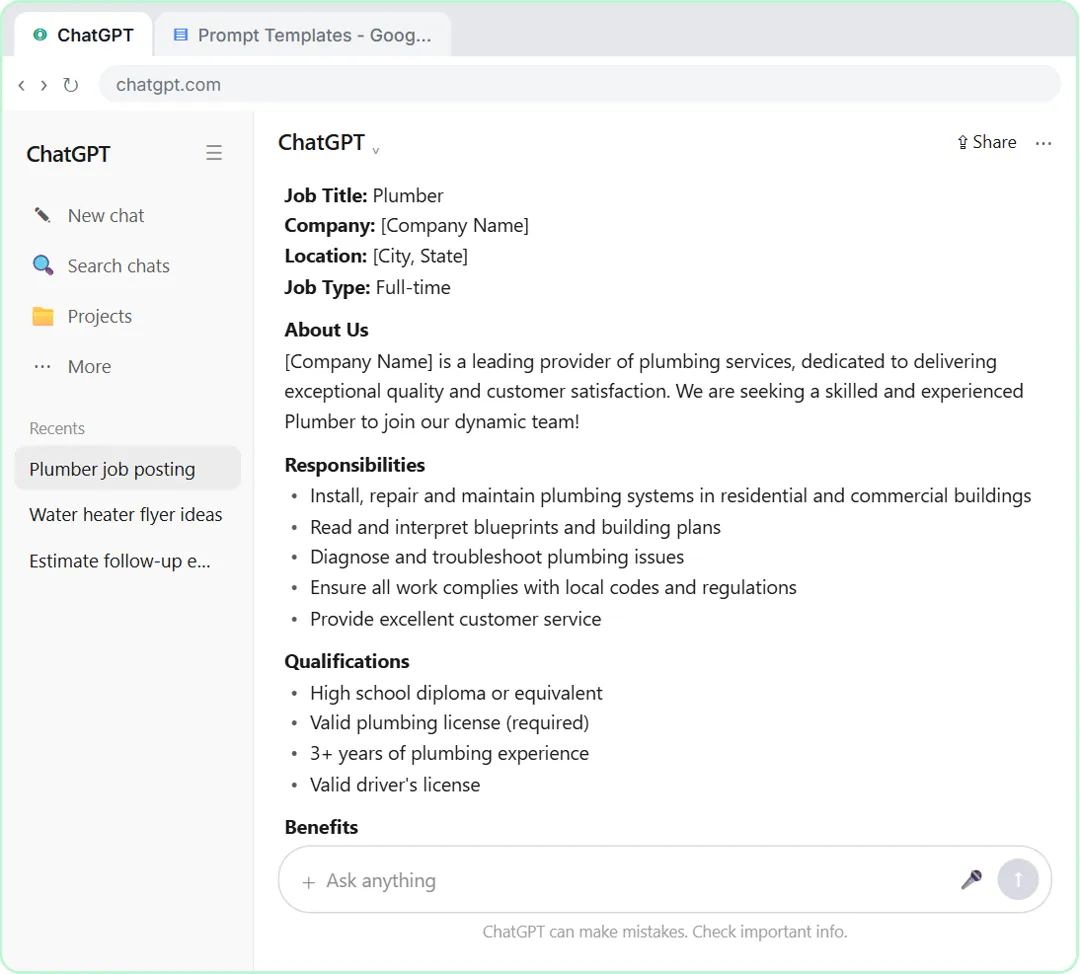 Make ChatGPT Ask You Questions First: The Interview Prompt
Ask for a job posting the quick way, then with the interview prompt: ChatGPT asks what it needs, one question at a time, and writes a posting you can actually use.
Free · Live ~6 min Beginner
Which free courses fit this job?
- Better Prompts: Turn vague AI answers into work you can send, with prompt habits that work in any assistant.
- Master ChatGPT for Work: Go from safe first chats to ChatGPT that knows your job, reads your files and runs multi-step work: data controls, memory, prompts, meeting minutes…
- AI for Marketing Teams: On-brand content in less time, then automations that turn posts and comments into leads.
New to AI at work? Start with AI for Marketers: Where to Start, Five Free Lessons, a short path of free lessons in order.
Practice it free, step by step
Give Examples: Few-Shot Prompts That Copy Your Style. Paste three of your real past replies into ChatGPT and get new Google review replies that sound like you, not like a template. You do every step yourself in a practice copy of ChatGPT, it checks your work as you go, and “Do it for me” finishes any step you get stuck on. Free, and nothing touches your real accounts.
Start the free lessonMore templates for this job
Single prompts from the prompt library, each with a filled-in example and a checklist for the answer.
- Landing page headline prompt: Get six distinct landing page headlines, subheadlines and button text from a ChatGPT prompt that uses only your real offer and…
- Website service page copy prompt: Write a website page for one service: who needs it, what happens on the visit, what they get, your published price, a short FAQ…
- Email shortener prompt: Cut a long email down to what the reader needs without changing a fact, date, price or promise, plus a list of what was removed…
- Product description prompt: Write product page copy with a ChatGPT prompt that uses only your spec list: a short opening, scannable bullets, who it's for…
Prompts for other roles
Frequently asked questions
- Will AI replace copywriters?
- It changes the work. Drafts and variations get faster, so research, judgment, voice and fact-checking become a bigger share of the value a copywriter brings.
- How do I get AI to match a specific voice?
- Paste three samples and ask the assistant to describe the voice before writing. Correct the description, then ask for the draft. The few-shot examples lesson practices this.