AI Prompts for Marketing Managers: 11 Copy-Ready Templates
Updated · By Robert Breen
Marketing managers run on plans and briefs: the campaign plan, the creative brief for the agency, the persona, the email sequence, the results summary for leadership. AI can produce a first draft of any of these in minutes, which frees time for strategy and for checking what is actually working.
The catch is that generic marketing copy is everywhere. These prompts force specificity: your audience, your offer, your proof, your brand voice. They also keep claims honest, telling the assistant not to invent statistics, testimonials or results. Your brand and your numbers stay yours.
For hands-on practice, break a marketing plan into steps with prompt chaining, then keep your brand voice and files in a ChatGPT Project.
How do you use these prompts?
Copy a prompt into ChatGPT, Claude, Gemini or Copilot and replace every [BLANK] with your own details. Where a prompt says PASTE, paste your notes, email or document there. Each prompt follows the four parts from Prompt Writing 101: a Role, the Context, the Task and the Format you want back. Then check every name, date, number and promise in the answer before you use it.
Strategy and planning
1. Plan a campaign in steps
You are a marketing manager at [COMPANY], which sells [PRODUCT OR SERVICE] to [AUDIENCE]. Goal: [GOAL] by [DATE] with a budget of [BUDGET]. Channels we use: [CHANNELS].

Work in steps and stop after each so I can approve it: 1) three campaign angles with the insight behind each, 2) for the angle I pick, the message, offer and call to action, 3) a channel plan with what runs where and when, 4) how we will measure it.

Format: start with step 1 only.
2. Write a buyer persona from real data
Act as a marketing strategist. Here is what we know about our best customers from [SOURCES, SUCH AS SALES NOTES, SURVEYS, REVIEWS]:

[PASTE NOTES]

Write one buyer persona: role and context, goals, frustrations, how they buy, the words they use (quoted from the notes) and what would make them choose us. Base every point on the notes and mark anything inferred as "Assumption".

Format: headed sections, under 350 words.
3. Write a creative brief
You are briefing [AGENCY OR DESIGNER] on [PROJECT]. Facts: audience [AUDIENCE], single message [MESSAGE], proof points [PROOF], tone [TONE], mandatory elements [LOGO, LEGAL LINES, SIZES], deadline [DEADLINE], budget [BUDGET].

Write a one-page creative brief that a designer could start from without a meeting. Add a "What success looks like" line and a list of what we do not want.

Format: headed sections, under 300 words.
Email and content
4. Draft a nurture email sequence
You are a marketing manager writing a [NUMBER]-email nurture sequence for people who [HOW THEY JOINED, SUCH AS DOWNLOADED A GUIDE]. Product: [PRODUCT]. The one action we want: [ACTION].

For each email give the send day, subject line, preview text, a body under 150 words and one call to action. Each email should teach one useful thing before it asks for anything. Use only these proof points: [PROOF POINTS].

Format: one labeled block per email.
5. Write subject lines to test
Act as an email marketer. The email is about [TOPIC] for [AUDIENCE], and the main benefit is [BENEFIT].

Write ten subject lines under 50 characters in five different styles (benefit, question, curiosity, number, direct), two per style, plus a preview line for each. Avoid spam-trigger words and all caps.

Format: a table with Style, Subject line, Preview text, Character count.
6. Outline a blog post that answers a real question
You are planning a blog post for [COMPANY] that answers the question "[CUSTOMER QUESTION]" for [AUDIENCE]. What we know that others do not: [YOUR EXPERIENCE OR DATA].

Write an outline: a working title, a two-sentence direct answer for the top, H2 headings phrased as questions, the key point under each, and where our own experience fits. Do not include statistics unless I provided them.

Format: an outline with headings and one-line notes.
Testing and results
7. Plan an A/B test
You are a marketing manager. We want to test [ELEMENT, SUCH AS A LANDING PAGE HEADLINE] on [CHANNEL]. Current version: [CURRENT]. Our traffic is about [TRAFFIC PER WEEK] and the conversion we measure is [METRIC].

Write a test plan: hypothesis, the variant to test (one change only), what we measure, how long to run it given our traffic and what result would make us switch. Explain any assumption you make about sample size.

Format: headed sections, under 250 words.
8. Summarize campaign results for leadership
Act as a marketing manager reporting on [CAMPAIGN] for [PERIOD]. Results:

[PASTE METRICS BY CHANNEL, SPEND, LEADS, SALES]

Write a summary for leadership: the headline result against the goal of [GOAL], what worked, what did not, cost per result by channel (show the math) and what we will change next. Use only these numbers.

Format: a headline sentence, a results table, then three short sections.
Brand and clients
9. Write a brand voice guide
You are writing a brand voice guide for [COMPANY]. Here are three pieces of our writing we are proud of:

[PASTE EXAMPLES]

Describe our voice in four or five traits, each with a "we say / we do not say" pair taken from or modeled on the examples. Add words we use and words we avoid.

Format: a table of traits, then two short word lists, under 300 words.
10. Reply to a client's revision request
Act as a marketing manager at an agency. The client wrote: "[CLIENT FEEDBACK]". The agreed scope included [NUMBER] rounds of revisions; this is round [NUMBER]. What we can change now: [CHANGES WE AGREE TO]. What would be a scope change: [OUT OF SCOPE ITEMS].

Write a friendly reply that confirms the changes we will make and the date, and explains any out-of-scope item with the option to quote it separately.

Format: under 160 words.
11. Check a draft for unsupported claims
You are a careful marketing editor. Here is a draft:

[PASTE DRAFT]

List every claim that needs proof: numbers, comparisons, "best" or "fastest", guarantees, customer results and quotes. For each, say what proof we would need. Do not rewrite the draft.

Format: a table with Claim, Type, Proof needed.
How do you adapt these prompts to your own work?
- Paste real customer words (reviews, sales call notes) into persona and copy prompts. Specific language beats any adjective you can give the assistant.
- Put your brand voice guide and product facts in a project so every draft starts on-brand. ChatGPT Projects shows the setup.
- Never publish an AI-written number, testimonial or comparison without a source you can point to.
Where can you practice these skills for free?
These free Stepthrough lessons practice the same jobs step by step, with a made-up business and practice copies of the real tools, so nothing touches your real accounts.
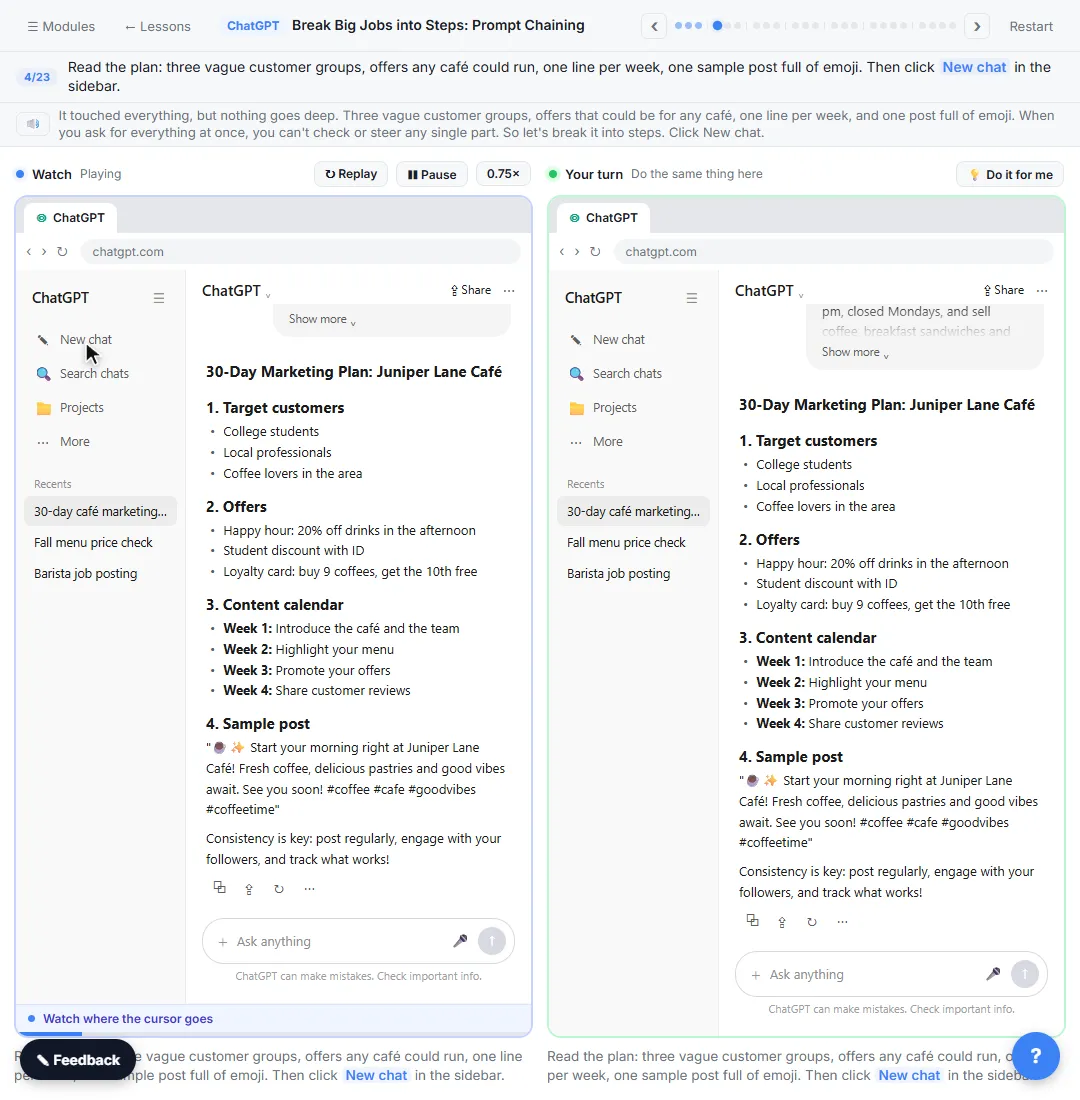 Break Big Jobs into Steps: Prompt Chaining for a Marketing Plan
Ask ChatGPT for a whole marketing plan in one prompt, then build a better one in four small steps: customers, offers, a calendar table and the posts.
Free · Live ~7 min Beginner
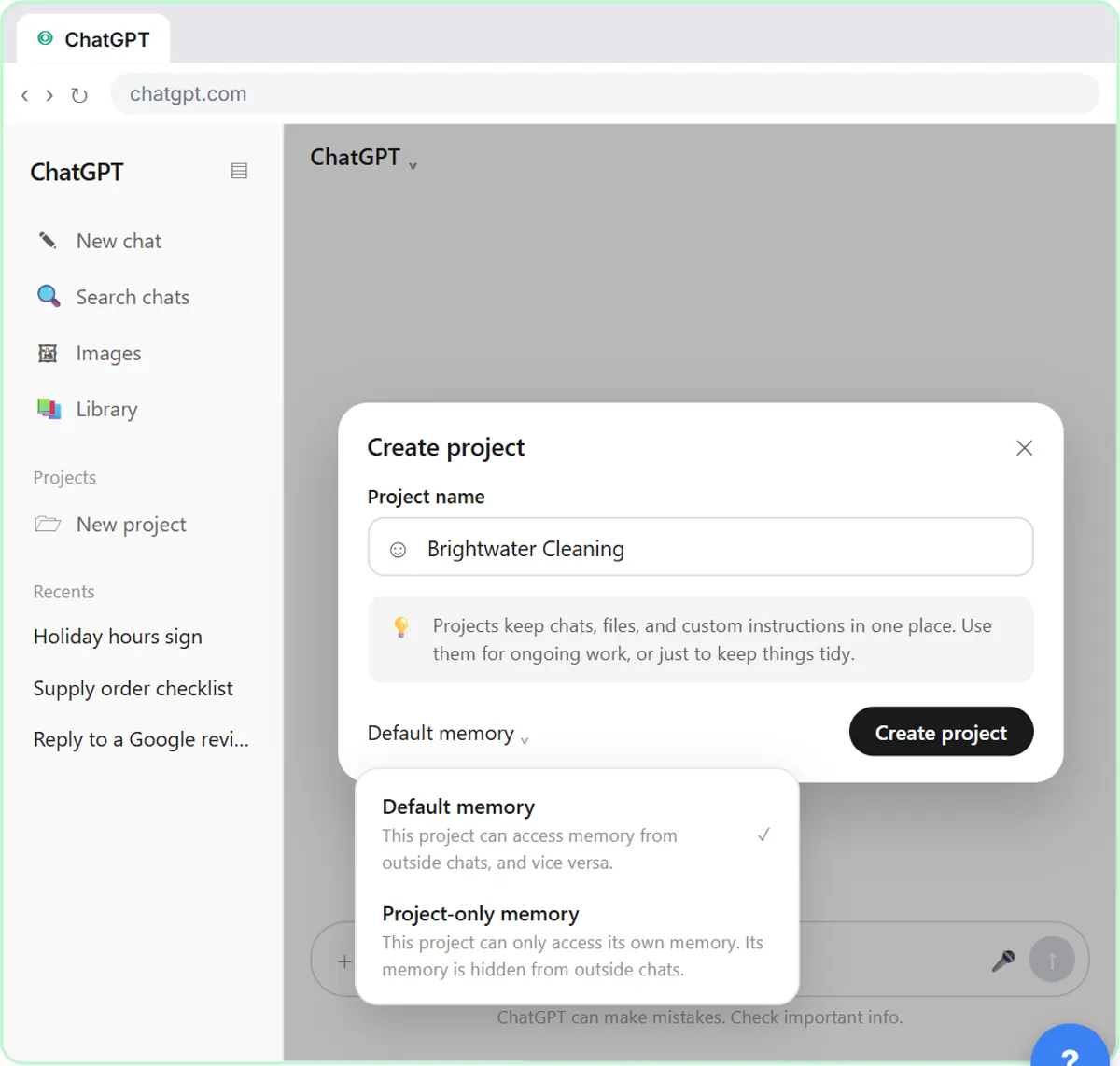 ChatGPT Projects: Keep Your Brand Voice, Files and Instructions in One Place
Set up a ChatGPT Project with your brand voice instructions, your price list and your style guide, so every new chat already knows your business.
Free · Live ~9 min Beginner
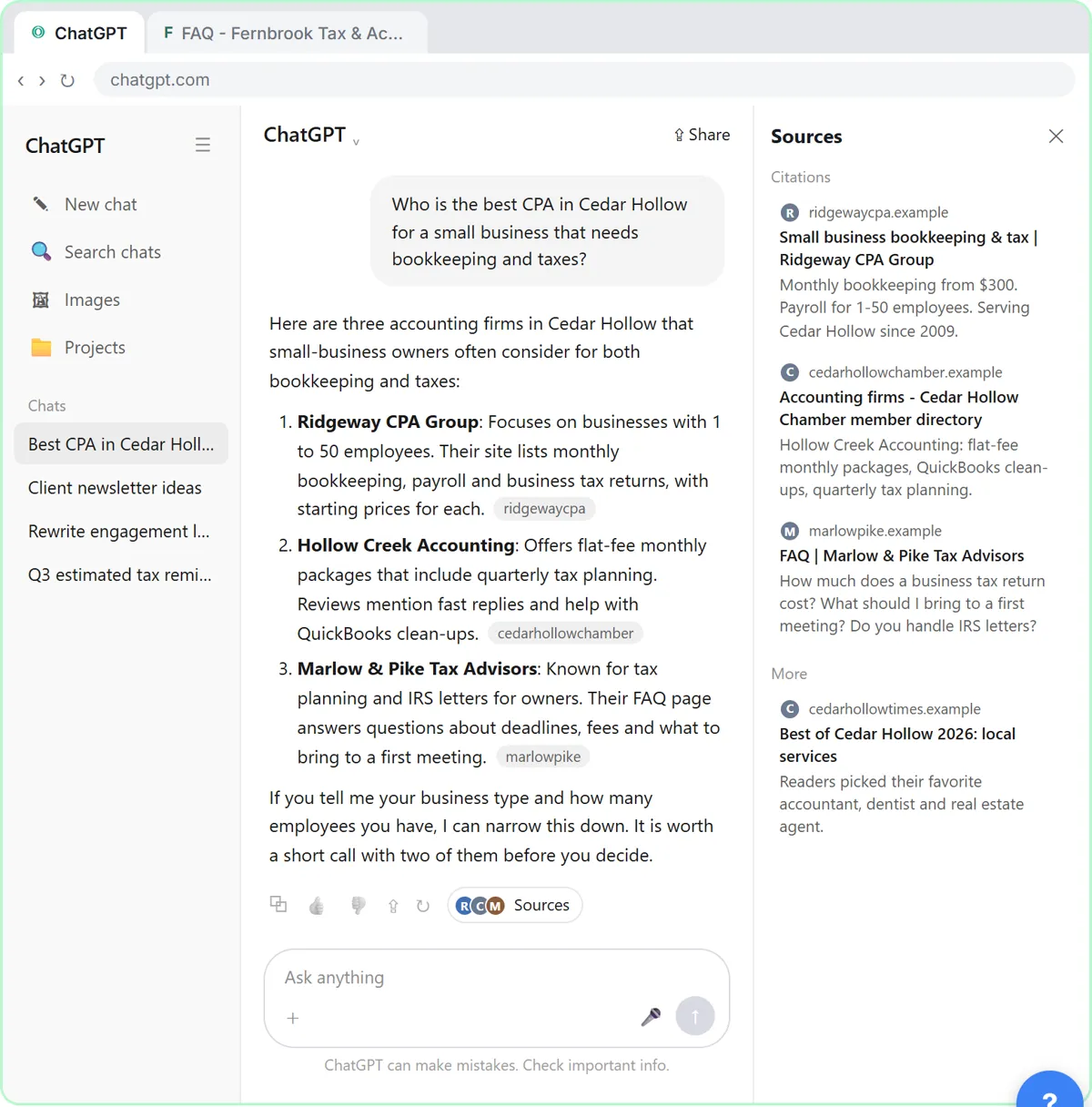 Get Your Business Recommended by ChatGPT
Ask ChatGPT who it recommends in your town, see which pages it trusts, then use it to write an FAQ page and Business Profile copy that answer real customer questions.
Free · Live ~10 min Intermediate
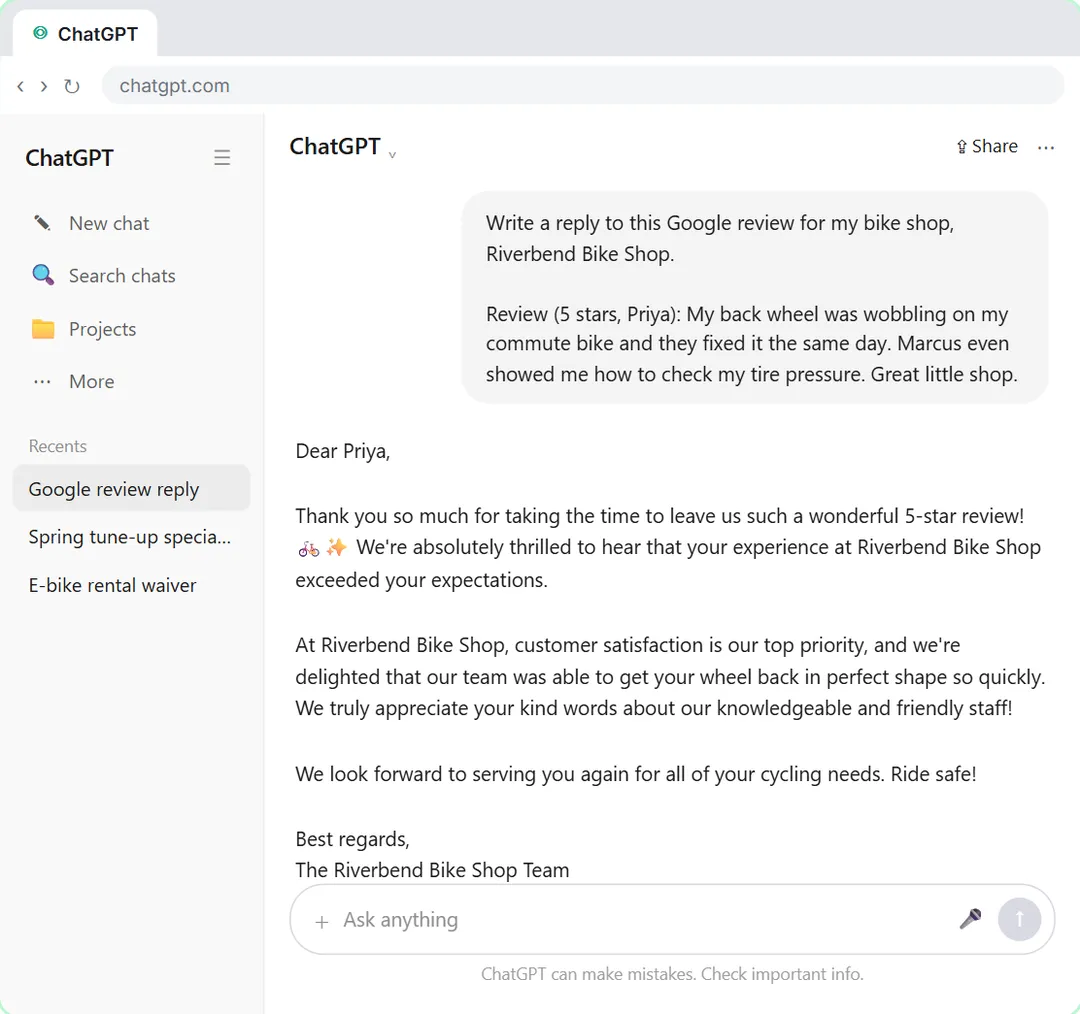 Give Examples: Few-Shot Prompts That Copy Your Style
Paste three of your real past replies into ChatGPT and get new Google review replies that sound like you, not like a template.
Free · Live ~6 min Beginner
◷Answer "Just a Few More Changes" Without Giving Away the Project using ChatGPT for MarketingA client wants a third round of edits, an earlier launch and a free landing page. Give ChatGPT the thread and your contract facts, catch the promises you can't make…
Free · Live ~10 min Beginner
Which free courses fit this job?
- AI for Marketing Teams: On-brand content in less time, then automations that turn posts and comments into leads.
- Master ChatGPT for Work: Go from safe first chats to ChatGPT that knows your job, reads your files and runs multi-step work: data controls, memory, prompts, meeting minutes…
- Better Prompts: Turn vague AI answers into work you can send, with prompt habits that work in any assistant.
New to AI at work? Start with AI for Marketers: Where to Start, Five Free Lessons, a short path of free lessons in order.
Practice it free, step by step
Break Big Jobs into Steps: Prompt Chaining for a Marketing Plan. Ask ChatGPT for a whole marketing plan in one prompt, then build a better one in four small steps: customers, offers, a calendar table and the posts. You do every step yourself in a practice copy of ChatGPT, it checks your work as you go, and “Do it for me” finishes any step you get stuck on. Free, and nothing touches your real accounts.
Start the free lessonMore templates for this job
Single prompts from the prompt library, each with a filled-in example and a checklist for the answer.
- Creative brief prompt: Turn campaign notes and brand rules into a one-page creative brief: goal, audience, message, proof, don'ts, deliverables with…
- Buyer persona prompt: Write a buyer persona from real customer words, such as signup answers and reviews: their goal, worries, words they use and what…
- Lead nurture email sequence prompt: Plan a short nurture sequence for signups who aren't ready to buy: useful emails by segment, one approved offer at the end and…
- Campaign results summary prompt: Turn the numbers from a finished marketing campaign into a plain summary: what ran, what each piece did, what to repeat and what…
Prompts for other roles
Frequently asked questions
- How do I stop AI marketing copy sounding generic?
- Give it your audience, offer, proof and two examples of your own best writing. Generic input produces generic copy; specific input produces specific copy.
- Can AI help my business show up in ChatGPT answers?
- The free lesson Get Your Business Recommended by ChatGPT covers how AI search finds and describes businesses and what you can do about it.