"Debrief" can mean two things in hiring. The panel's internal debrief is covered in Interview Debrief: Best Practices and a Free Template. This guide is about the other one: the conversation or email with the candidate after the interview.
What should a candidate debrief cover?
Four things, in this order:
- Thanks. Name the role and thank them for their time.
- Where things stand. "We are finishing interviews this week" is honest and useful.
- When they will hear back. A real date, and keep it. If you can't give one, say when you will update them.
- Their questions. Answer what you can; say plainly what you can't share yet.
If the candidate is not moving forward, add brief, job-related feedback only if your company's policy allows it. Many employers limit feedback for legal and consistency reasons, so check first.
What does a short debrief call sound like?
Five minutes is enough. A made-up example for a front desk lead role:
Hi Priya, thanks again for coming in on Tuesday for the front desk lead role. I wanted to give you a quick update. We've finished our interviews and the team is meeting on Thursday to decide. You'll hear from me by Friday at the latest, either way. Is there anything you'd like to ask me in the meantime?
It thanks her, gives a decision date, and makes no promise about the outcome.
What should I avoid saying?
Anything that hasn't been decided, and anything that isn't about the job:
- No early offers. "You're our top pick" or "the pay should be fine" can lead a candidate to resign from a job on a promise you can't keep.
- No comparisons. Don't discuss other candidates.
- No personal topics. Feedback should be about the role's requirements, never age, family, health, religion, origin or anything similar.
- No guesses about timing. Give the date you can keep, not the one you hope for.
The candidate status reply lesson shows exactly this trap: a best candidate with another offer and a Friday deadline, and an eager draft that promises pay and a start date only the hiring manager can approve. You have ChatGPT check every promise against the hiring facts, fix the ones that aren't decided, and send a warm, honest reply with a firm date.
Try it free, step by step
Keep Top Candidates Warm with Honest Status Replies using ChatGPT. Your best candidate has another offer and wants to know if she got the job, if you'll match her pay and when she can start. Give ChatGPT the thread and the hiring facts, catch the promises you can't… You do every step yourself in a practice copy of ChatGPT, it checks your work as you go, and “Do it for me” finishes any step you get stuck on. Free, and nothing touches your real accounts.
Start the free lessonHow do I give useful feedback to a candidate who wasn't selected?
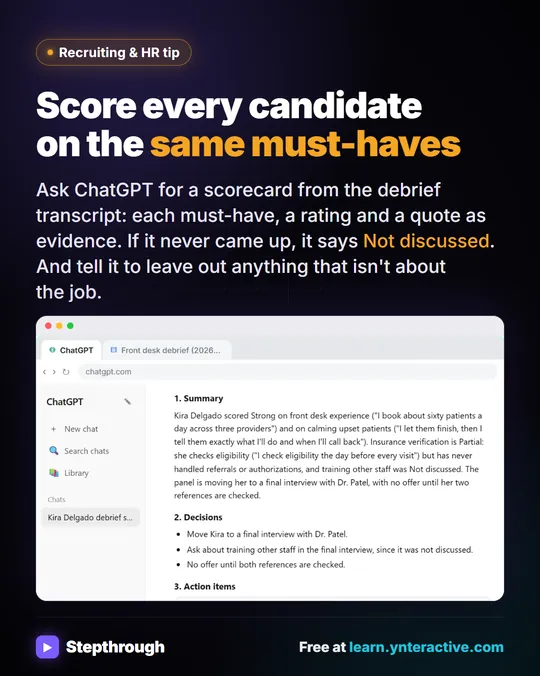
Keep it short, specific and tied to the job's must-haves. "The role needs daily experience with scheduling software, and the candidate we chose had more of it" is useful and fair. "We went another way" is safe but tells them nothing. Base feedback on your notes against the requirements, which is why a structured interview scorecard helps: the free interview debrief to scorecard lesson turns the panel's discussion into ratings with evidence.
How do I draft the follow-up email with ChatGPT?
Give it the facts and the limits:
Role: You write candidate emails for [COMPANY]'s hiring team.
Context: Candidate: [NAME], role: [ROLE], interviewed on [DATE]. Status: [e.g. decision meeting Thursday]. We will reply by [DATE]. Not decided yet: [e.g. pay, start date].
Task: Write a short update email after the interview.
Format: Under 120 words, warm and plain. Use only these facts. Don't promise an offer, pay or a start date.
Then ask it to list every promise in the draft next to the fact that supports it, and remove anything unsupported. The prompt library has a candidate follow-up after interview prompt and a candidate rejection email prompt.
Key takeaways
- A candidate debrief thanks them, says where the process stands, gives a reply date and answers questions.
- Promise only what has been decided; leave pay, start dates and offers to the person who approves them.
- Feedback, if your policy allows it, should be brief and tied to the job's requirements.
- A structured scorecard makes fair, specific feedback much easier.
- Have ChatGPT check every promise in a draft against your facts before you send it.
Frequently asked questions
- Should I call or email a candidate after an interview?
Either works. A call feels more personal for finalists; email is fine for a quick status update and leaves a clear record. Many teams call with an offer and email everything else.
- How soon should I follow up after an interview?
Within the time you told the candidate, and ideally within a few business days. If the decision is delayed, send an update before the promised date passes.
- Do I have to give rejected candidates feedback?
Generally there is no rule requiring it, and many companies limit it. Follow your company's policy, and keep any feedback job-related.
- What if the candidate has another offer?
Tell them honestly when you can decide. Don't make an offer you aren't authorized to make. If the timeline matters, ask the hiring manager whether the decision can move faster.
Where can I go next?
See ChatGPT for Recruiters and the candidate experience entry.
For good and bad moments across the whole process, see candidate experience examples.