What are AI citations and how do I check them?
Quick answer
AI citations are the links, quotes or source labels an AI assistant attaches to its answer to show where each claim came from. They let you check the answer, but they are not proof: a cited page can be misread, outdated or fail to say what the answer claims.
Last updated
Updated · By Robert Breen
Why it matters for a small business
A cited answer is far easier to verify than one that just sounds sure. Instead of researching from scratch, you open the source next to the claim and confirm it. For anything a client, a manager or a regulator will rely on, that check is the job, and citations make it quick.
The trap is treating the citation itself as the check. AI tools sometimes attach a real link to a claim the page does not support, quote a passage out of context or cite an old version of a policy. The habit to build is simple: for every claim that matters, open the source and find the sentence that backs it. If you cannot find it, the claim is unsupported, however official the link looks.
In a real lesson: Turn an Interview Debrief into a Scorecard and a Candidate Follow-Up (Recruiting & HR)
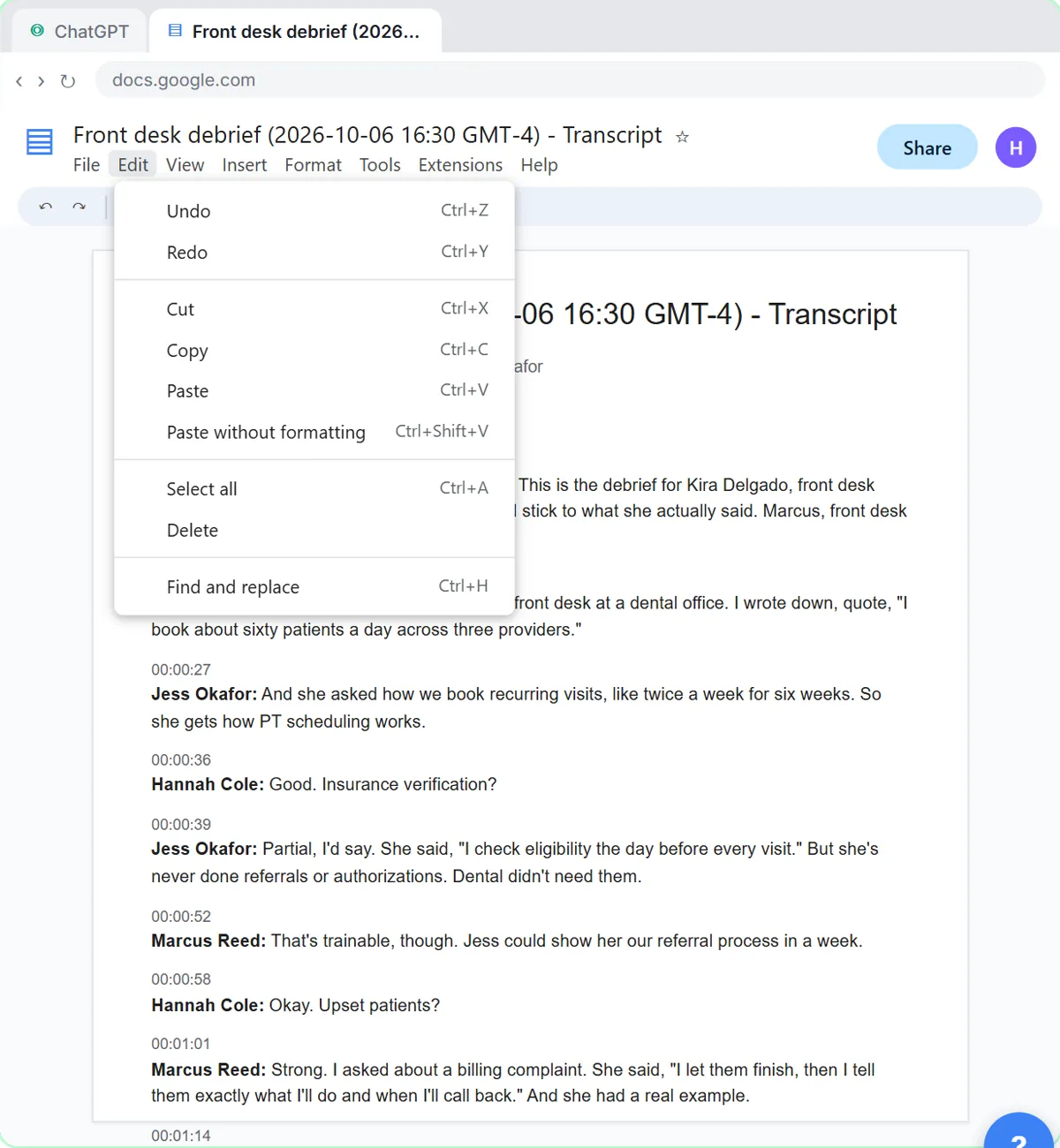
The Interview Debrief to Scorecard lesson builds citations into the request. Hannah Cole, HR manager at Willow Bend Physical Therapy, a made-up practice, gives ChatGPT the transcript of a panel debrief for Kira Delgado, who interviewed for Front Desk Lead, and asks it to score each must-have as Strong, Partial or Not discussed "with a short quote from the interview as evidence."
The summary that comes back cites its source line by line. Front desk experience is Strong, backed by "I book about sixty patients a day across three providers." Insurance verification is Partial, backed by "I check eligibility the day before every visit." Training other staff is Not discussed, because no quote exists for it. A score with no quote is a score you should question.
The quotes are only useful if someone checks them. Before the scorecard is used, Hannah can open the transcript, search each quote and confirm it is there, said by the right person, and means what the score claims. The claim-status reply lesson uses the same idea with numbered facts: every promise in the draft points to a fact, and two that point to nothing get fixed.
Try this lesson free or read the step-by-step guide.
Common confusions
Citation vs grounding
Grounding is limiting the answer to trusted sources. Citations show which source each claim came from, so you can check the grounding worked. You want both.
A real link vs a supporting source
A link that opens is not the same as a source that supports the claim. A hallucination can arrive with a perfectly real URL attached.
Tips
- Ask for a quote or a fact number next to each key claim, not just a list of links at the end.
- Open the sources behind the claims your decision depends on and find the exact sentence.
- Prefer primary sources, like the policy, the contract or the vendor's own page, over articles about them.
Related terms
More AI assistants terms
Where you use it: free lessons
- Turn an Interview Debrief into a Scorecard and a Candidate Follow-Up (Recruiting & HR) (ChatGPT, 9 min)
- Reply Faster to Claim-Status Emails: ChatGPT for Independent Insurance Agencies (ChatGPT, 10 min)
- Reply Faster to a Client Asking for a Case Update: ChatGPT for Small Law Firms (ChatGPT, 10 min)
- How to Fix Bad ChatGPT Answers: Push Back, Add Constraints and Check Facts (ChatGPT, 7 min)
Prompt templates that use it
Frequently asked questions
- Can AI make up citations?
- Yes. Assistants have produced citations to sources that do not exist or that say something different. Tools that search the web as they answer do this less, but you still need to open the sources that matter.
- How do I get ChatGPT to cite its sources?
- Ask for a short quote or a link next to each claim, and give it the source material when you can. When you paste the document yourself, ask it to quote the exact sentence it relied on.