What is semantic search?
Quick answer
Semantic search finds information by what it means rather than by the exact words typed. A question like "will my rate go up?" can find a passage about premiums at renewal even though the words barely overlap. It usually works by comparing embeddings, number versions of text.
Last updated
Updated · By Robert Breen
Why it matters for a small business
People rarely use the same words as your documents. Clients write "when do I get paid", your policy file says "claim payment", and a keyword search finds nothing. Semantic search closes that gap, which is why it sits underneath most tools that answer questions from company files, help centers and shared drives.
It also decides what an AI assistant gets to read. In a RAG setup, the search step picks the few passages the model sees before it writes. If the search picks the wrong passage, even a careful model gives a wrong answer. Knowing this helps you diagnose a bad answer: was it the writing, or what was found?
In a real lesson: Reply Faster to Claim-Status Emails: ChatGPT for Independent Insurance Agencies
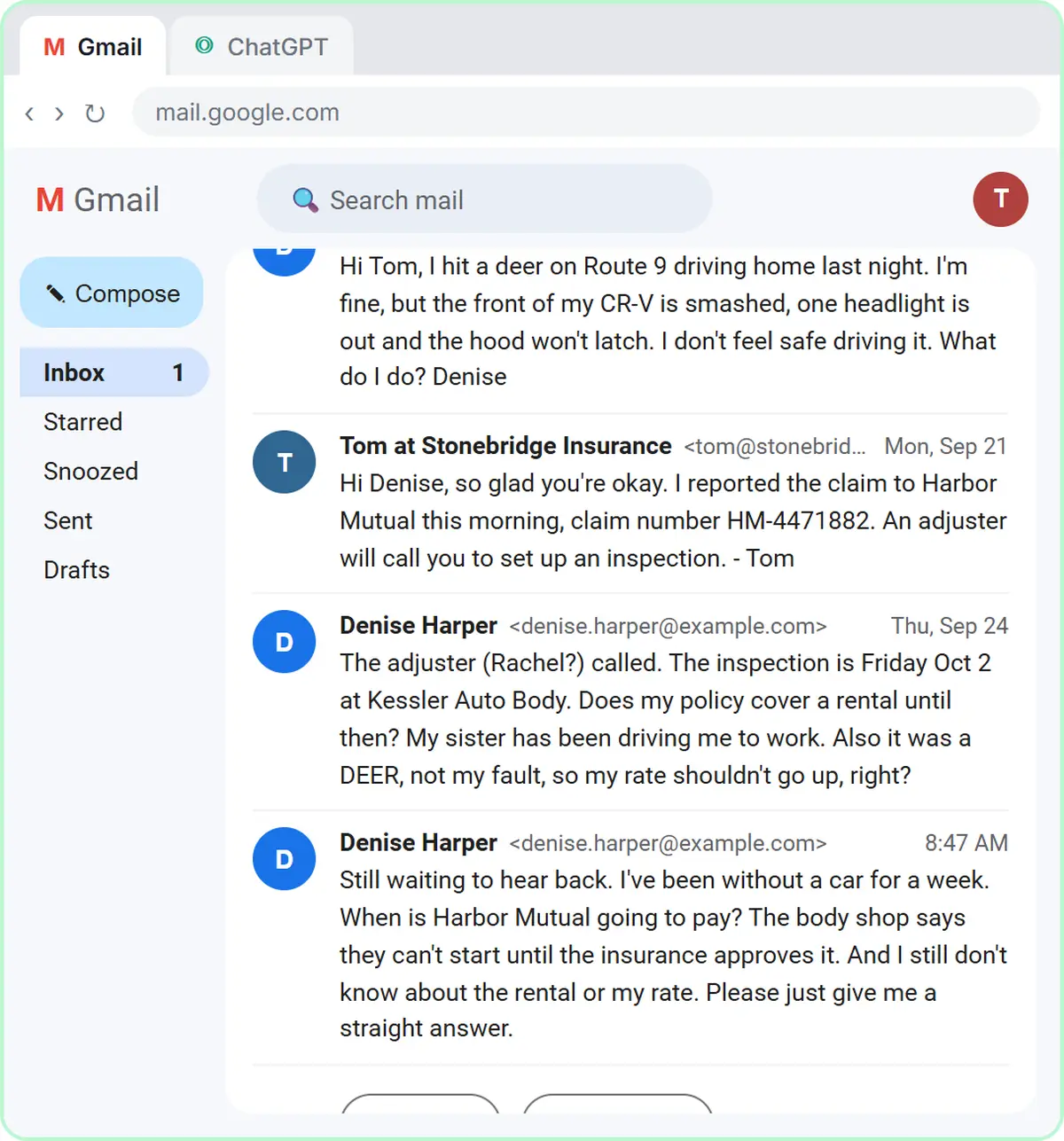
The claim-status reply lesson does not run a search engine, but it shows the matching problem semantic search solves. Denise Harper emails Stonebridge Insurance Agency, a made-up agency, about her deer claim. Her questions are in her own words: "Does my policy cover a rental until then?", "my rate shouldn't go up, right?" and "When is Harbor Mutual going to pay?"
The facts you paste use different wording. Fact 4 talks about "Rental reimbursement, $40 per day, up to $1,200 per claim." Fact 5 says Harbor Mutual "sets her rate at renewal on Jan 15." Fact 3 explains who decides payment. To answer well, ChatGPT has to connect each question to the right fact by meaning, which is exactly what semantic search does across a large document collection.
With eight facts pasted in one message, the model can read them all. An agency with hundreds of policy documents could not paste them every time. That is where semantic search would pick the relevant passages first, and where a check step, like the lesson's claim-by-claim table, still matters.
Try this lesson free or read the step-by-step guide.
Common confusions
Semantic search vs keyword search
Keyword search matches the words you typed, which is precise for names, numbers and codes like a claim number. Semantic search matches meaning, which suits questions. Many tools combine both.
Semantic search vs AI search
AI search usually means an assistant that searches and then writes an answer. Semantic search is only the finding part, and it can return passages without writing anything.
Tips
- For exact items like invoice numbers or policy IDs, keyword search is still the better tool.
- Write documents with clear headings and one topic per section so the right passage is easy to find.
- When an AI answer is wrong, check which passages it was given before rewriting the prompt.
Related terms
More AI basics terms
Where you use it: free lessons
- Reply Faster to Claim-Status Emails: ChatGPT for Independent Insurance Agencies (ChatGPT, 10 min)
- Reply Faster to Clients Chasing Their Refund: ChatGPT for Tax and Bookkeeping Firms (ChatGPT, 10 min)
Frequently asked questions
- Is semantic search the same as Google search?
- Not exactly. Modern web search engines use meaning-based techniques among many other signals. Semantic search, as a term, usually refers to searching your own collection of documents by meaning.
- Do I need a vector database for semantic search?
- For a large collection, usually yes, since that is where the embeddings are stored and compared. For a few pages, pasting or uploading the text to an assistant is simpler.