What is synthetic data?
Quick answer
Synthetic data is artificial data created to look and behave like real data: fake customers, invented invoices, made-up transcripts. Teams use it to test tools, train or evaluate AI models, and share realistic examples without exposing anyone's real information.
Last updated
Updated · By Robert Breen
Why it matters for a small business
Testing a new workflow on real client files is risky. If the automation misfires, it might email the wrong person or paste a real tax ID into a sheet nobody secured. Testing on synthetic records lets you break things safely, and lets you build the awkward cases on purpose, such as a vendor with no amount or an expense that fits two categories.
AI labs also use synthetic data to train and check models, often generating it with other models. That has limits. Synthetic data only contains the patterns someone thought to put in, so a tool that passes every made-up test can still stumble on the messy real thing. Use it to build and check, then run a small, supervised trial on real work before you rely on the result.
In a real lesson: Build an AI Agent That Categorizes Business Expenses
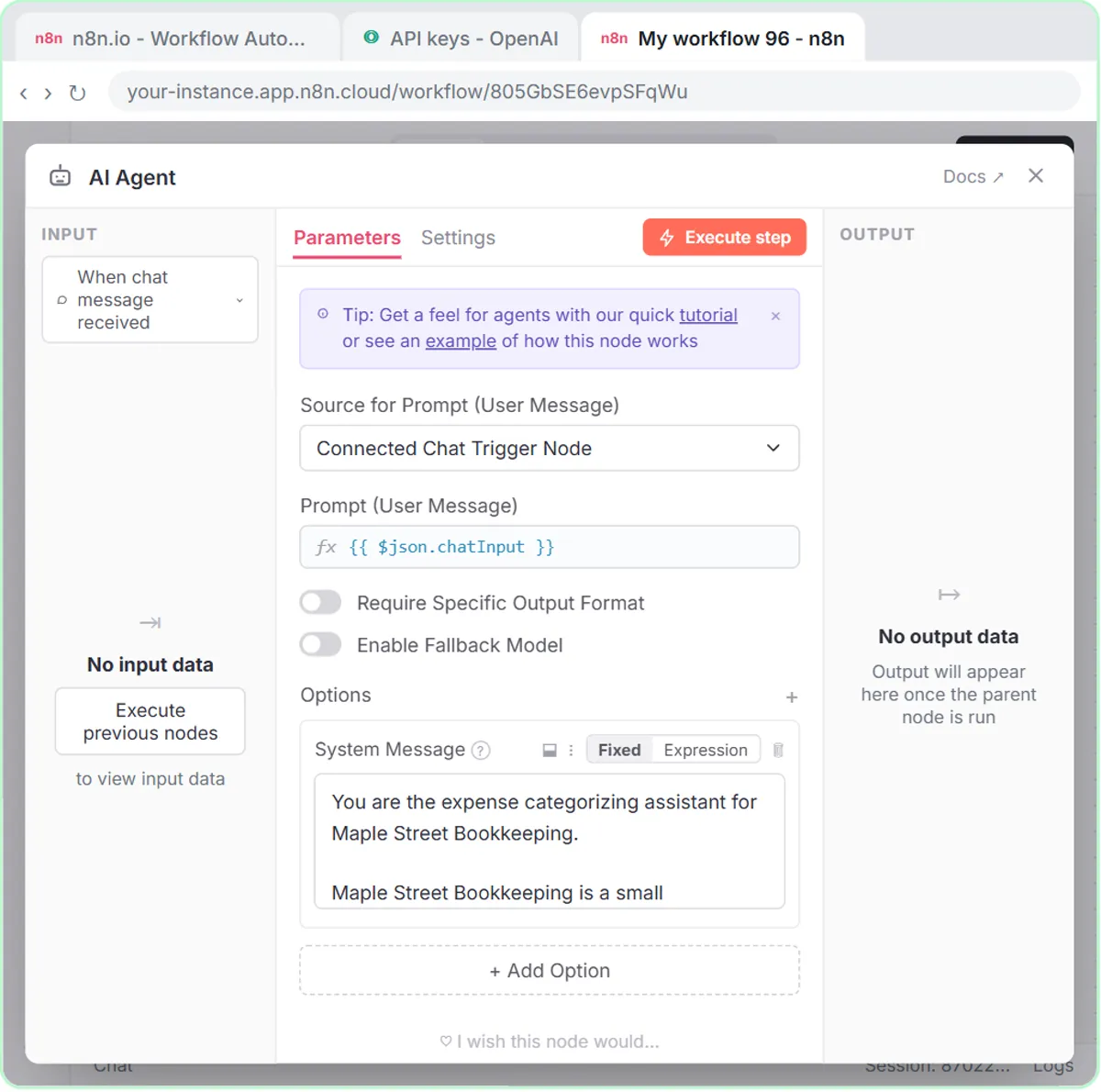
The AI Expense Categorizer Agent lesson runs entirely on synthetic data. Maple Street Bookkeeping is a made-up firm, and the test message is three made-up expenses: "Sep 22, Corner Office Supply, $64.18, printer paper and toner. Sep 23, CloudLedger, $45.00, monthly accounting software. Sep 24, Harbor Street Cafe, $38.50, lunch with a client."
Those three lines are chosen to hit different categories in the system prompt: Office Supplies, Software and Subscriptions, and Meals. The agent saves each one to an Expense Log sheet with Date, Vendor, Amount, Category and Note, and no real client's books are touched.
To test it properly you would add synthetic edge cases: a charge with no description, a hotel bill that includes dinner, which could be Travel or Meals, a refund. The prompt says unclear items go to Needs Review, and made-up tricky rows are how you find out whether that rule really works.
Try this lesson free or read the step-by-step guide.
Common confusions
Synthetic data vs anonymized data
Anonymized data starts as real records with names and IDs removed or masked, as in redaction. Synthetic data never came from a real person in the first place, though it may be modeled on real patterns.
Synthetic data vs test data
Test data is any data used to try a workflow. It can be synthetic, a copy of real records, or a mix. Synthetic is the safest kind to share.
Tips
- Ask an AI chat to draft twenty realistic but fake records for testing, then add three nasty edge cases by hand.
- Label synthetic files clearly so nobody mistakes them for real clients later.
- Do not invent synthetic data from real records by only changing names. Details can still identify a person.
Related terms
More AI basics terms
Where you use it: free lessons
- Build an AI Agent That Categorizes Business Expenses (n8n, 12 min)
- AI Receipt Extractor: Receipts to Google Sheets with n8n (n8n, 12 min)
Frequently asked questions
- Can ChatGPT create synthetic data for me?
- Yes. Describe the columns, the number of rows and the edge cases you want, and ask for a table or CSV. Check that it did not accidentally reuse real names or details you pasted earlier in the chat.
- Is synthetic data private by default?
- Usually much safer, but not automatically. If it was generated from real records, it can sometimes echo them closely. Data made from scratch, like the lesson's expenses, carries no such risk.