What is an AI training opt-out?
Quick answer
An AI training opt-out is a setting or agreement that tells an AI provider not to use your conversations, files or other content to train or improve its models. Business plans often have it on by default; personal accounts may need to change a setting.
Last updated
Updated · By Robert Breen
Why it matters for a small business
When content is used for training, small pieces of it can, in rare cases, influence what the model says to other people later. For most casual use that risk is low, but for a firm handling client files it is a risk with no upside. Turning training off is the first setting most companies check, and it is often a condition in an AI acceptable use policy.
It is easy to overestimate what it does. Opting out of training doesn't delete your chats, doesn't stop the provider from storing them for a period and doesn't control what employees paste in. It sits alongside ChatGPT data controls, retention rules and redaction habits as one layer of protection.
In a real lesson: Reply Faster to a Client Asking for a Case Update: ChatGPT for Small Law Firms
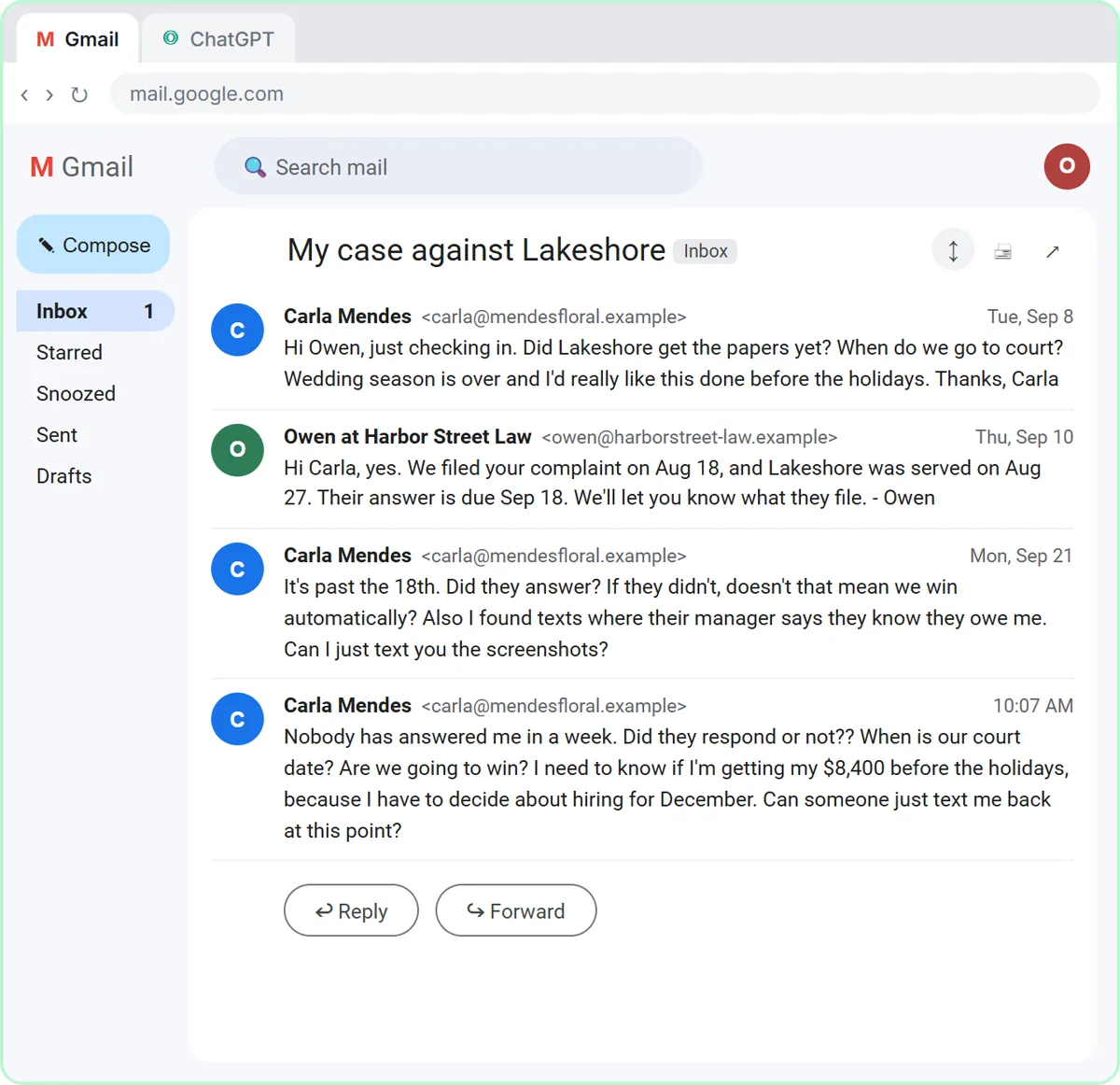
Stepthrough's lessons use made-up clients, so none of them walk through the setting itself. The law firm case update lesson shows the kind of text a firm would want kept out of training. You're at Harbor Street Law, a made-up small firm, replying to Carla Mendes, who is suing an event venue over an unpaid $8,400.
The facts you paste include firm policies, such as no predictions or legal advice by email and no case details by text or social media, only through the secure client portal under Documents. Even practice text like this looks a lot like real client communication.
Before a firm drafts real client emails in ChatGPT or any assistant, someone should confirm which account staff use and that training is off for it. This isn't legal advice; your professional rules and firm policy come first.
Try this lesson free or read the step-by-step guide.
Common confusions
Training opt-out vs zero data retention
A training opt-out controls how your data is used. Zero data retention controls whether it is stored at all. They answer different questions.
Training opt-out vs memory
Turning off training doesn't turn off ChatGPT memory, which saves details to personalize your own chats. They are separate settings.
Tips
- Check the training setting on every account staff use for work, including personal ones.
- Prefer business plans where training is off by default and covered in the agreement.
- Keep redacting sensitive details even with training off.
Related terms
More AI assistants terms
Where you use it: free lessons
- Reply Faster to a Client Asking for a Case Update: ChatGPT for Small Law Firms (ChatGPT, 10 min)
- Turn a Client Meeting into Action Items and a Follow-Up Email (Accounting Firms) (ChatGPT, 9 min)
More free tutorials
Frequently asked questions
- Where is the training opt-out in ChatGPT?
- In personal accounts it is in the data controls part of settings. Menu names change, so look for the option about improving the model. Business plans usually handle it at the workspace level.
- Does opting out delete my past chats?
- No. It affects how content is used, not whether existing chats are kept. Deleting chats is a separate action with its own rules.