AI Prompts for Product Managers: 11 Copy-Ready Templates
Updated · By Robert Breen
Product managers translate between customers, engineers and leadership, and every translation is a document: the interview summary, the problem statement, the spec, the release note. The decisions are the job; the drafting is overhead. An AI assistant can take a first pass at the overhead so you spend more time with customers and the team.
These prompts keep evidence attached. Synthesis prompts quote what customers actually said, specs mark open questions instead of filling them in, and prioritization prompts show the scoring so the team can argue with it. The AI organizes; you decide.
To practice research synthesis with made-up interviews, try Speak AI: Turn Customer Interviews into Themes and Quotes or Claude Research for a cited scan.
How do you use these prompts?
Copy a prompt into ChatGPT, Claude, Gemini or Copilot and replace every [BLANK] with your own details. Where a prompt says PASTE, paste your notes, email or document there. Each prompt follows the four parts from Prompt Writing 101: a Role, the Context, the Task and the Format you want back. Then check every name, date, number and promise in the answer before you use it.
Discovery
1. Synthesize customer interviews into themes
You are a product manager at [COMPANY] researching [PROBLEM AREA]. Here are notes or transcripts from [NUMBER] customer interviews:

[PASTE INTERVIEWS]

Group what customers said into themes. For each theme, count how many interviews mentioned it, quote two short lines word for word, and note any customer who said the opposite. Do not suggest solutions yet.

Format: a table with Theme, Interviews mentioning it, Quotes, Counterpoints.
2. Write a problem statement
Act as a product manager. From this research summary:

[PASTE SUMMARY]

Write a problem statement in the form: [USER TYPE] needs a way to [NEED] because [INSIGHT], and today they [CURRENT WORKAROUND]. Then list what evidence supports it, what evidence would disprove it, and the one metric that would show we solved it.

Format: the statement in bold, then three short bulleted sections.
3. Prepare a customer interview guide
You are a product manager planning interviews with [CUSTOMER TYPE] about [TOPIC]. We want to learn [LEARNING GOALS].

Write a 30-minute interview guide: a warm-up, questions about their past behavior (not hypotheticals), probes for specifics, and a wrap-up. Avoid leading questions and do not describe our planned feature.

Format: sections with timings and numbered questions.
Specs and stories
4. Draft a one-page PRD
You are a product manager writing a one-page product requirements doc for [FEATURE] at [COMPANY]. Inputs: problem [PROBLEM], users [USERS], goals [GOALS], constraints [CONSTRAINTS], what is out of scope [OUT OF SCOPE].

Write the PRD with: problem, goals and success metrics, user stories, requirements (must, should, could), out of scope, and open questions. Put anything I have not decided under Open questions rather than deciding it.

Format: headed sections, under 600 words.
5. Write user stories with acceptance criteria
Act as a product manager. Feature: [FEATURE DESCRIPTION]. Users: [USER TYPES].

Write user stories in the form "As a [user], I want [action], so that [benefit]", each with three to five acceptance criteria in Given, When, Then form. Include at least one story for an error or edge case.

Format: numbered stories, criteria indented under each.
6. Find gaps in a spec
You are a senior engineer and a QA lead reviewing this spec for [FEATURE]:

[PASTE SPEC]

List the questions the team will ask before building: unclear behavior, missing edge cases, permissions, empty states, errors, performance and data concerns. For each, quote the line it relates to.

Format: a table with Area, Question, Related line, Priority (Blocker, Important, Nice to know).
Prioritization and roadmap
7. Score a backlog with RICE
Act as a product manager prioritizing [NUMBER] ideas. For each idea I give reach, impact, confidence and effort:

[PASTE IDEAS WITH VALUES]

Calculate a RICE score (Reach x Impact x Confidence / Effort) for each, show the math, and rank them. Then point out any idea where the score looks driven by a single guessed value, so we can discuss it.

Format: a ranked table with all inputs and the score, then the flagged ideas.
8. Explain a roadmap decision to stakeholders
You are a product manager. We decided to [DECISION] and not [ALTERNATIVE] this quarter because [REASONS AND EVIDENCE]. Stakeholders who wanted the alternative: [WHO AND WHY].

Write a short message that states the decision, the reasoning, what it means for the stakeholders who wanted the alternative and when we will revisit it: [REVIEW DATE].

Format: under 200 words, respectful and direct.
Launch
9. Write release notes for customers
You are writing release notes for [PRODUCT] version [VERSION]. Here are the changes from the engineering changelog:

[PASTE CHANGELOG]

Rewrite them for customers: lead with what they can now do, group into New, Improved and Fixed, and skip internal-only changes. Do not promise anything that is not in the changelog.

Format: a short headline, then three headed lists, each item one sentence.
10. Draft an internal launch brief
Act as a product manager preparing [FEATURE] for launch on [DATE]. Facts: who it is for [AUDIENCE], what it does [WHAT], limits [LIMITS], pricing or plan [PLAN], support contact [CONTACT].

Write a one-page brief for sales and support: what it is in one sentence, who should use it, how to explain it to a customer, known limits, and five likely customer questions with answers based on these facts.

Format: headed sections with a Q and A list at the end.
11. Summarize post-launch feedback
You are a product manager reviewing feedback on [FEATURE] two weeks after launch. Here are support tickets, survey comments and sales notes:

[PASTE FEEDBACK]

Sort the feedback into Bugs, Confusion, Missing capabilities and Praise, with a count and two quotes for each. Then list the three changes that would address the most feedback.

Format: a summary table, then the three changes.
How do you adapt these prompts to your own work?
- Remove customer names and company details from interview notes before pasting, unless your tool and agreements allow it.
- Paste your team's PRD template or a past PRD and ask the assistant to fill it, so the output matches what engineering expects.
- Chain the prompts: synthesis, then problem statement, then PRD, checking each step before the next. Prompt chaining shows the pattern.
Where can you practice these skills for free?
These free Stepthrough lessons practice the same jobs step by step, with a made-up business and practice copies of the real tools, so nothing touches your real accounts.
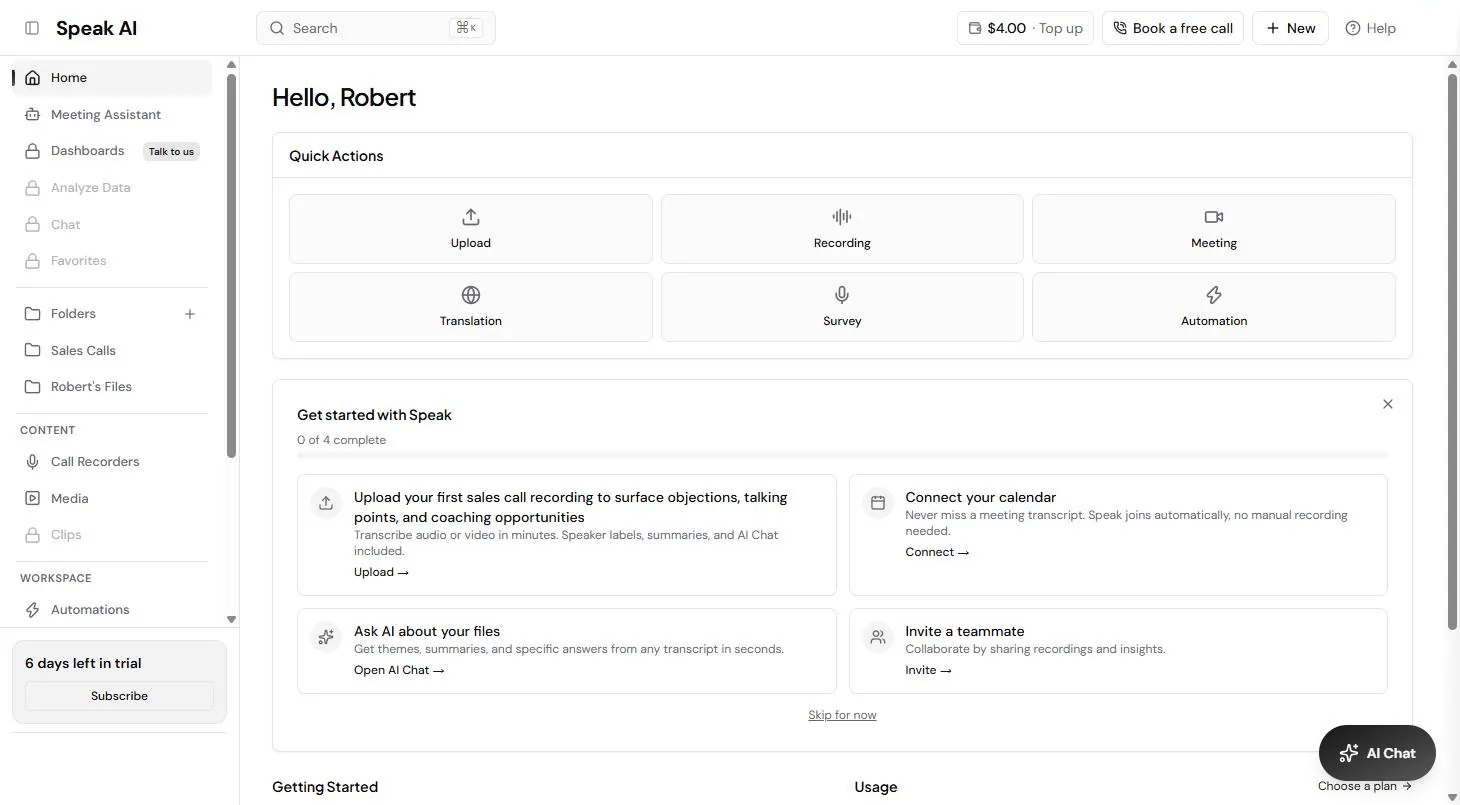 Speak AI: Turn Customer Interviews into Themes and Quotes
A business case for any small team that runs customer interviews or sales calls: upload the recording to Speak AI, read the transcript, keywords and tone, ask AI Chat…
Free · Live ~10 min Beginner
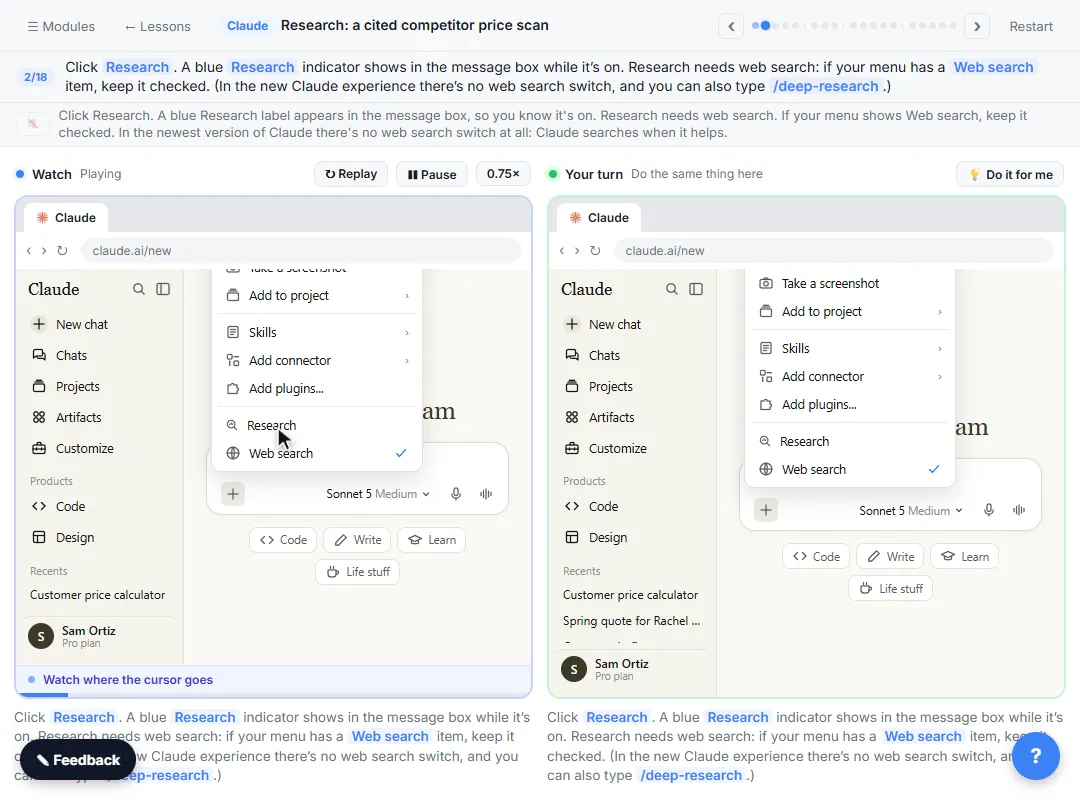 Claude Research: Get a Cited Competitor Price Scan, Then Check It
Turn on Research, have Claude check what nearby competitors charge, read the cited report, check a source and ask a follow-up.
Free · Live ~7 min Beginner
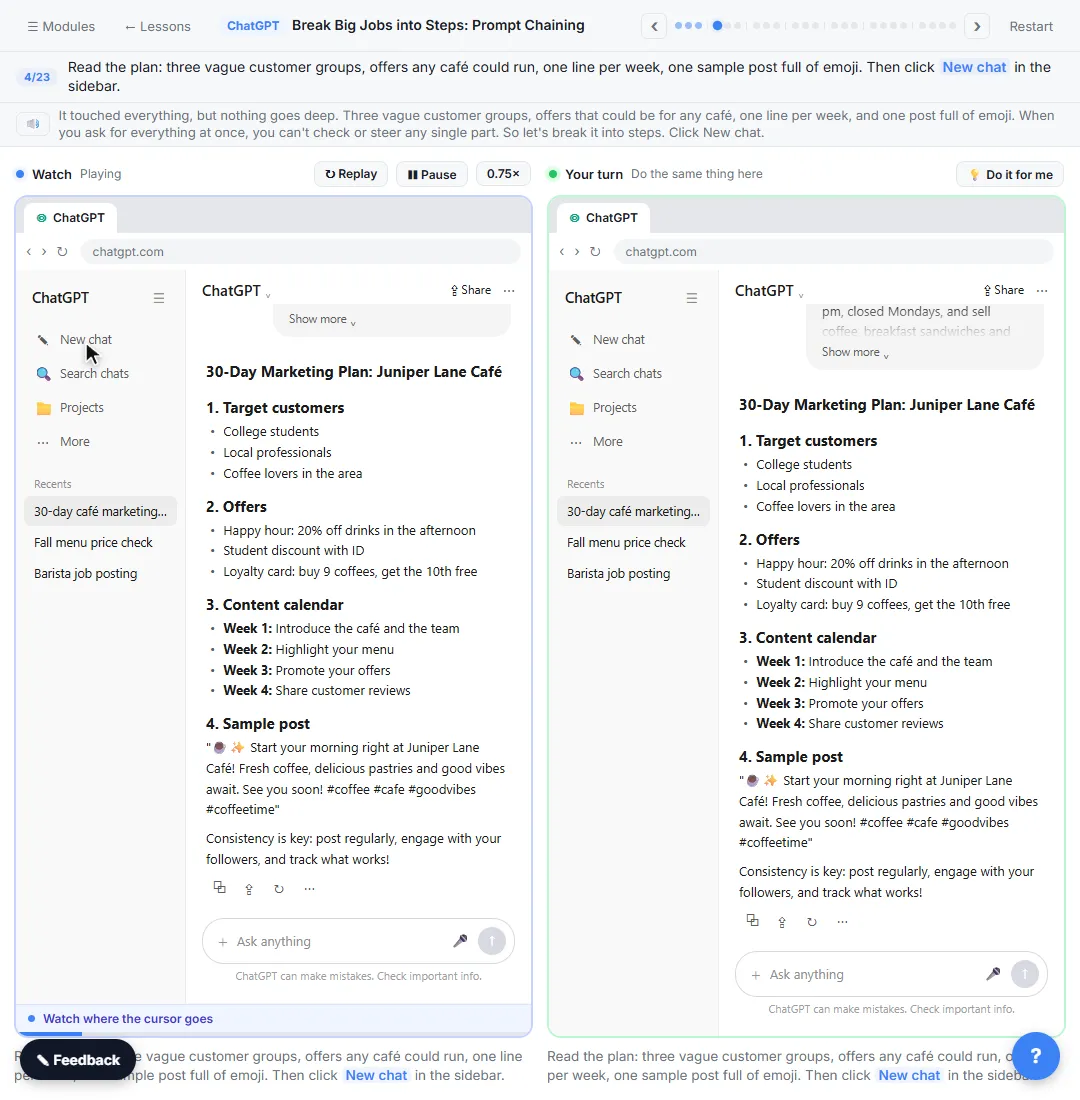 Break Big Jobs into Steps: Prompt Chaining for a Marketing Plan
Ask ChatGPT for a whole marketing plan in one prompt, then build a better one in four small steps: customers, offers, a calendar table and the posts.
Free · Live ~7 min Beginner
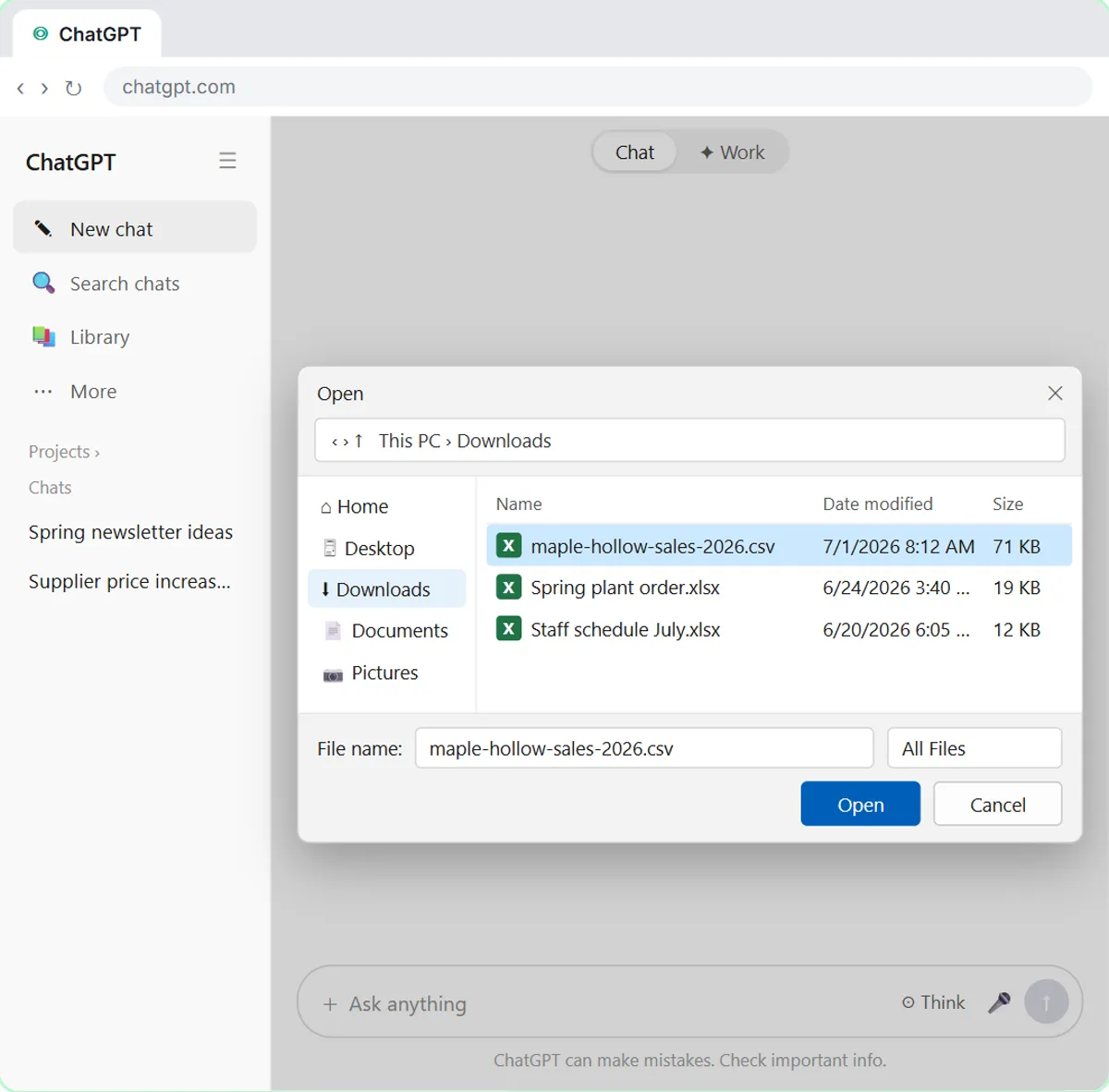 Analyze a Spreadsheet with ChatGPT: Upload a CSV, Get a Chart and Three Takeaways
Upload a CSV of sales to ChatGPT, have it check the data first, ask your questions, get a chart you can download, and finish with the three takeaways that matter.
Free · Live ~10 min Beginner
 Claude Artifacts: Build a Price Calculator You Can Try, Change and Share
Have Claude build an interactive lawn price calculator, try it in the artifact panel, ask for a change, and share it with a link.
Free · Live ~7 min Beginner
Which free courses fit this job?
- Better Prompts: Turn vague AI answers into work you can send, with prompt habits that work in any assistant.
- Master ChatGPT for Work: Go from safe first chats to ChatGPT that knows your job, reads your files and runs multi-step work: data controls, memory, prompts, meeting minutes…
- Claude Jump Start: Get Claude to remember your business, research with sources, check contracts and build shareable tools.
Practice it free, step by step
Speak AI: Turn Customer Interviews into Themes and Quotes. A business case for any small team that runs customer interviews or sales calls: upload the recording to Speak AI, read the transcript, keywords and tone, ask AI Chat for a summary with quotes and… You do every step yourself in a practice copy of Speak AI, it checks your work as you go, and “Do it for me” finishes any step you get stuck on. Free, and nothing touches your real accounts.
Start the free lessonMore templates for this job
Single prompts from the prompt library, each with a filled-in example and a checklist for the answer.
- Customer call notes summary prompt: A copy-ready prompt that turns raw customer call notes into a clean summary: needs, decisions, owners and next steps. Includes a…
- Churn reason analysis prompt: Group a pile of cancellation notes into themes, count only what is actually there, quote real customer words and list the notes…
- Software tool evaluation scorecard prompt: A sample software evaluation scorecard: compare two or three tools against your must-haves, with each vendor claim marked…
- Decision log prompt: Pull every settled decision out of meeting notes and messages into a dated log: who decided, why, and when to revisit, plus what…
Prompts for other roles
Frequently asked questions
- Can AI write a PRD?
- It can draft one from your problem, goals and constraints. The decisions in it (scope, trade-offs, success metrics) need to be yours, and engineering should review it before work starts.
- Is AI synthesis of interviews reliable?
- It is a fast first pass. Ask for exact quotes and counts so you can check every theme against the transcripts, and read at least a few interviews yourself.