This guide is for bookkeepers, staff accountants and owners who keep their own books. It covers what goes on a trial balance, the checks to run in order, and the errors a balanced trial balance still hides.
What goes on a trial balance?
Every account in the general ledger with a balance on the report date: assets, liabilities, equity, income and expenses. Each account appears once, with its balance in the debit column or the credit column. Assets and expenses normally carry debit balances. Liabilities, equity and income normally carry credit balances. Total debits should equal total credits.
The trial balance glossary entry has a full example for a small studio, and the chart of accounts is the list it follows.
Why doesn't my trial balance balance?
Because something was recorded on only one side, on the wrong side, or with the wrong number. Accounting software usually won't post an entry whose debits and credits differ, so out-of-balance trial balances mostly show up in spreadsheets, manual books, imported balances or a file that was edited by hand. The usual causes:
| Cause | What it looks like |
|---|---|
| One-sided entry | The difference equals the amount of one entry |
| Balance on the wrong side | The difference is twice the amount, so half of it is a balance you can find |
| Transposed digits (54 typed as 45) | The difference divides evenly by 9 |
| Slide error (450 typed as 45) | The difference also divides by 9 |
| Missing account | One account's balance never made it onto the report |
| Addition error | The columns were added wrong, often after a manual edit |
How do I find the error, step by step?
Work from the cheapest check to the slowest. Stop when the totals agree.
- Re-add both columns. Use a calculator or a fresh sum formula, not the total that is already there.
- Write down the difference. Every later check uses it.
- Search for the exact amount. A one-sided entry often equals the difference. Look in the journal for that number.
- Halve it and search again. If an account sits in the wrong column, the difference is twice its balance.
- Divide it by 9. If it divides evenly, look for transposed digits or a misplaced decimal.
- Compare with last period. List each account next to last month's balance. A new account, a missing one or a balance that flipped sides stands out fast.
If none of these works, check the journal entries posted since the last trial balance that did balance, one by one. The error is somewhere in that list.
Can ChatGPT help find a trial balance error?
Yes, as a fast second pair of eyes on an export, not as the bookkeeper. Upload the trial balance and last month's version, and ask it to list every account whose balance changed sides, appeared, disappeared or changed by more than a set amount, and to check whether the difference divides by 9.
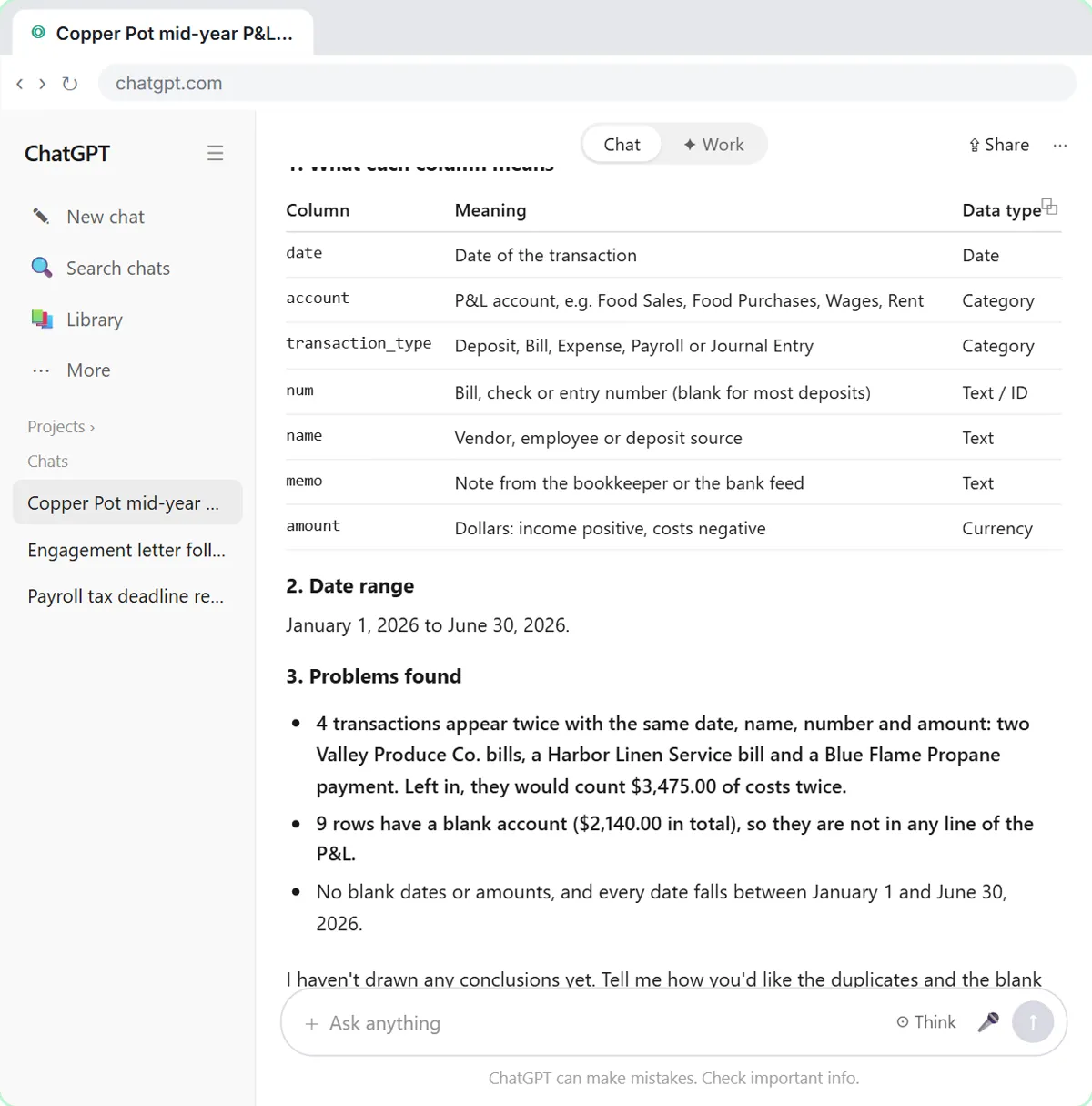
The habit that makes this safe is the one the P&L analysis lesson teaches: make ChatGPT check the file before it adds anything up, decide yourself what to do about odd rows, and add the key totals yourself. AI can add wrong, so its arithmetic is a lead to check, not an answer.
Try it free, step by step
Analyze a Client's P&L Export with ChatGPT (Accounting & Bookkeeping Firms). Upload a client's Profit and Loss Detail export to ChatGPT, catch duplicate bank-feed entries and uncategorized rows first, then get a monthly P&L summary, a chart and three takeaways for the client… You do every step yourself in a practice copy of ChatGPT, it checks your work as you go, and “Do it for me” finishes any step you get stuck on. Free, and nothing touches your real accounts.
Start the free lessonDoes a balanced trial balance mean the books are right?
No. It proves debits equal credits, nothing more. These errors leave it in balance:
- An entry left out completely.
- An entry posted to the wrong account on the correct side, such as office supplies booked to rent.
- Two errors of the same size that cancel out.
- A wrong amount entered on both sides of the same entry.
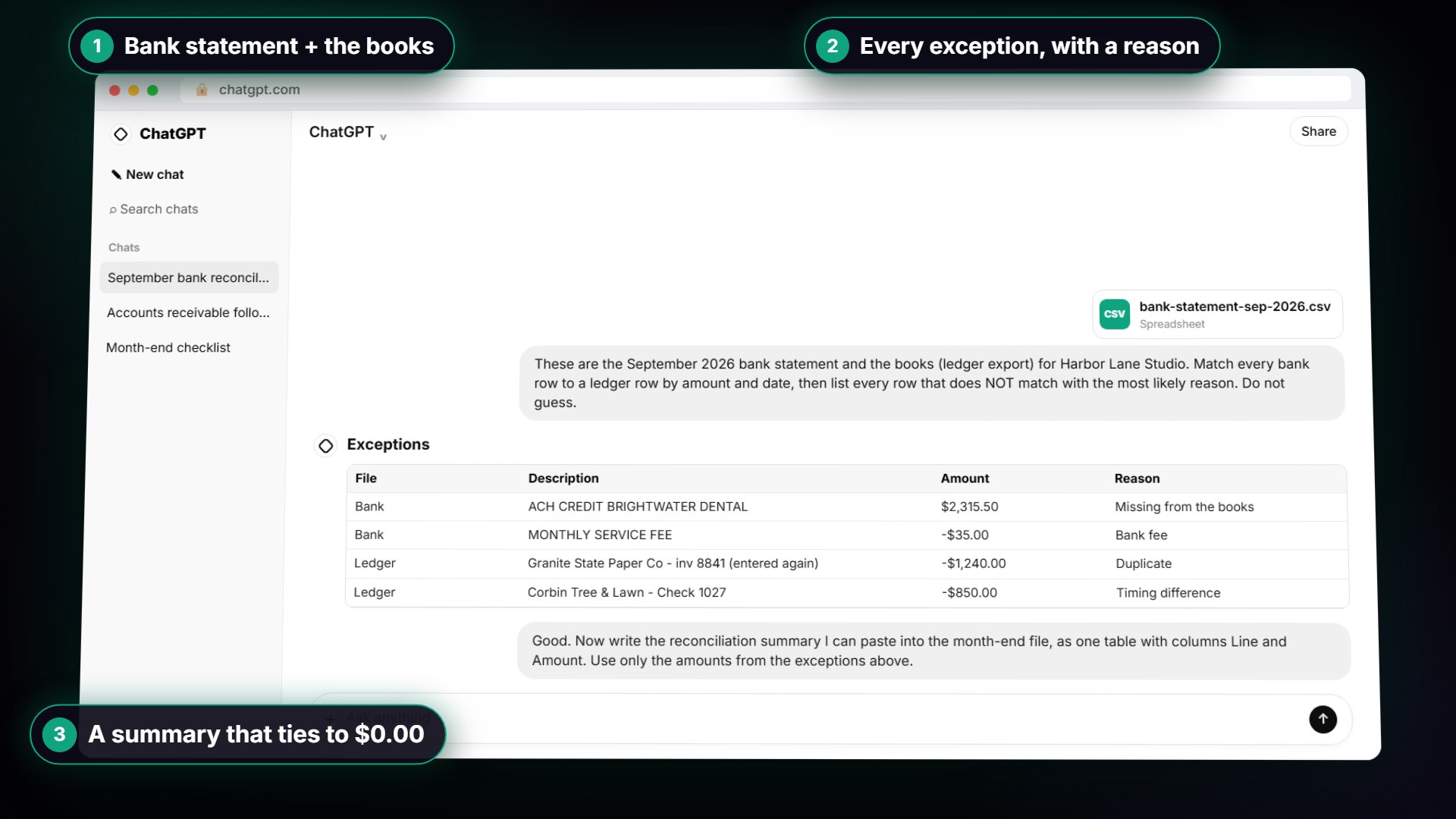
That is why month-end also includes a bank reconciliation, which checks the books against an outside record. The free bank reconciliation lesson has ChatGPT match every bank row against the ledger and list the exceptions.
Key takeaways
- A trial balance lists every general ledger account with its debit or credit balance, and the totals should agree.
- Find the difference first, then search for that amount, half of it, and check whether it divides by 9.
- Compare each account with last period to spot missing, new or flipped balances.
- ChatGPT can flag changes in an export, but add the totals yourself.
- A balanced trial balance can still hide omissions, wrong accounts and offsetting errors.
Frequently asked questions
- Why does dividing the difference by 9 help?
Swapping two digits or moving a decimal point always creates a difference that is a multiple of 9. If yours divides evenly by 9, a typing error of that kind is the likely cause.
- What is the difference between an unadjusted and an adjusted trial balance?
The unadjusted one comes straight from the ledger. The adjusted one is run after month-end entries such as accruals, prepaids and depreciation, and it feeds the financial statements.
- How often should I run a trial balance?
At least at every month-end close, and before preparing financial statements. Running it after a large batch of manual entries catches errors while they are easy to trace.
- Can I make the trial balance agree with a suspense account?
Some bookkeepers park an unexplained difference in a temporary suspense account so work can continue, but it has to be cleared before the period is closed. It is a placeholder, not a fix.
Where can I go next?
For the rest of the month-end routine, see the closing the books and reconciling item entries.