What is a journal entry in accounting?
Quick answer
A journal entry is the basic accounting record of a single transaction: a date, the accounts affected, a debit and credit for each, and a short description. Total debits always equal total credits, which is how the books stay in balance.
Last updated
Updated · By Robert Breen
Why it matters for a small business
Most journal entries are created for you. When you pay a bill in accounting software, the program writes the entry behind the scenes. Bookkeepers write them by hand for things the software can't see: correcting a mistake, recording depreciation, moving a charge between accounts or booking a loan.
Reading an entry is a useful skill even if you never write one. Each line says which account changed and by how much, so you can follow what happened to the business. A clear description on every entry turns an audit or a question from your accountant into a five-minute conversation instead of a week of digging.
In a real lesson: Turn a Client Meeting into Action Items and a Follow-Up Email (Accounting Firms)
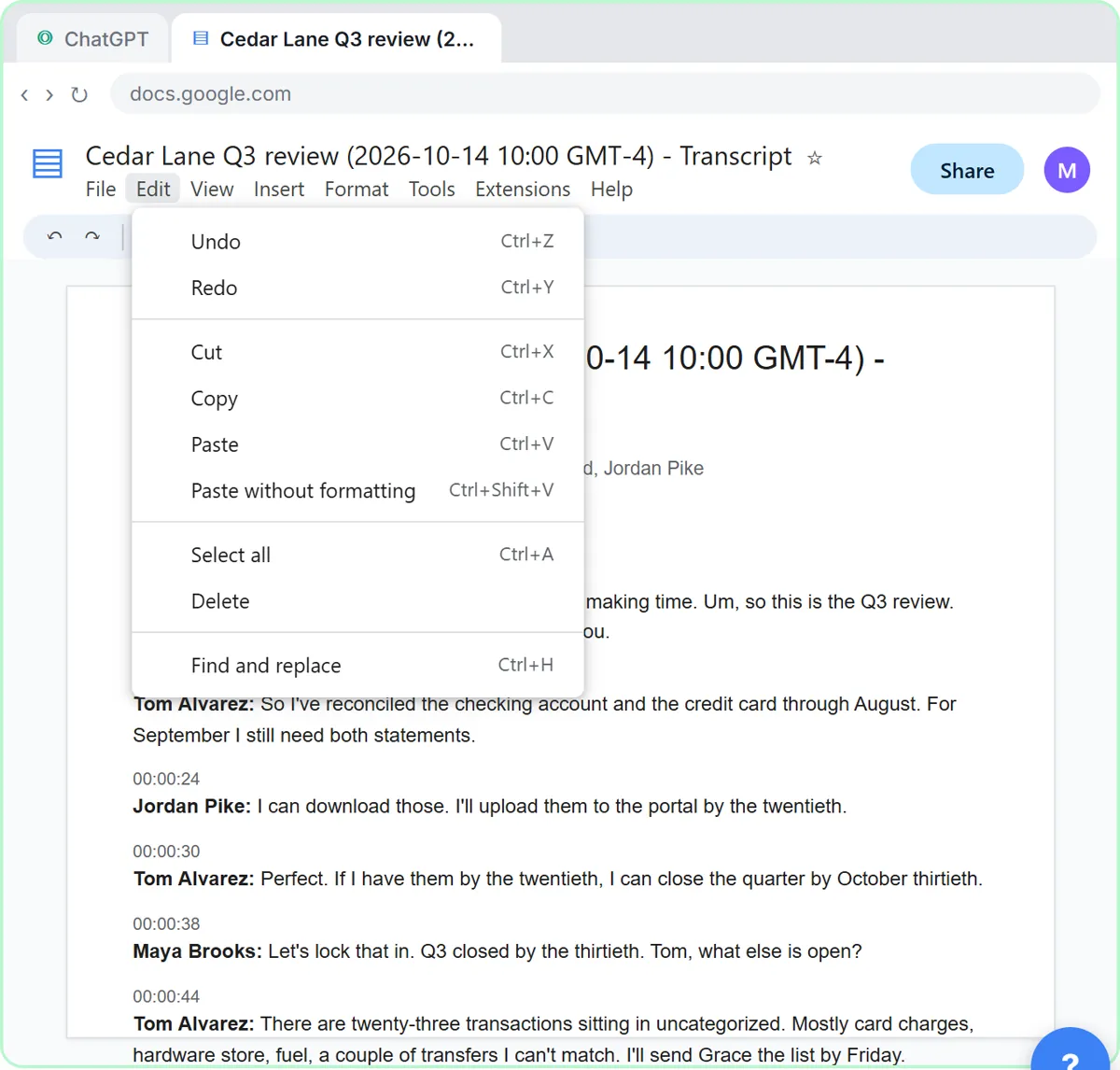
The Summarize a Client Meeting lesson includes a moment where a journal entry will eventually be needed. In the transcript, the bookkeeper tells the client, Cedar Lane Landscaping, a made-up customer of Millbrook Accounting, that its thirty-eight thousand dollar truck will be set up as equipment with a loan against it, not as an expense.
She also asks the client's contact to send the purchase agreement and loan paperwork. Those documents are what a bookkeeper would use to write the entry, since they show the date, price and loan terms. How to depreciate the truck is deferred to the year-end planning meeting.
The lesson itself never shows a journal entry. Its job is to turn the transcript into a summary, a table of action items and a follow-up email. The truck is simply the moment in the conversation where a manual entry becomes necessary, and the paperwork request is the supporting-documents habit that goes with it.
Try this lesson free or read the step-by-step guide.
Common confusions
Journal entry vs general ledger
The entry is one transaction. The general ledger collects the effects of every entry by account. Entries go in, ledger balances come out.
Debit vs "money out"
A debit is not automatically a decrease. Depending on the account, a debit can raise or lower the balance. Learn the rule for each account type instead of guessing from the bank's use of the word.
Tips
- Attach the source document to every manual entry, or note where it lives.
- Write the description for someone who has never seen the transaction. Future you counts.
- Let AI draft an explanation of an entry if you like, but have an accountant confirm the accounts and amounts.
Related terms
More Business terms
Where you use it: free lessons
- Turn a Client Meeting into Action Items and a Follow-Up Email (Accounting Firms) (ChatGPT, 9 min)
- Build an AI Agent That Categorizes Business Expenses (n8n, 12 min)
Frequently asked questions
- Why do debits have to equal credits?
- Every transaction has two sides, such as an asset and the loan used to buy it. Matching totals is the built-in check that nothing was recorded one-sided.
- Can I fix a mistake by deleting an entry?
- Usually it is better to post a correcting entry so the history stays visible. Your accountant can tell you how your software and your period locks work.