What is a retainer in a professional services firm?
Quick answer
A retainer is an advance payment, or a recurring monthly fee, that a client gives a professional firm to secure their services. In law it is often a deposit the firm draws against as it works. In consulting and accounting it is usually a fixed monthly fee for an agreed scope.
Last updated
Updated · By Robert Breen
Why it matters for a small business
For the client, a retainer means priority access and a predictable cost. For the firm, it means steadier income and less chasing of invoices. Neither is automatic: what the retainer covers, how it is replenished and what happens to unused money all depend on the written agreement.
The word means different things in different fields, which causes confusion. A law firm's retainer may be held in a special client account and rules about handling it can be strict. A consultant's monthly retainer is simply revenue for the month. This entry is general information, not legal advice, so ask your attorney or accountant how it applies to you.
In a real lesson: Turn a Client Meeting into Action Items and a Follow-Up Email (Accounting Firms)
The Summarize a Client Meeting lesson ends on a retainer-style decision. In the transcript, the client, Cedar Lane Landscaping, a made-up customer of Millbrook Accounting, says quarterly bookkeeping is getting hard with how much the business is growing, and asks whether monthly bookkeeping would make more sense.
The bookkeeper, Maya, says it might, and promises to send a quote for monthly service that the client can decide on. The follow-up email in the lesson captures that action item along with the others: Maya will send the quote by October 21.
Nothing in the transcript says the monthly arrangement would be a retainer, and no price is mentioned. It is simply a good picture of how the conversation starts: a client outgrows a periodic service and asks for something more regular. The lesson's job is making sure that promised quote does not get lost in the meeting.
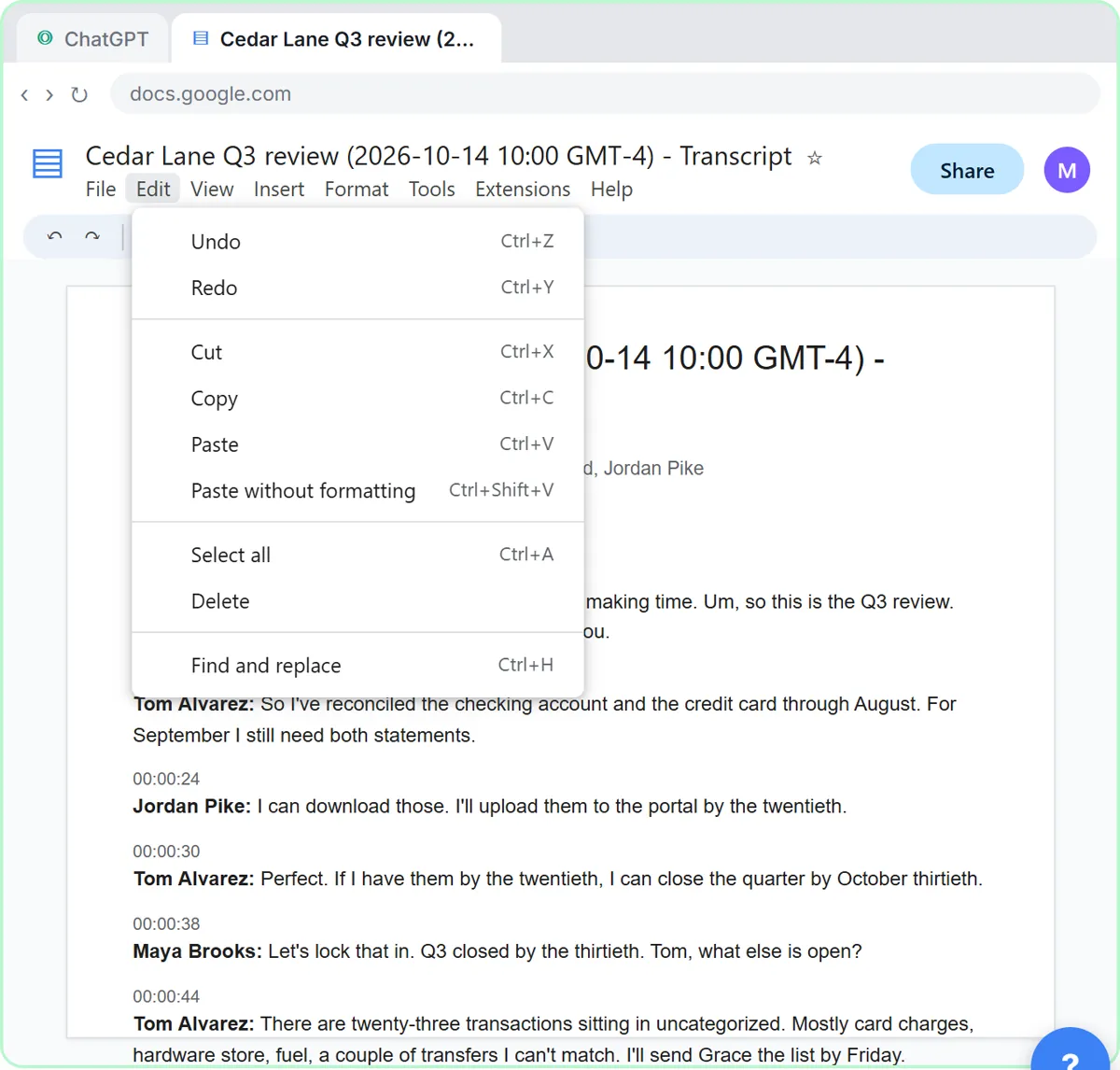
Try this lesson free or read the step-by-step guide.
Common confusions
Retainer vs deposit
A deposit holds a spot or covers a specific cost. A retainer, in the legal sense, is a balance the firm draws on as it works. The agreement should say which one you have.
Retainer vs engagement letter
The engagement letter is the agreement describing the work. The retainer is the payment arrangement the letter may include.
Tips
- Get the retainer terms in writing, including what happens to unused funds.
- Ask for regular statements showing how the money was used.
- For recurring monthly retainers, define the scope and a limit so the arrangement does not drift.
Related terms
More Business terms
Where you use it: free lessons
- Turn a Client Meeting into Action Items and a Follow-Up Email (Accounting Firms) (ChatGPT, 9 min)
- Reply Faster to a Client Asking for a Case Update: ChatGPT for Small Law Firms (ChatGPT, 10 min)
- n8n: Talk to Your Google Sheets with ChatGPT (AI Agent) (n8n, 8 min)
- Turn a Client Kickoff Call into a Proposal Outline with ChatGPT (Agencies & Consultants) (ChatGPT, 10 min)
Frequently asked questions
- Is a retainer refundable?
- It depends on the agreement and local rules. A true advance for legal work is typically refundable to the extent it was not earned, but your attorney can confirm what applies to you.
- Is a monthly retainer cheaper?
- Not necessarily. It buys predictability. Compare what you would pay hourly for the same amount of work.