What is an opportunity in sales?
Quick answer
A sales opportunity is a specific potential deal with a qualified buyer: someone who has a need you can meet, is actively talking to you and could buy within a reasonable time. In a CRM it is usually a record with a company, an expected value, a deal stage and an expected close date.
Last updated
Updated · By Robert Breen
Why it matters for a small business
Opportunities are what a sales forecast is built from. A list of a hundred leads says little about next month's revenue. Ten opportunities, each with a value, a stage and a close date, say a lot. Converting a lead to an opportunity is the moment a salesperson commits time to it, so the line between the two should be written down.
Each open opportunity needs a next step and someone who owns it. The common failure is not losing deals but letting them go quiet: no follow-up after a demo, a trial that ends with no call. Tracking opportunities by deal stage in a sales pipeline shows which ones need a message today, and that is where AI saves the most time.
In a real lesson: Build an n8n AI Agent That Writes Deal Follow-Ups
In AI Deal Follow-Up Agent, you build an n8n agent for Northwind Scheduling Software, a made-up company. You give it three open deals, and each one is an opportunity: a named person at a named company with a live conversation. Maria Lopez at Maple Row Cleaning "had a demo today." Sam Patel at Fernhill Lawn Care has a "trial ends Friday." Jen Walsh at Birch Lane Grooming has been "quiet since pricing."
For each one, the agent returns a Prospect, Company, Stage, Follow-up Message and Next Step, and saves them to the Deal Follow-Ups sheet. The Next Step column is the habit that keeps an opportunity alive: every open deal has one clear ask.
The system prompt also says "Do not invent prices, discounts or results." Opportunities have real values attached, so AI should never promise terms nobody agreed to.
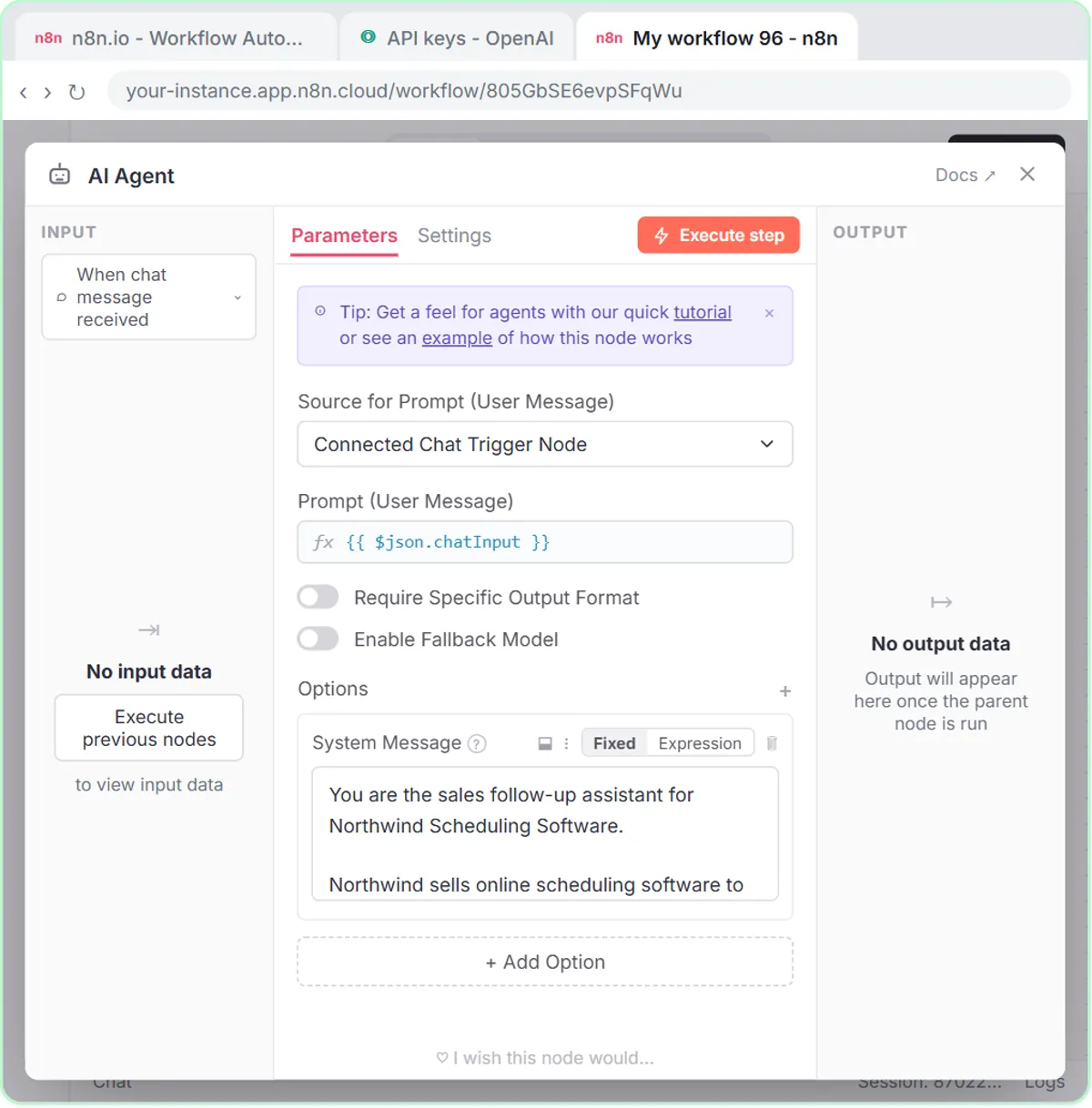
Try this lesson free or read the step-by-step guide.
Common confusions
Opportunity vs lead
A sales lead is a possible buyer you can contact. An opportunity is a qualified, active potential deal with a stage, value and close date.
Opportunity vs deal
Many CRMs use the words interchangeably. Where they differ, "deal" often means the same record, and "closed deal" means one that was won.
Tips
- Write down the rule that turns a lead into an opportunity.
- Give every open opportunity a next step and a date.
- Close out stalled opportunities as lost, so the pipeline stays honest.
- Track your win rate on opportunities, not on all leads.
Related terms
More Business terms
Where you use it: free lessons
- Build an n8n AI Agent That Writes Deal Follow-Ups (n8n, 12 min)
More free tutorials
Frequently asked questions
- When does a lead become an opportunity?
- When it passes your qualification rule, for example a confirmed need, a decision maker involved and a realistic timeline, and a salesperson agrees to work it. Each team sets its own criteria.
- How do you calculate an opportunity's weighted value?
- Multiply its expected value by the chance of winning at its current stage. A made-up $10,000 opportunity at a stage you win 25 percent of the time counts as $2,500 in a weighted forecast.
- Can AI manage sales opportunities?
- AI can draft follow-ups, summarize calls and suggest next steps. A salesperson should confirm stage changes and values, because forecasts and commission depend on them.