What is a win rate in sales?
Quick answer
Win rate is the percentage of sales opportunities a team closes as won out of all opportunities that reached a decision, won or lost. A common formula is deals won divided by deals won plus deals lost, times 100. It shows how well a team turns real prospects into paying customers.
Last updated
Updated · By Robert Breen
Why it matters for a small business
Win rate shows whether your sales process works once a real buyer is talking to you. Lead volume says how many people showed up. Win rate says how many of the serious ones said yes. If you win 2 of every 10 decided opportunities, you know you need about 50 qualified opportunities to land 10 new customers, which is the starting point for an honest sales forecast.
The number is only as good as the records behind it. Teams often log every win but forget to mark deals lost, or leave dead deals open for months, which makes the rate look better or worse than it really is. Clear deal stages in your CRM and a habit of closing out quiet deals keep it honest. AI helps with the work that actually moves the number: steady, timely follow-up on every open deal, so fewer slip away from simple neglect.
In a real lesson: Build an n8n AI Agent That Writes Deal Follow-Ups
Stepthrough has no lesson that calculates win rate, because that math belongs in your CRM. The AI Deal Follow-Up Agent lesson works on what comes before it: keeping every open deal alive until it is decided. You build an n8n agent for Northwind Scheduling Software, a made-up company, and give it three deals, including Jen Walsh at Birch Lane Grooming, who has been "quiet since pricing."
A deal like that is where win rates leak. Nobody says no, the rep gets busy and the deal quietly dies. The agent's system prompt asks for each message to stay "under 80 words and end with one clear ask," and adds a firm rule: "Do not invent prices, discounts or results." So the nudge is short and honest, not a panicked discount.
Each follow-up is saved as a row in the Deal Follow-Ups sheet with Prospect, Company, Stage, Follow-up Message and Next Step. Add a column for won or lost when each deal is decided, and you have the raw data a win rate needs.
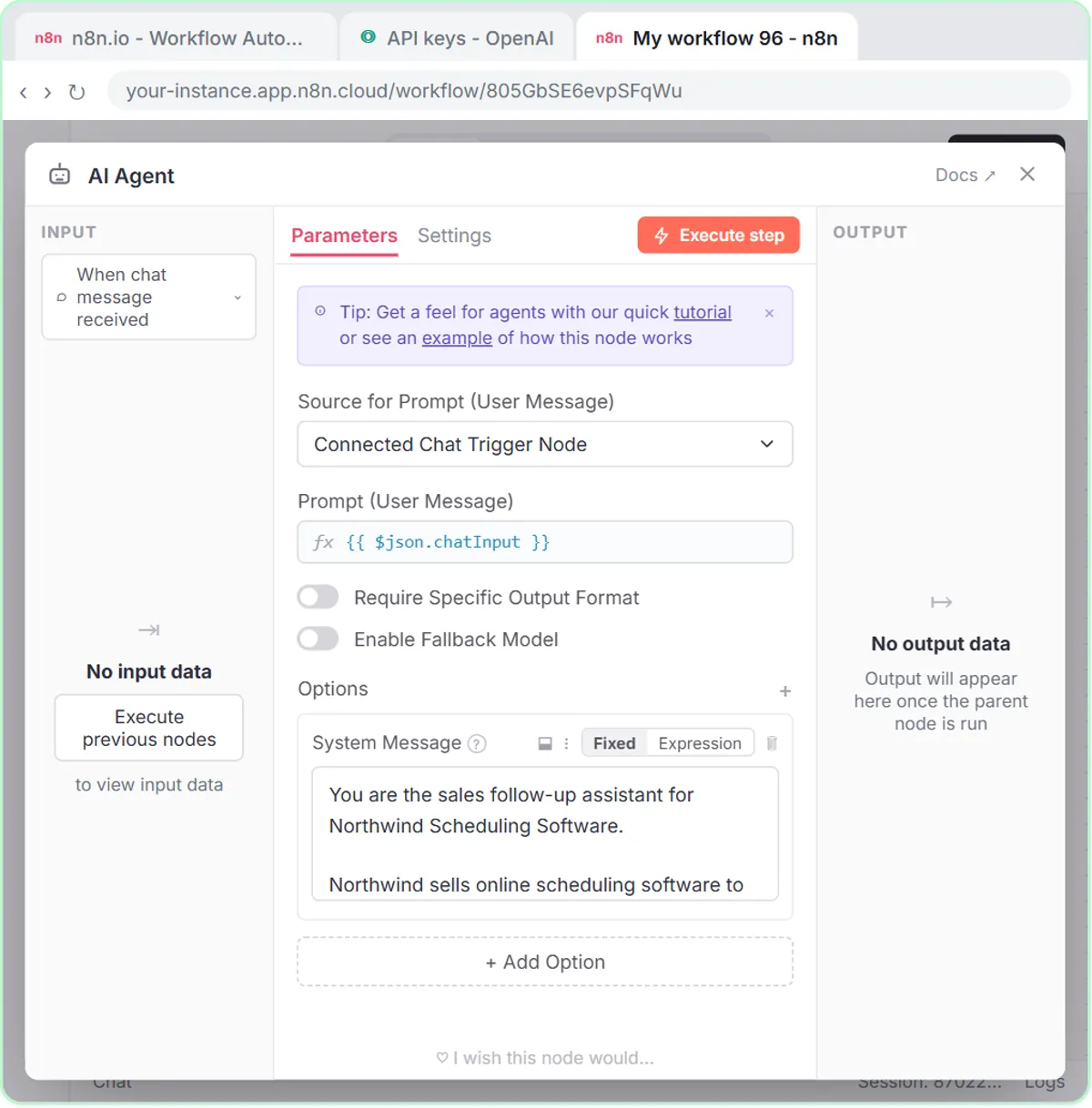
Try this lesson free or read the step-by-step guide.
Common confusions
Win rate vs conversion rate
Conversion rate usually measures an earlier step, such as visitors who fill in a form. Win rate measures the end of the funnel: of the deals that reached a decision, how many you closed.
Win rate vs close rate
Many teams use the two names for the same thing. Some calculate close rate against every lead, not just decided deals, which gives a much lower number. Write down which formula you use.
Tips
- Count lost deals as carefully as won ones, or the rate will flatter you.
- Set a rule for when a quiet deal is marked lost, such as 60 days with no reply.
- Track win rate by lead source and by rep to see where deals are really won.
- Ask AI to draft a short, honest check-in for any deal that has gone quiet.
Related terms
More Business terms
Where you use it: free lessons
- Build an n8n AI Agent That Writes Deal Follow-Ups (n8n, 12 min)
Frequently asked questions
- How do you calculate win rate?
- Divide the deals you won by the deals that reached a decision, won plus lost, then multiply by 100. If you won 6 deals and lost 14 in a quarter, your win rate is 6 divided by 20, or 30 percent.
- What is a good sales win rate?
- There is no single good number. It depends on your industry, your deal size and how strictly you qualify leads. The most useful comparison is your own rate over time, broken down by quarter, lead source and rep.
- Should open deals count in win rate?
- No. Open deals have not been decided yet, so including them drags the rate down. Leave them out until they are won or lost, and set a clear rule for closing out deals that have gone silent.