What is accounts payable?
Updated · By Robert Breen
Accounts payable, or AP, is the money your business owes to suppliers and vendors for goods or services it has already received but not yet paid for. It is also the name of the routine that records those bills, approves them and pays them on time.
Why it matters for a small business
Every bill you receive is a promise to pay, and AP is how you keep track of those promises. When it works, you know what you owe, to whom and by when, so you can pay on schedule, catch duplicates and take any early-payment discount. When it doesn't, bills hide in an inbox until a vendor calls.
AP is the mirror image of accounts receivable, which tracks what customers owe you. Together they explain why a profitable business can still run short of cash: money coming in and money going out rarely land on the same day. Good AP habits also give you cleaner books at month end.
In a real lesson: AI Receipt Extractor: Receipts to Google Sheets with n8n
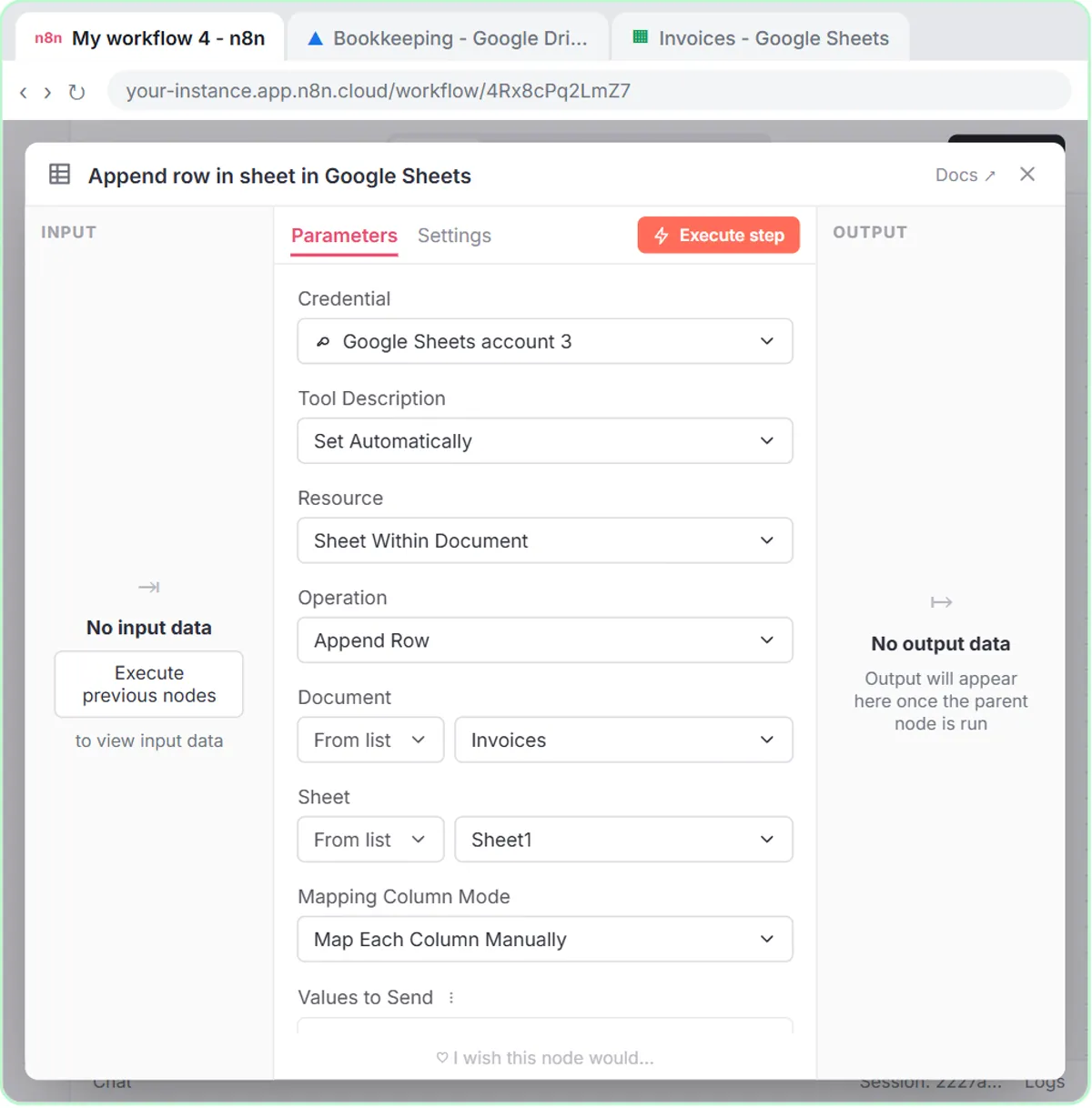
The AI Receipt Extractor lesson covers only the first slice of the AP routine: getting a document into a list. You build an n8n workflow where you attach a photo of a receipt in the chat. An AI agent reads it and adds a row to a Google Sheet called Invoices, with four columns: Date, Category, Vendor and Amount.
The agent's instructions are three short lines: extract the date, vendor and amount, come up with a category, and use the Google Sheets tool to add the receipt. That removes retyping, one of the slowest parts of paying and recording bills.
To be clear about the limits: the lesson records receipts. It does not match them to purchase orders, route anything for approval or schedule payments, and the sheet is not a ledger. Think of it as the intake step in front of a fuller AP process, one a person still checks.
Try this lesson free or read the step-by-step guide.
Common confusions
Accounts payable vs accounts receivable
Payable is money you owe. Receivable is money owed to you. A single customer can be both, if they buy from you while you also buy from them, but each balance is tracked separately.
Accounts payable vs expenses
An expense is a cost you recognize. Payable is the unpaid balance of that cost. If you buy printer paper on credit today, it is an expense now and a payable until you pay the invoice.
Tips
- Pick one place where bills arrive, such as a shared mailbox, so nothing lives in a single person's inbox.
- Record the due date when you log a bill, not just the amount. Due dates drive the whole routine.
- Have someone other than the person who pays bills review the list of new vendors. It is a cheap way to catch mistakes and fraud.
Related terms
Where you use it: free lessons
- AI Receipt Extractor: Receipts to Google Sheets with n8n (n8n, 12 min)
- Build an AI Agent That Categorizes Business Expenses (n8n, 12 min)
Frequently asked questions
- Do small businesses need a formal AP process?
- A light one, yes. Even a shared sheet with vendor, amount, due date and status prevents missed payments. The process can grow as volume does.
- Is a receipt the same as a vendor invoice?
- Not quite. A receipt proves something was paid. A vendor invoice asks you to pay. The lesson reads receipts, but the same idea of pulling out date, vendor and amount applies to both.