What is ROI, and how do you estimate it for an AI automation?
Quick answer
Return on investment, or ROI, compares what an investment gives back with what it cost. In words: take the gain, subtract the cost, then divide by the cost. If something costs 1,000 dollars and returns 1,500 dollars of value, the net gain is 500 dollars and the ROI is 50 percent. Those numbers are made up.
Last updated
Updated · By Robert Breen
Why it matters for a small business
ROI is how a manager decides between projects and whether to keep paying for one. For AI tools, it is also the question that comes up first, and the easiest one to answer badly. Vendors and enthusiasts tend to count every minute saved and ignore every minute spent. An honest estimate counts both.
For an AI automation, the costs include your build time, subscriptions, API usage, time spent reviewing output, time fixing mistakes and upkeep when something changes. The gain is usually time saved, so time the task by hand first, then time it with the automation, review included. A made-up example: saving one hour a week, worth 40 dollars to you, against 10 dollars a month in usage and six hours to build.
In a real lesson: Build an AI Agent That Categorizes Business Expenses
The AI Expense Categorizer Agent lesson gives you the pieces for an honest estimate. On the cost side, its narration says you are "charged per request, not per month," and that each batch of expenses costs fractions of a cent. Add the time you spend building the workflow, which is real even if the lesson takes about twelve minutes.
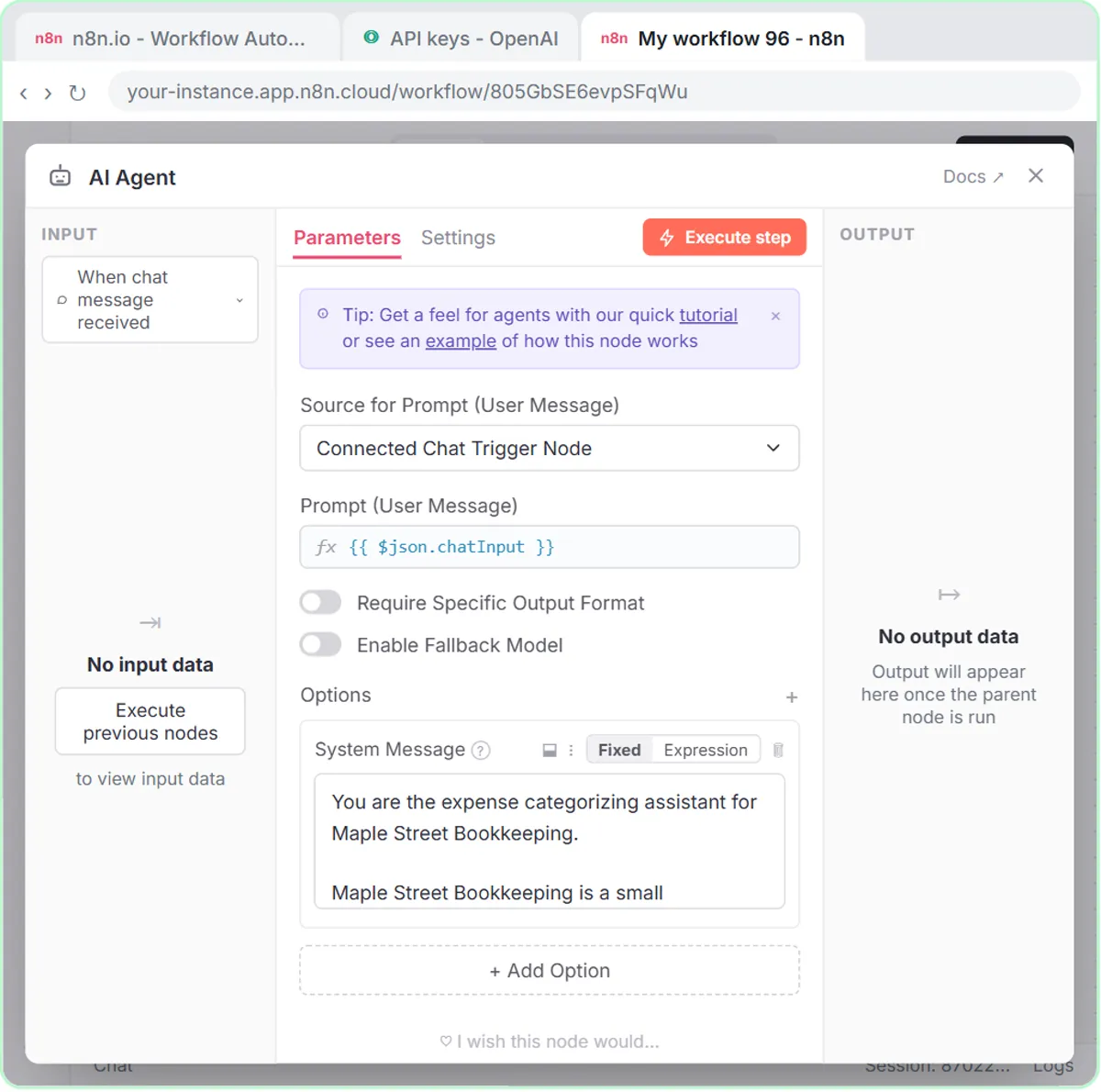
On the review side, the system prompt for Maple Street Bookkeeping, a made-up firm, says the audience is "the bookkeeper who reviews every entry before it is posted." That review time stays, so the saving is the typing and sorting, not the checking. Items sent to Needs Review still need a person's full attention.
The AI Receipt Extractor lesson works the same way: the gain is not retyping each receipt into the Invoices sheet. Neither lesson measures time saved, so measure it yourself. Run the old way and the new way on the same batch, write down both times, and plan a small trial with an AI pilot plan prompt before you scale up.
Try this lesson free or read the step-by-step guide.
Common confusions
ROI vs payback period
ROI is a ratio of gain to cost. Payback period is how long it takes for savings to cover the cost. A small automation can pay back quickly even if the total ROI is modest.
ROI vs time saved
Time saved is only valuable if it goes somewhere useful. If the hour saved is not used for other work, the real gain is smaller than the math says.
Tips
- Time the task by hand before you automate it, so you have a real baseline.
- Count review and fixing time as a cost, every week, not just at launch.
- Report a range with your assumptions listed, not a single precise number.
- For larger financial decisions, have your accountant check the inputs.
Related terms
More Business terms
Where you use it: free lessons
- Build an AI Agent That Categorizes Business Expenses (n8n, 12 min)
- AI Receipt Extractor: Receipts to Google Sheets with n8n (n8n, 12 min)
Prompt templates that use it
Frequently asked questions
- How do I put a dollar value on time saved?
- A common approach multiplies hours saved by what an hour of that person's time costs the business, including more than base pay. Your finance team or accountant can give you the figure to use.
- What if the ROI of an AI automation is negative?
- Then stop, simplify or wait. A negative estimate is useful information, and a small pilot is a cheap way to find it out before you commit.