What is deferred revenue?
Quick answer
Deferred revenue, also called unearned revenue, is money a business has received for goods or services it has not delivered yet. It is recorded as a liability, because the business still owes the customer the work or a refund. As the work is delivered, the amount moves from the liability into revenue.
Last updated
Updated · By Robert Breen
Why it matters for a small business
Deposits, prepaid plans, annual subscriptions and some retainers all create it. The cash is in your account, but it isn't fully yours yet. If the job is cancelled, you may have to give it back. Treating it as earned can make a strong month look stronger than it was, and leave you short when the work has to be done.
Here is a made-up example. A client pays $1,200 in January for a year of monthly service. On accrual accounting books, $100 becomes revenue each month as the service happens. After three months, $300 is revenue and $900 is still deferred revenue. Businesses using cash-basis books record the full payment when it arrives, so ask your accountant which method you use and how to record prepayments.
In a real lesson: Reply Faster: Turn a Messy Customer Email Thread into a Clear, Friendly Reply
Stepthrough has no lesson about recording revenue, but Reply Faster: Customer Emails contains a classic case. Cedar Lane Bakery, a made-up shop, confirms a cake order with "We got your $40 deposit." The facts you paste include "Lemon is fine, same price: $120 total" and "The owner approved 10% off the $80 balance, so $72 is due at pickup."
On accrual books, that $40 is deferred revenue until the cake is picked up on Saturday, Oct 3. At pickup the bakery has earned the sale: the $40 deposit plus the $72 balance, $112 in all.
The lesson's real job is the reply. It has ChatGPT "Make a table of every promise or claim in it and the fact that backs it up," which is the same habit that keeps a deposit and balance from being misstated in an email.
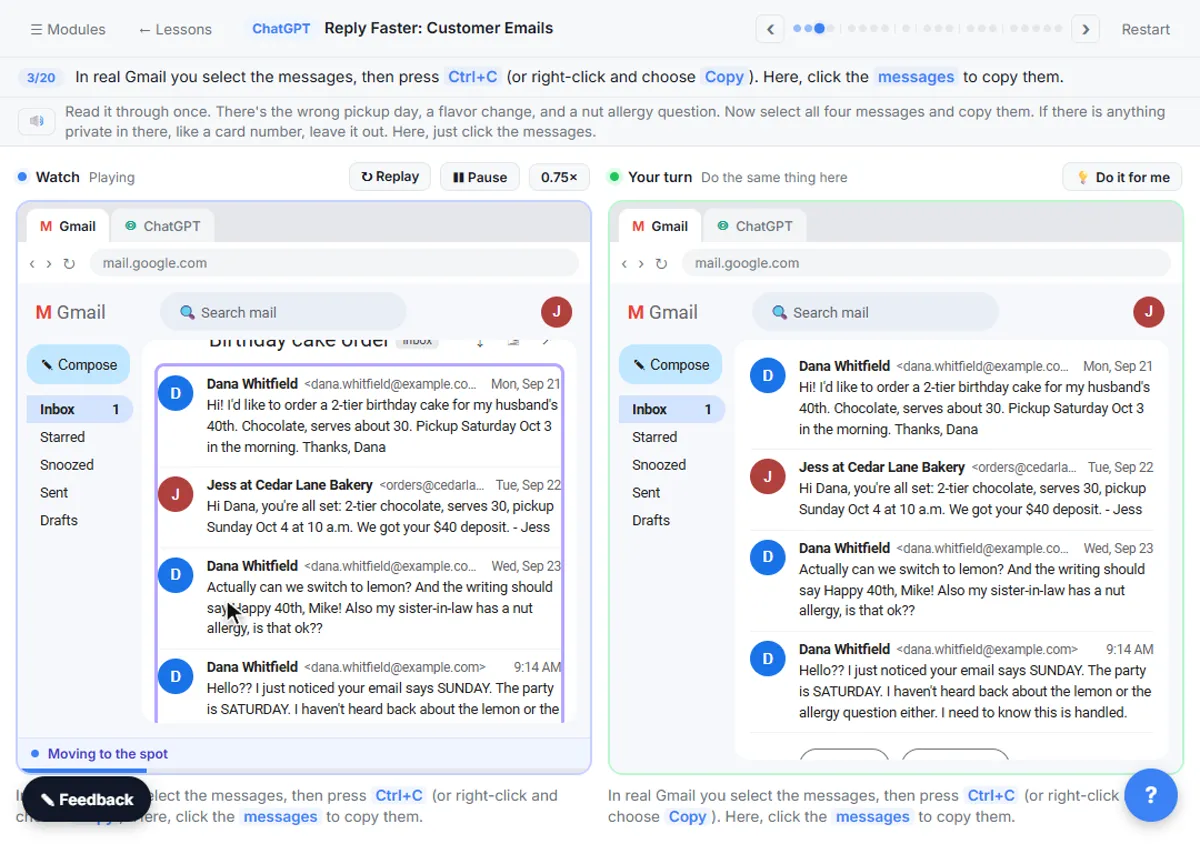
Try this lesson free or read the step-by-step guide.
Common confusions
Deferred revenue vs accounts receivable
They are opposites in timing. A receivable means you delivered and haven't been paid. Deferred revenue means you were paid and haven't delivered.
Deferred revenue vs prepaid expense
They are the same deal seen from two sides. When a client prepays you, you hold deferred revenue. The client holds a prepaid expense until you deliver.
Tips
- Record deposits and prepayments separately from earned sales.
- Keep a simple schedule showing how much is still owed in work for each prepaid customer.
- When AI drafts a reply about a deposit, check the deposit, balance and total against your records.
Related terms
More Business terms
Where you use it: free lessons
More free tutorials
Frequently asked questions
- Is deferred revenue a liability?
- Yes. It is money you have received but not yet earned, so you owe the customer either the goods or services or a refund. It usually sits under current liabilities on the balance sheet and shrinks as you deliver.
- Is deferred revenue the same as unearned revenue?
- Yes. Both names describe payment received before the work is delivered. Some businesses also call it deferred income or, for deposits, customer deposits. The accounting is the same.
- Is a customer deposit deferred revenue?
- Usually, yes. A deposit paid before you deliver is held as a liability until the order is completed, then recognized as revenue. If the deposit can be refunded, that is one more reason not to count it as earned.