What are billable hours?
Quick answer
Billable hours are the hours a professional spends on work that is charged to a client, usually at an hourly rate. Time spent on the firm's own business, like marketing or training, is non-billable. Tracking the difference shows what the work really earns.
Last updated
Updated · By Robert Breen
Why it matters for a small business
Many law, accounting and consulting firms sell time, so the clock is the product. A rate of two hundred dollars an hour means nothing if only half the hours worked get recorded. Keeping an honest, same-day record of time is what separates a profitable practice from a busy one.
Billable hours also create a tension worth naming. Clients can feel nervous when time is charged for a reply or a short call, so clear scope and updates matter. Some firms move to flat fees or monthly arrangements for that reason. Whichever you choose, the underlying question is the same: what did this work cost to deliver?
In a real lesson: Reply Faster to a Client Asking for a Case Update: ChatGPT for Small Law Firms
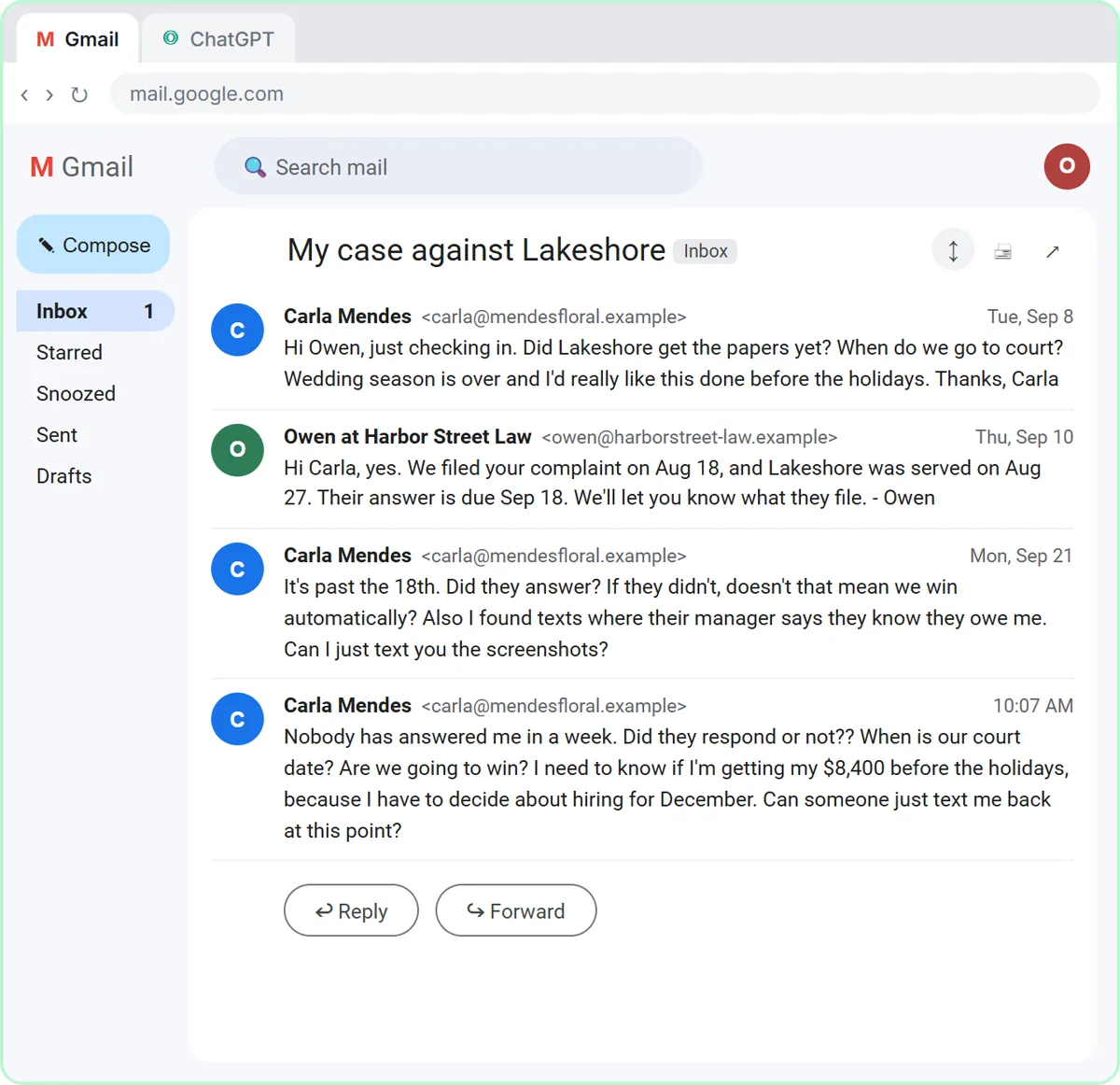
The Reply Faster: Client Case Updates lesson says nothing about billing, so no rates or time entries appear. It does show the kind of small tasks that fill a day at a firm: reading a four-message thread, checking the case dates, drafting a reply and arranging a call.
In the lesson, Owen, a paralegal at the made-up Harbor Street Law, answers a worried client named Carla. He writes a reply under 200 words and offers two times for Attorney Hale to call, Monday, October 5 at 11 a.m. or Tuesday, October 6 at 4 p.m.
Whether any of that is billable is a firm decision, and the lesson doesn't say. What it does show is why time capture is hard. Work like this is short, frequent and easy to forget. Anything that cuts the drafting time, such as a first draft from ChatGPT that the paralegal then checks, changes how long each reply takes, which a firm should consider when it sets its own rates.
Try this lesson free or read the step-by-step guide.
Common confusions
Billable vs billed
Billable time is what could be charged. Billed time is what actually appears on an invoice after review. Firms sometimes write time off, so the two numbers differ.
Billable hours vs utilization
Billable hours is a count. Utilization is the share of available working time that was billable. A person can have long days and low utilization.
Tips
- Record time as you go. Memory at the end of the week is expensive.
- Write time-entry descriptions a client could read without confusion.
- Decide in advance whether short emails and calls are billed, and tell clients.
Related terms
More Business terms
Where you use it: free lessons
- Reply Faster to a Client Asking for a Case Update: ChatGPT for Small Law Firms (ChatGPT, 10 min)
- Turn a Client Meeting into Action Items and a Follow-Up Email (Accounting Firms) (ChatGPT, 9 min)
Frequently asked questions
- Is AI-assisted work billed at the same rate?
- That is a decision for your firm, and for some professions a matter of professional rules. Check your rules and be open with clients about how you work.
- What counts as non-billable?
- Firm administration, marketing, training and time you choose not to charge. Track it anyway so you know the true cost of running the practice.