What is a follow-up prompt?
Quick answer
A follow-up prompt is your next message in a chat that already has the facts in it. Instead of starting over, you ask for one change or one next step, like a different number or a short text version. The AI sees the earlier messages, so you do not paste anything twice.
Last updated
Take the free module →Module 5 of the free ChatGPT for Everyday Work course, about 9 minutes. No account needed.
Updated · By Robert Breen
Why it matters for a small business
The second message often matters more than the first. A first answer is a draft. A short follow-up fixes what is wrong, adds what is missing or changes the format, and it costs a sentence instead of a fresh start. It also keeps your corrections, because the fix lives in the same chat as the facts.
Good follow-ups name one thing: the new headcount, a shorter length, a different tone. Vague ones such as make it better give the AI nothing to act on. When the topic changes instead, start a new chat. Follow-ups work because of the context window, the amount of earlier text the AI can see at once.
Vague follow-up vs useful follow-up
| Instead of | Try | Why it works |
|---|---|---|
| Make it better | Cut it to under 100 words and keep the date | It names the change |
| Redo the quote | The library is now 100 guests, not 80 | One new fact, same chat |
| Now another one | Write a short text to Sam with the new total | It names the next output |
| That is wrong | The deposit should be on the total, not on delivery | It states the correction |
The second and third rows mirror the free stop-losing-context lesson. The others follow the same rule.
In a real lesson: Stop Losing Context: When to Start a New Chat vs Keep Going using ChatGPT
In the free Stop Losing Context lesson, the first message asks for a short, friendly quote using only the pasted facts for Oakwood Library (a made-up customer). The second tells ChatGPT one thing: the library now has 100 guests, not 80. The quote is redone.
The third asks for a short text to Sam. It already has the new headcount, because the change happened in the same chat. The lesson's point is what the office manager did not do: she did not paste the facts again.
Try this lesson free or read the step-by-step guide.
Common confusions
Follow-up prompt vs new prompt
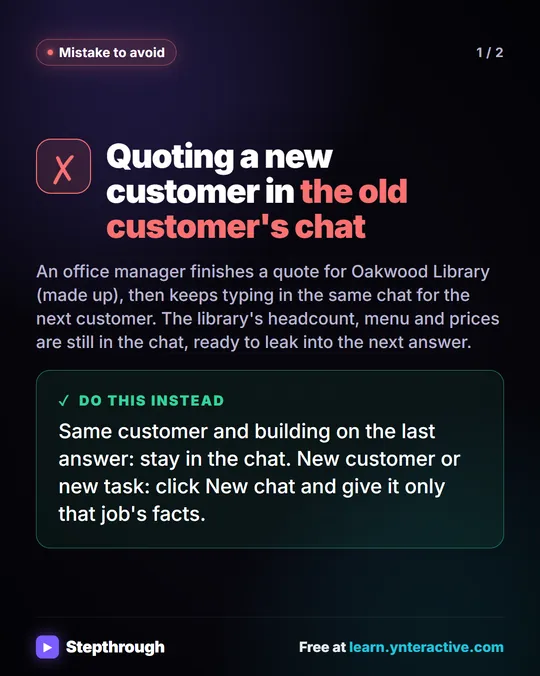
A new prompt starts a task. A follow-up builds on an answer you already have. If the earlier text would mislead the AI, begin a new chat instead.
Follow-up prompt vs prompt chaining
Prompt chaining is a planned series of steps, each using the last output. A follow-up can be a single correction you think of after reading the answer.
Tips
- Change one thing at a time so you can see what moved.
- Check the numbers against your source after every follow-up.
- If three follow-ups have not fixed it, start a new chat with a better first message.
Related terms
More Prompting terms
Where you use it: free lessons
- Stop Losing Context: When to Start a New Chat vs Keep Going using ChatGPT (ChatGPT, 9 min)
- Prompt Writing 101: Role, Context, Task, Format (ChatGPT, 8 min)
- Build an n8n AI Agent That Writes Deal Follow-Ups (n8n, 12 min)
- Reply Faster: Turn a Messy Customer Email Thread into a Clear, Friendly Reply (ChatGPT, 9 min)
Prompt templates that use it
Visual guide
Follow-up prompt in a few slides, with the same guide written out as text.
Frequently asked questions
- Do I need to repeat my facts in a follow-up?
- No, if you are still in the same chat. The AI can see the earlier messages, as the lesson shows.
- How many follow-ups are too many?
- There is no fixed number. If the chat has become long and confused, start a new one and paste only the facts that still matter.
- Is a follow-up the same as iterative prompting?
- They are close. Iterative prompting is the habit of improving an answer over several rounds, and each round is a follow-up prompt.