What is prompt chaining?
Updated · By Robert Breen
Prompt chaining means splitting a job into a planned sequence of smaller prompts, where each step works on the output of the one before. A common chain is draft, then check, then fix, which catches problems that one big prompt would let slip through.
Why it matters for a small business
One prompt that asks for everything at once (write it, make it accurate, make it warm, keep it short) gives the model several jobs to juggle, and the one it drops is usually accuracy. Splitting the work gives each step one clear goal. The checking step in particular works better as its own prompt, because the model reads the finished draft as something to inspect rather than something to defend.
Chains are also easy to reuse. The same three prompts work on the next difficult email, and in automation tools each link can become its own step in a workflow.
In a real lesson: Reply Faster to a Client Asking for a Case Update: ChatGPT for Small Law Firms
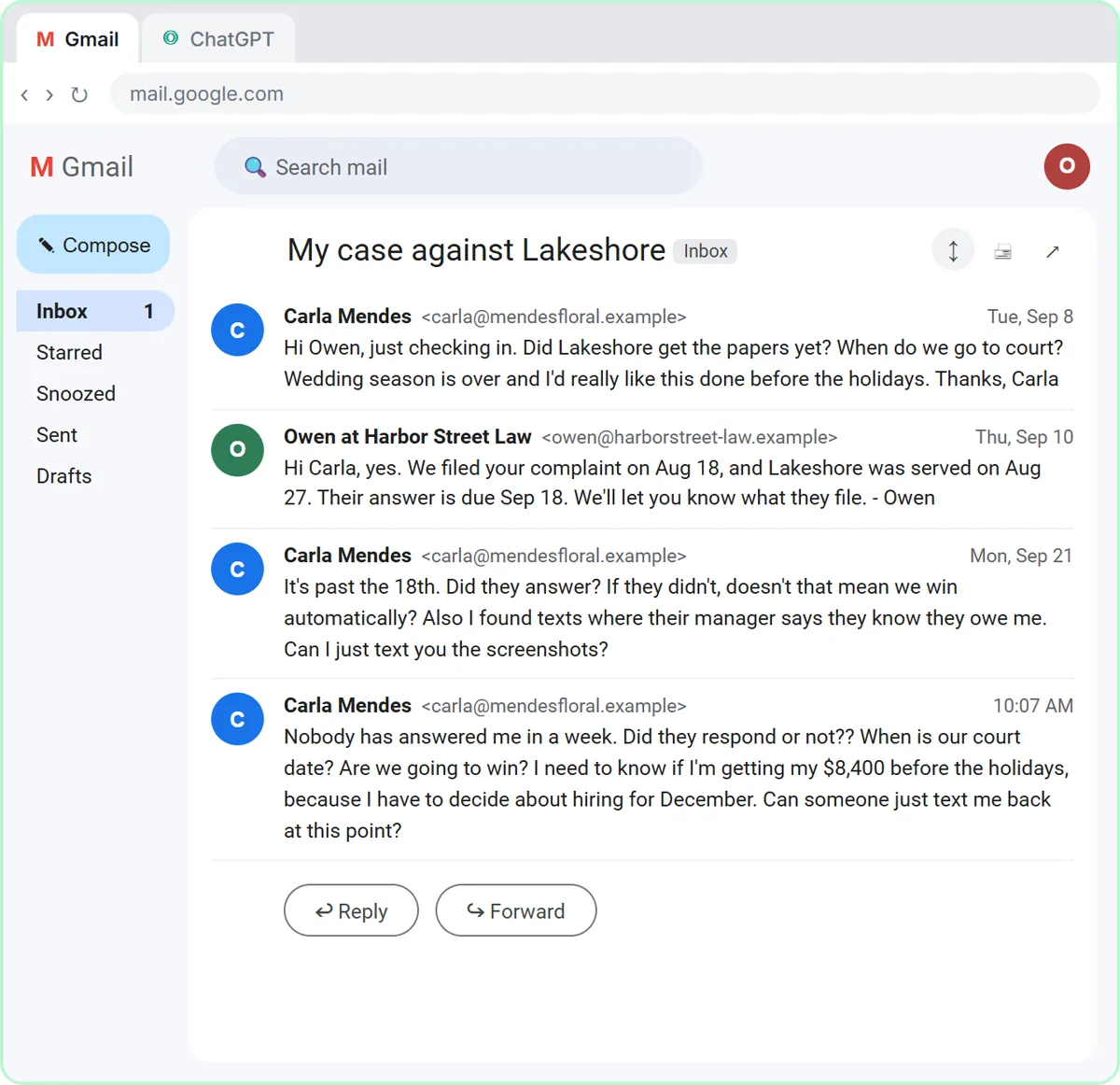
In Reply Faster to a Client Asking for a Case Update, Owen Park, a paralegal at the made-up Harbor Street Law, has to answer Carla, who wants a court date and a promise she'll win. The chain has three links. First, one message with the thread, nine numbered facts and instructions ("No legal advice. Keep it under 200 words."). That produces a reassuring first draft.
Second, Paste check asks ChatGPT to put every promise or claim in a table next to the fact that supports it. Five of eight claims match. Three don't: the "automatic win", the "court date", and a prediction about getting paid. ChatGPT suggests safer wording for each.
Third, Paste fix uses all three wordings, adds the line about keeping the original texts, makes the reply warmer and easier to scan, and keeps every other fact the same. Each link has one job, and the final email from Gmail says only what the firm can stand behind.
Try this lesson free or read the step-by-step guide.
Common confusions
Prompt chaining vs iterative prompting
A chain is planned in advance: you know the steps before you start. Iterative prompting is reacting to what came back and asking for changes until it's right. The law lesson's chain is planned; the follow-up edits you make after reading are iteration.
Prompt chaining vs an AI agent
In a chain, you (or a fixed workflow) decide the order of steps. An AI agent decides for itself which tool or step to use next.
Tips
- Give each link one job: write, check, or revise.
- Keep the chain in the same chat so later steps can see the earlier draft and facts.
- Save the check and fix prompts in your prompt library; they work on almost any reply.
Related terms
Where you use it: free lessons
- Reply Faster to a Client Asking for a Case Update: ChatGPT for Small Law Firms (ChatGPT, 10 min)
- Reply Faster: Turn a Messy Customer Email Thread into a Clear, Friendly Reply (ChatGPT, 9 min)
- Reply Faster to Clients Chasing Their Refund: ChatGPT for Tax and Bookkeeping Firms (ChatGPT, 10 min)
Prompt templates that use it
Frequently asked questions
- How many steps should a prompt chain have?
- As few as do the job. Draft, check and fix covers most customer replies. Add a step only when it has a distinct purpose.
- Can I automate a prompt chain?
- Yes. In a tool like n8n, each prompt can be its own AI step, with the output of one passed as input to the next.