This guide is for accountants, consultants, account managers and anyone who meets with clients.
What should a client follow-up email include?
The decisions, the action items with an owner and a date, and anything still open, in that order. The glossary entry on follow-up emails sums up a good one: short, specific to that person, and easy to reply to, with one clear next step.
A simple template:
Hi [NAMES],

Thanks for today's [MEETING]. Here's what we agreed:
- [DECISION 1]
- [DECISION 2]

Next steps:
- [CLIENT NAME]: [TASK] by [DATE]
- [YOUR NAME]: [TASK] by [DATE]

Still open: [ANY QUESTION WE'LL COME BACK TO]

[ONE CLEAR NEXT STEP OR QUESTION]
[YOUR NAME]
Putting the client's own tasks first, with names and dates, is the part that gets things done. A recap that only lists what was discussed doesn't.
How do I get the action items from the transcript?
Ask ChatGPT for them before you ask for the email, with a rule not to guess. The request from Summarize a Client Meeting:
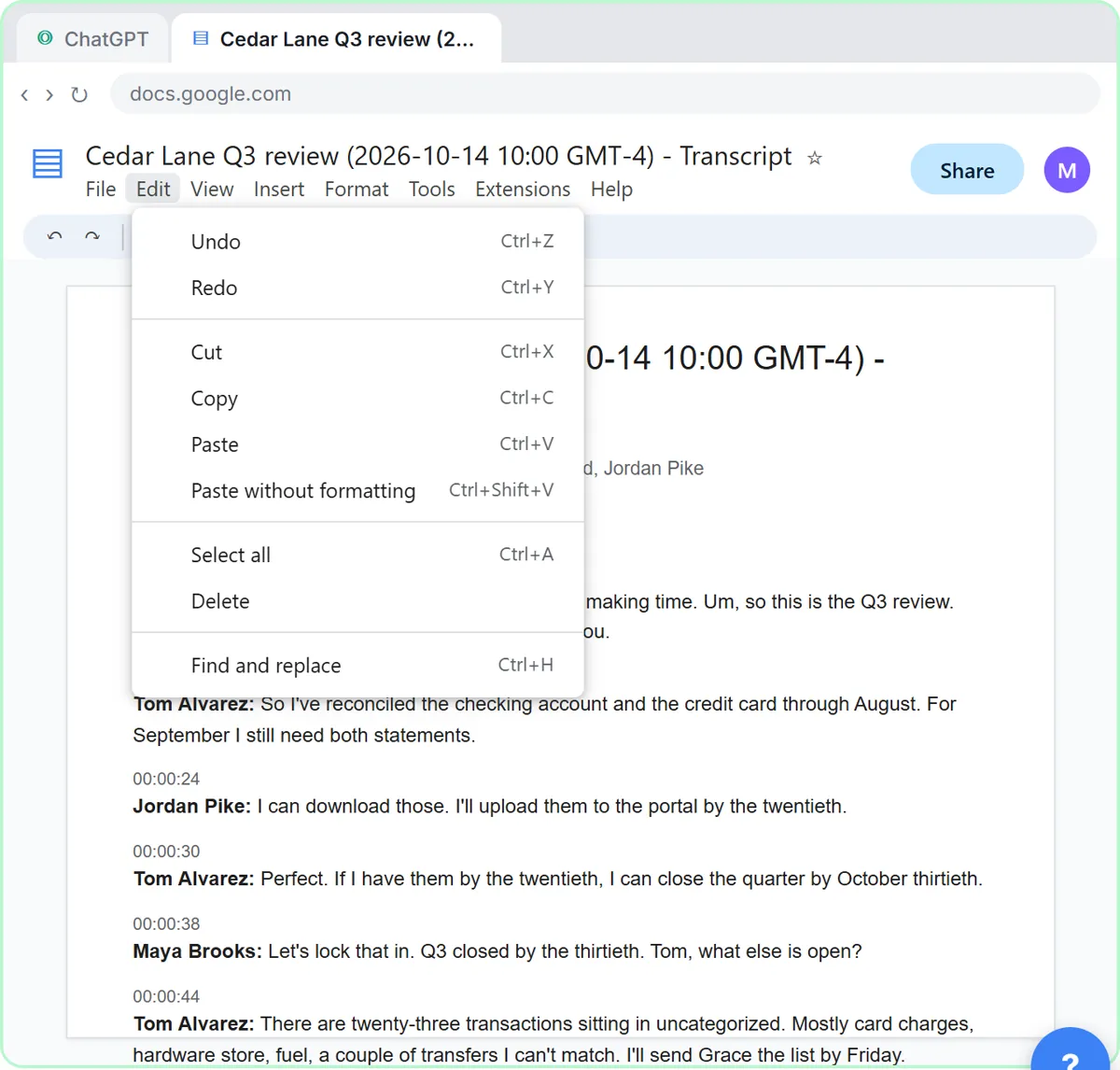
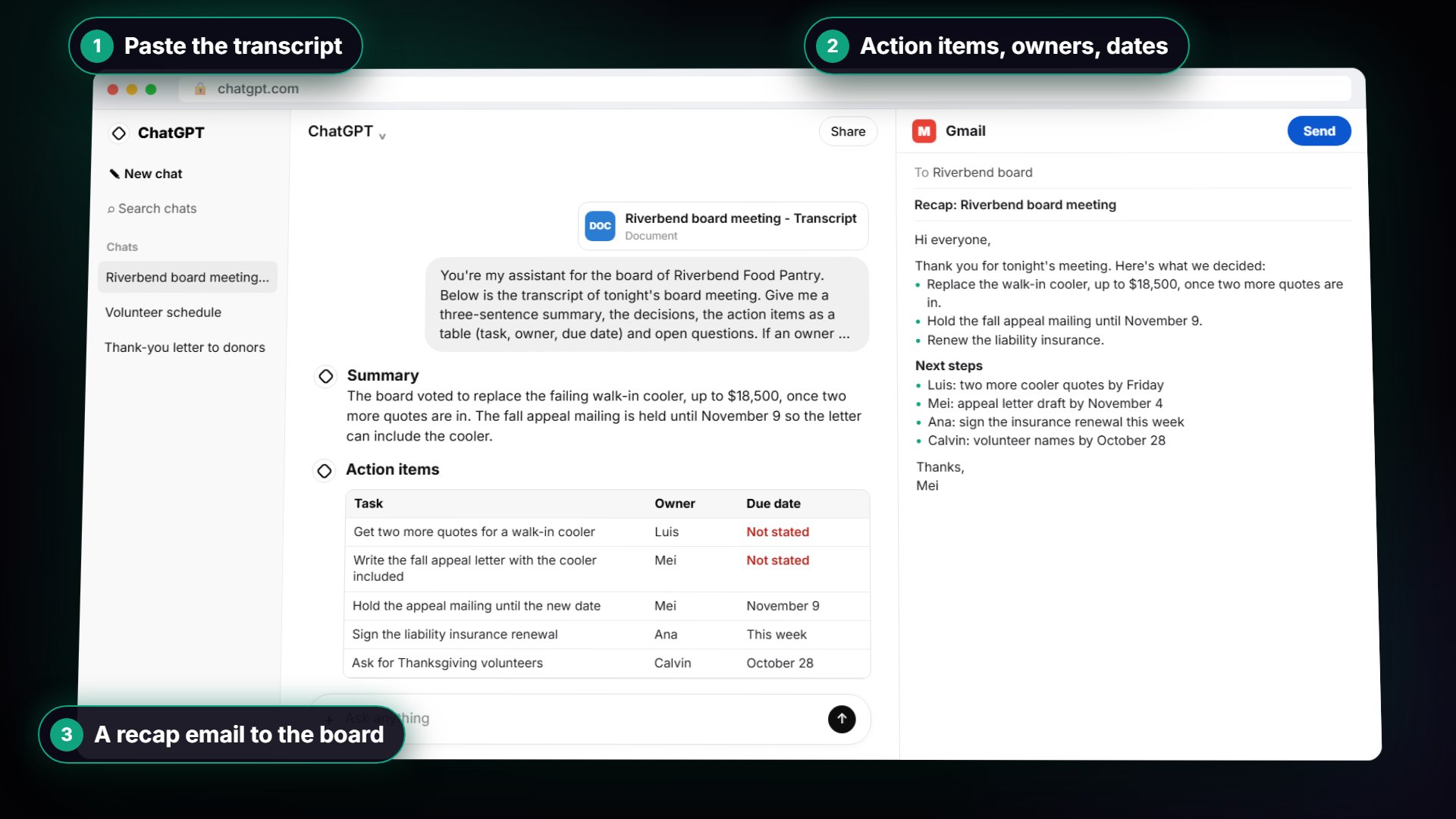
You're my client services assistant at Millbrook Accounting. Below is the transcript of today's Q3 review with our client Cedar Lane Landscaping. Give me:
1. A three-sentence summary
2. The decisions we made
3. The action items as a table: task, owner, due date
4. Open questions
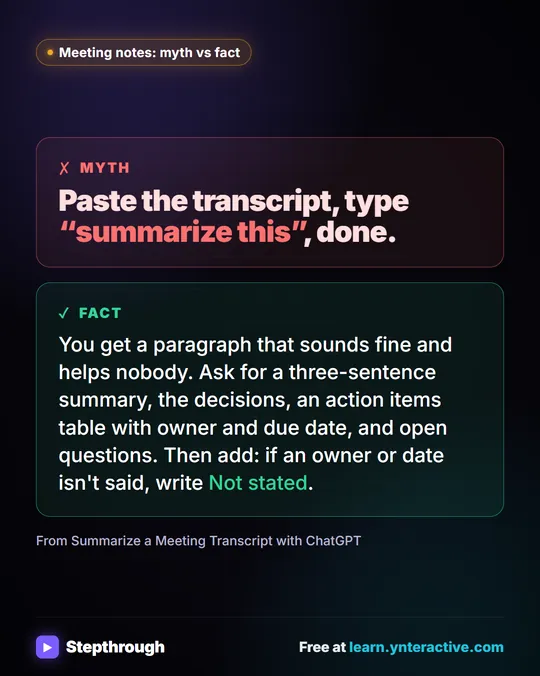
Only use what's in the transcript. If an owner or date isn't said, write "Not stated".
Paste the transcript under it. In real ChatGPT, press Shift+Enter for a new line first, because plain Enter sends. Or upload the transcript file with the + button and Add photos & files.
Try it free, step by step
Turn a Client Meeting into Action Items and a Follow-Up Email (Accounting Firms). Turn the transcript of a client's quarterly review into the decisions, an action items table with owners and due dates, and a follow-up email to the client. You do every step yourself in a practice copy of ChatGPT, it checks your work as you go, and “Do it for me” finishes any step you get stuck on. Free, and nothing touches your real accounts.
Start the free lessonWhy check the action items before writing the email?
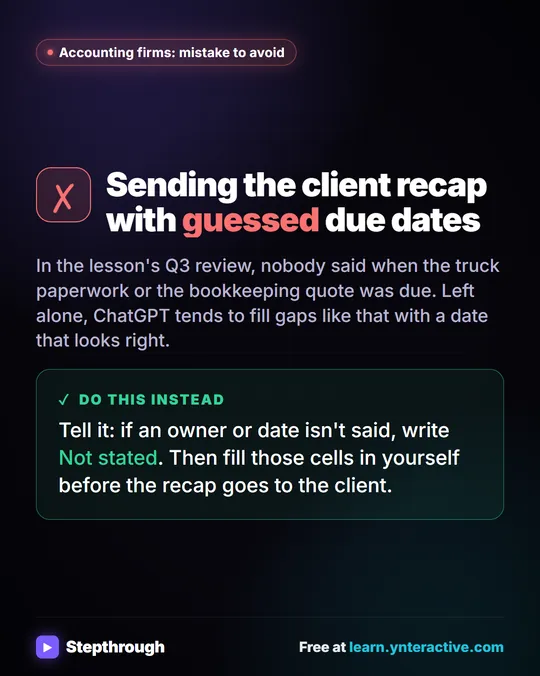
Because a follow-up with a wrong date is worse than no follow-up. In the lesson, the review covers September bank statements, 23 uncategorized transactions, a new truck, three missing W-9s and a question about monthly bookkeeping. The action items table comes back with two due dates marked Not stated: nobody said out loud when the truck paperwork was due or when the firm would send a quote.
You know those dates, so you fill them in with one sentence:
The truck paperwork is due Friday, and Maya will send the quote by October 21.
Now every action item has an owner and a date. The "Not stated" rule is what made the gap visible; without it, ChatGPT might have guessed.
How do I turn the table into the email?
One more request in the same chat, with a length and tone. The lesson's:
Now write a short follow-up email to Grace and Jordan with the decisions and action items. Friendly and plain, under 150 words.
Read it, then click Copy under the reply. Before sending, check three things: every name is right, every date matches the table, and every number matches what was said. In the lesson's meeting, the client said the truck cost about thirty-eight thousand dollars; if a number like that appears in your email, make sure it's the one you heard.
What belongs under "still open"?
Anything you agreed to come back to. In the lesson, the firm decides to leave depreciation on the new truck for the year-end planning meeting because "that's a bigger conversation," and the client's question about monthly bookkeeping waits on the firm's quote. Naming open items in the follow-up shows the client you heard them and sets up the next conversation.
Don't answer open questions in the follow-up unless you've actually decided. A follow-up that quietly resolves something you never agreed on causes more trouble than it saves.
How soon should I send a client follow-up?
While the meeting is fresh for both of you, ideally the same day. With a transcript and the prompt above, the whole routine takes a few minutes, so there's little reason to wait. If your firm reviews client emails before they go out, build that review into the same day.
What should I leave out for confidentiality?
Anything the email doesn't need, and anything your firm's policy says stays out of AI tools. The lesson's advice for client meetings: follow your firm's policy on AI tools, use a business account that doesn't train on your data, and leave out account numbers and tax IDs.
The transcript may contain things said in passing that don't belong in writing. Read the email as the client would, and as if it might be forwarded. Meeting Minutes vs Meeting Summary explains when you need a formal record instead, and ChatGPT for Accountants covers more of the client side. The accounting and bookkeeping firms page lists every accounting lesson.
If the meeting was a kickoff with a new client, the client onboarding process shows the steps around it.
Key takeaways
- A client follow-up email recaps decisions, lists action items with an owner and a date, and names what's still open.
- Ask ChatGPT for the decisions and an action items table first, with "Not stated" for any owner or date nobody said.
- Fill in the missing dates yourself in one sentence, then ask for a short email, such as "Friendly and plain, under 150 words."
- Check every name, date and number against the table and the meeting before sending.
- Leave account numbers, tax IDs and anything the email doesn't need out of ChatGPT, and follow your firm's AI policy.
Frequently asked questions
- What is the best subject line for a meeting follow-up email?
Name the meeting and the point, such as "Q3 review: next steps and dates." It helps the client find it later.
- Should the client's tasks or mine come first?
The client's, with names and dates. Those are the items most likely to slip, and seeing them first makes them clear.
- Can ChatGPT write the follow-up without a transcript?
Yes, from your own notes. Paste the notes under the same request so it pulls decisions and action items before writing the email.
- What if the client disagrees with the recap?
That's useful. A short recap sent the same day surfaces misunderstandings while they're easy to fix. Update the action items and reply with the corrected version.