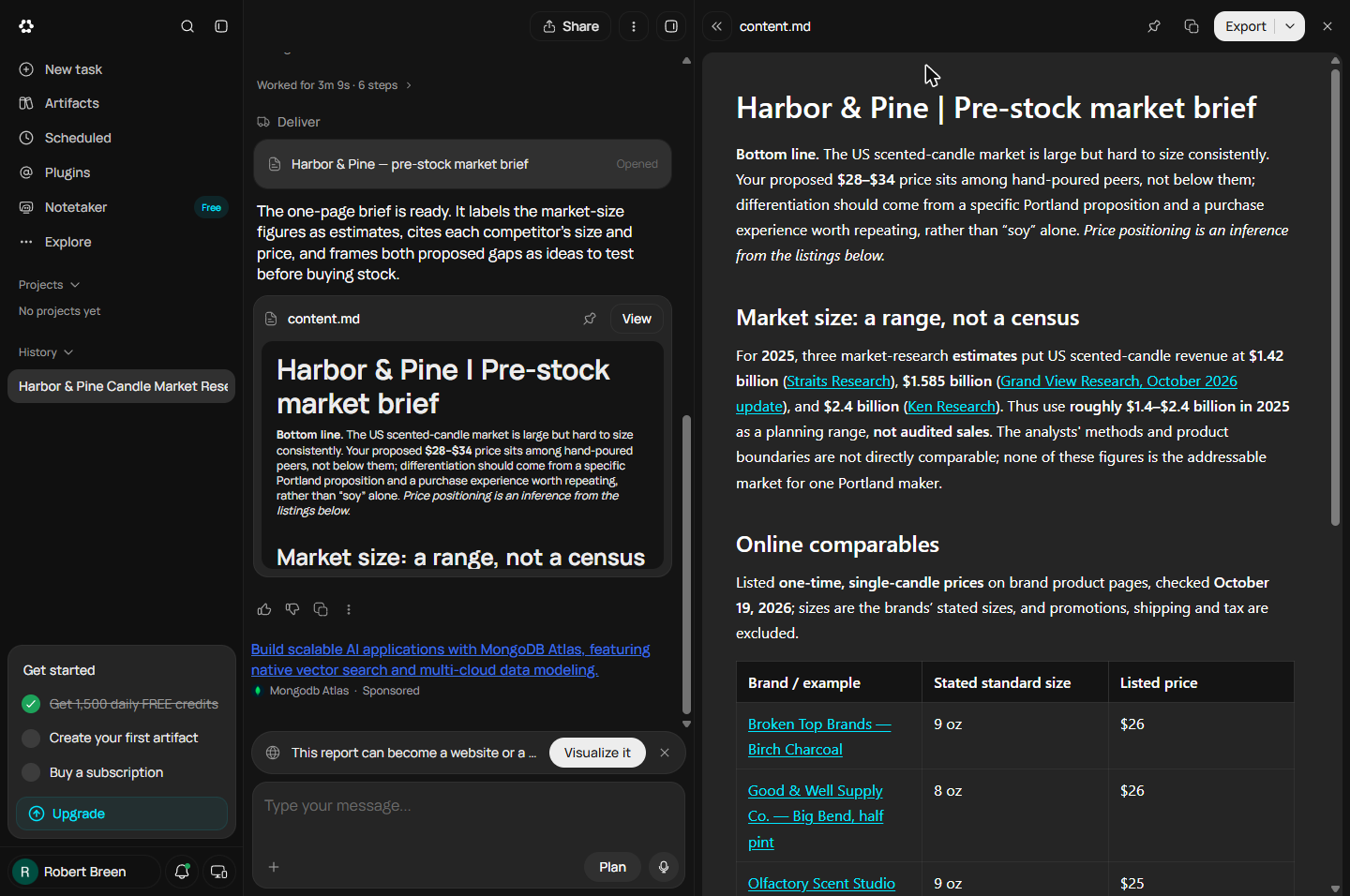
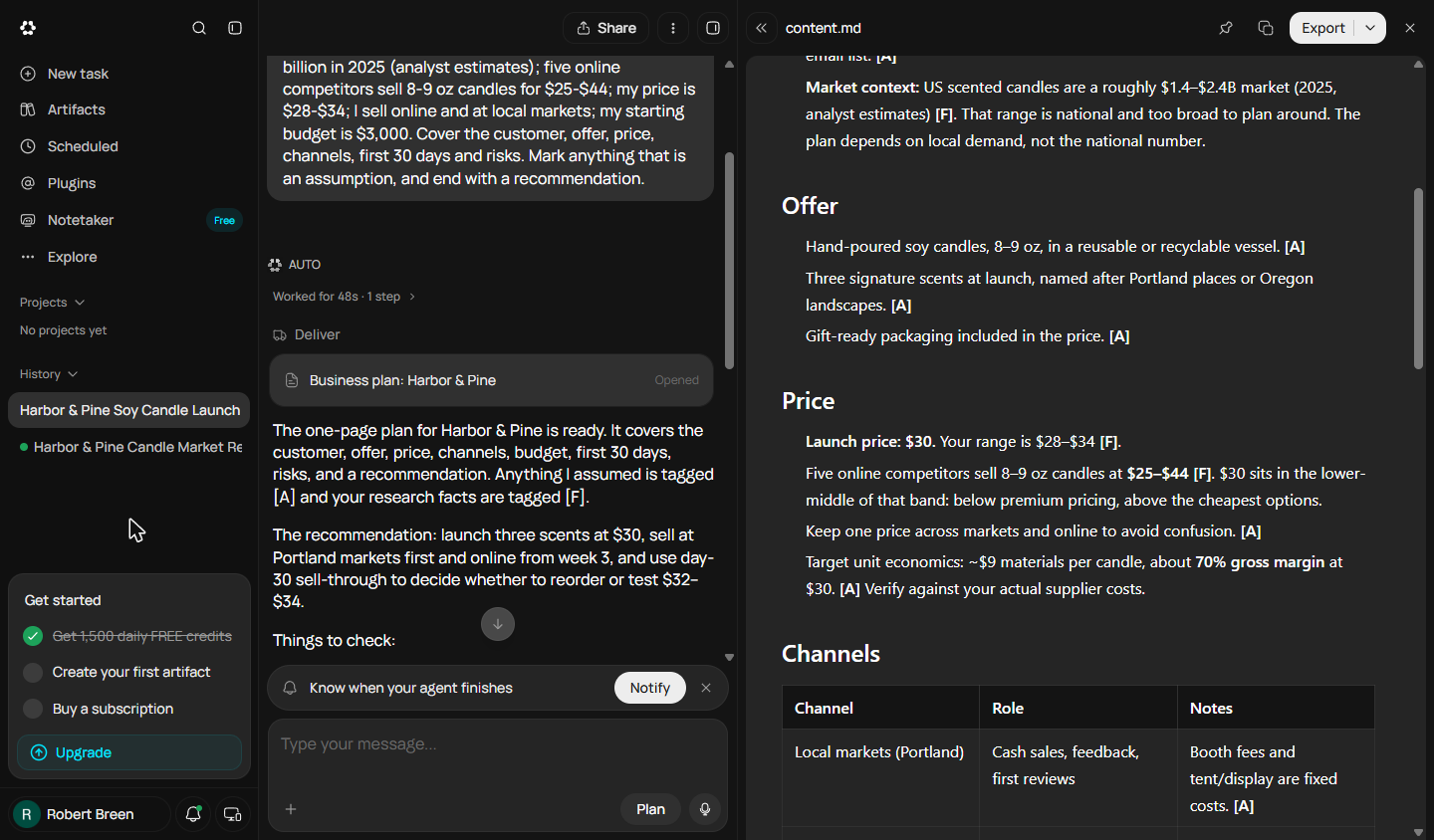
Everything in the files is from our real Runable Free-plan run on 19 October 2026.
Which files are there?
| File | Lesson | What it holds |
|---|---|---|
| runable-harbor-pine-research-brief.txt | Market research | The brief, the scope reply and the follow-up question |
| runable-competitor-check.csv | Market research | Five brands and three market estimates, with a verified column |
| runable-harbor-pine-research-facts.txt | Business plan | The research facts, the plan prompt and the fix we asked for |
| runable-harbor-pine-business-plan.md | Business plan | The plan Runable wrote, with corrected unit economics |
| runable-harbor-pine-carousel-copy.txt | Carousel | The five slides' words, the prompt and the approval |
What is in the research brief file?
Three things, in order. First, the brief: a small-batch soy candle brand in Portland, Oregon, selling online and at local markets for $28 to $34 a candle, asks before spending money on stock for 1) the US scented-candle market size, as a range with estimates labelled, 2) five premium small-batch brands that sell online, with the price of a standard 8 to 10 oz candle, and 3) two gaps a new brand could own, citing a source for every number on one page. Second, the reply to send when Runable asks "Does that scope work?": "Yes, that works. Go ahead." Third, the follow-up: "Which numbers in this brief are estimates, and which did you check on a live page today?"
Adapt it: replace the business, city, channels and price. Keep the decision line and the four rules (range, estimates labelled, a source for every number, one page). Those rules are why the brief came back with a range instead of one number.
What is in the competitor check sheet?
Eight rows and eight columns: competitor, candle, stated size, listed price, claim in the brief, source (open it yourself), verified (Y/N) and notes. Five rows are the brands from our brief, with listed one-time prices on 19 October 2026 from $25 to $44 for 8 to 9 oz candles. Three rows are the market-size estimates: Straits Research at $1.42 billion, Grand View Research at $1.585 billion and Ken Research at $2.4 billion, each an analyst estimate.
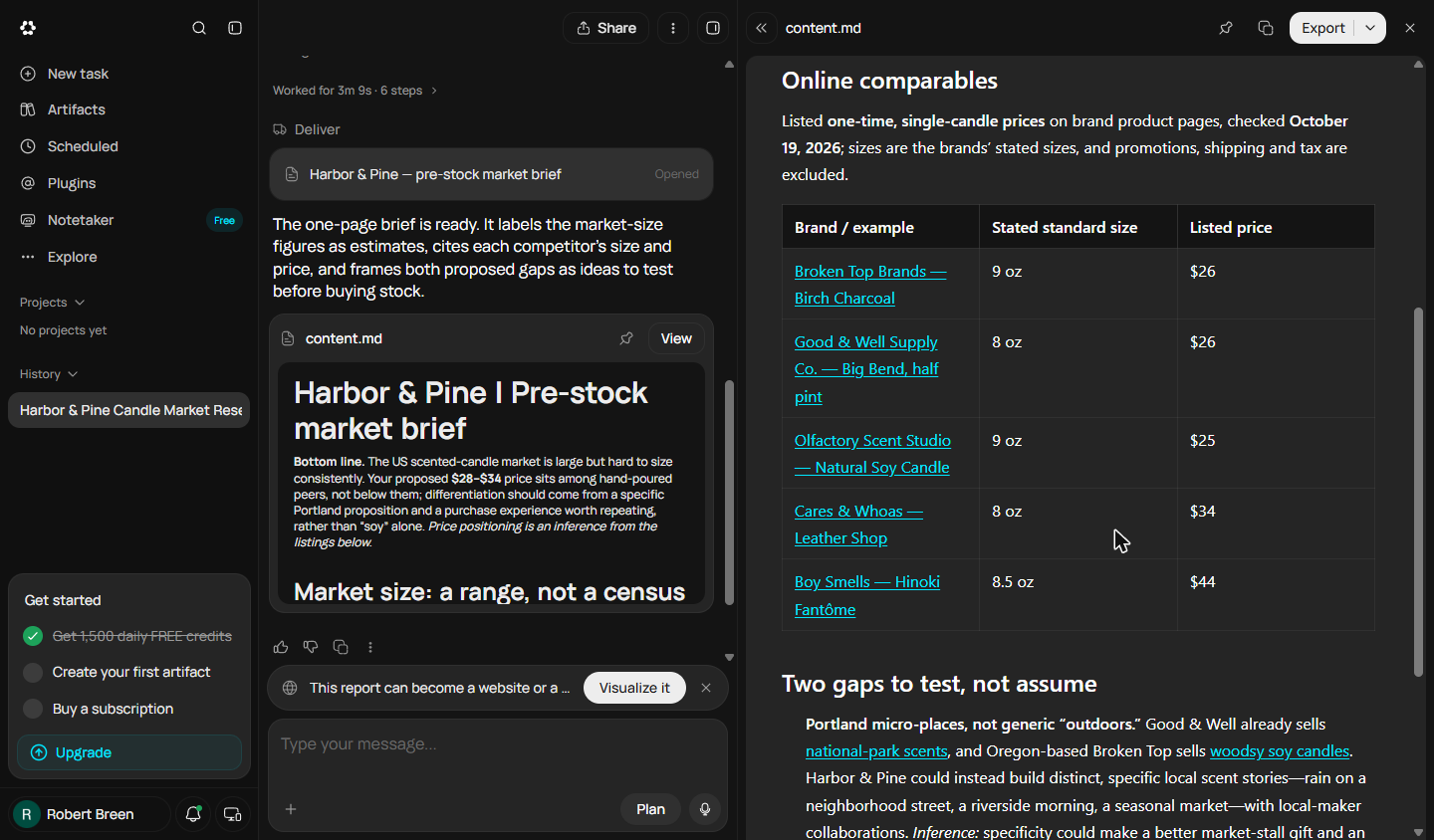
Use it: the verified column starts empty on purpose. Open each source yourself, find the number on the page, and type Y. That is source verification in its simplest form. Replace the rows with your own competitors.
Try it free, step by step
Turn Your Research into a One-Page Business Plan using Runable. A business case for new founders: turn your research into a one-page launch plan with Runable's Report tool and Business Plan template, read the fact and assumption tags, catch a cost-per-unit that… You do every step yourself in a practice copy of Runable, it checks your work as you go, and “Do it for me” finishes any step you get stuck on. Free, and nothing touches your real accounts.
Start the free lessonWhat is in the plan facts file?
The facts carried over from the research (the $1.4 to $2.4 billion range with each analyst's figure, five online brands at $25 to $44, a $28 to $34 price, online and Portland markets, a $3,000 budget), then the prompt we pasted over Runable's Report > Business Plan template. The prompt asks for a one-page launch plan covering the customer, offer, price, channels, first 30 days and risks, tells Runable to mark anything that is an assumption, and asks for a recommendation. Last comes the fix we asked for: the materials budget is $1,000 for 60 to 80 candles, which is $12.50 to $16.67 a candle, not $9, so fix the unit economics and show the math.
Adapt it: paste your own facts and keep "Mark anything that is an assumption." When a number looks off, reuse the fix's shape: state the inputs, state your division, and ask it to show the math.
What is in the finished plan?
The plan Runable wrote, copied from the app, with the corrected price section. Its headings are Summary, Customer, Offer, Price, Channels, Budget ($3,000), First 30 days, Risks and Recommendation. The price section has a unit economics table: 60 candles at $1,000 is $16.67 each, $13.33 gross profit at $30, a 44% gross margin, and $800 gross profit if all 60 sell. The budget splits $3,000 into first-batch materials ($1,000), labels and packaging ($500), market fees and display ($600), website and shipping supplies ($500), marketing ($300) and a reserve ($100). The risk table covers slow cure, weak market turnout, competitor price cuts, shipping breakage, supplier swings and labelling or sales-tax compliance. Lines tagged [A] are assumptions.
Use it: as a model of what a one-page plan looks like after one round of checking, not as facts for your business.
What is in the carousel copy file?
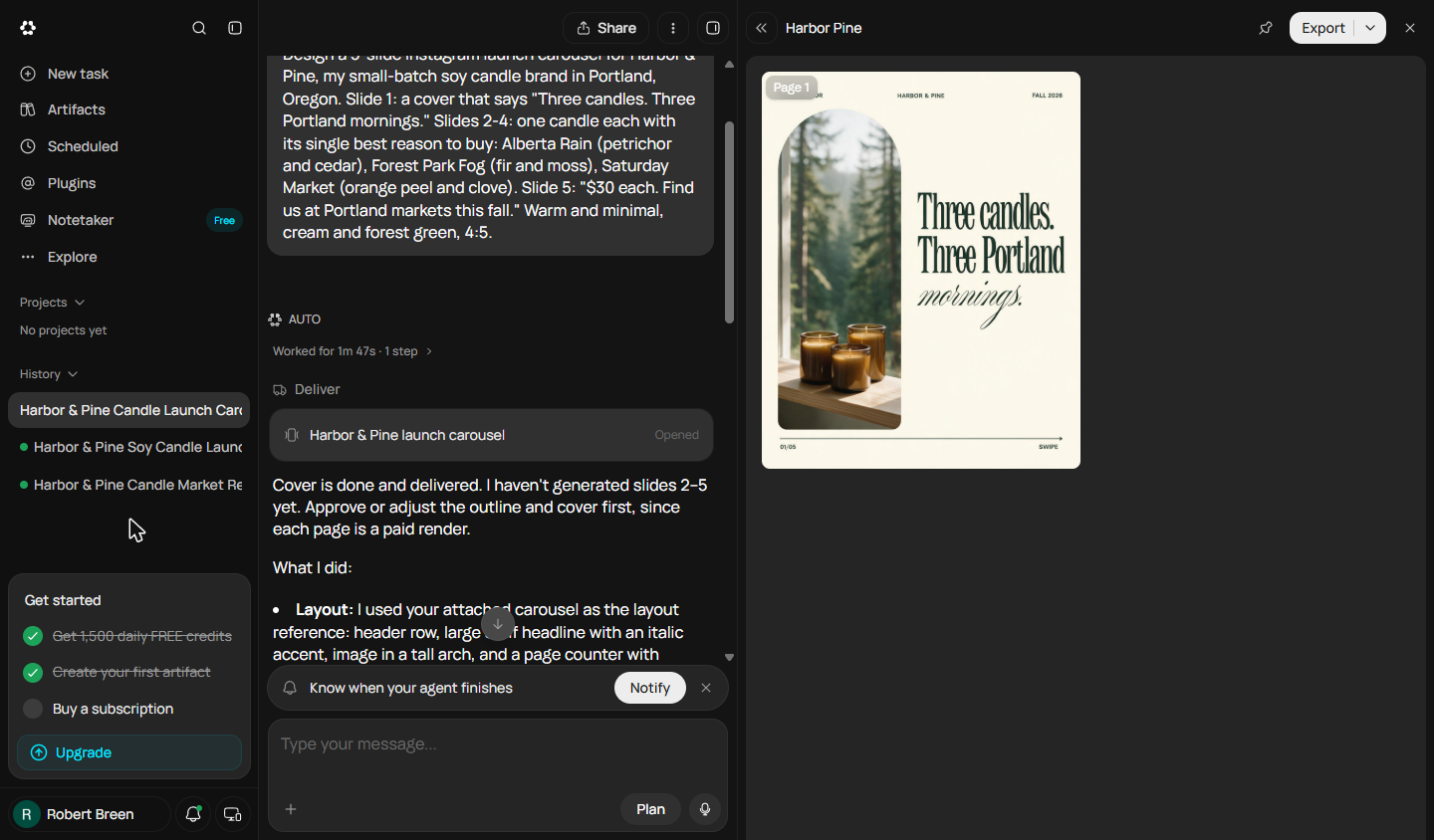
The words for five slides at 4:5: a cover ("Three candles. Three Portland mornings."), one slide each for three made-up scents with a single best reason to buy, and a closing slide with the $30 price and where to buy. Then the look (warm and minimal, cream and forest green), the prompt we pasted over Carousels > Product Showcase, the approval we sent after checking the cover ("The cover looks good. Build slides 2-5."), and a reminder to read every slide's small text, because ours said HARBOR & PIN2 on slide 3.
Adapt it: write your words first, one line per slide, then paste. See the carousel lesson for the full flow.
Key takeaways
- Five files, one set per lesson, all from our 19 October 2026 run.
- Keep the rules inside each prompt: label estimates, cite sources, mark assumptions, show the math.
- Fill in the verified column yourself.
- Use the finished plan as a model, not as your facts. For checks, see 8 Runable mistakes; for quick answers, the Runable FAQ; for one-page versions, the research cheat sheet. Runable is in the AI tools directory.
Frequently asked questions
- Are the files free?
Yes. Download and edit them. Running them in Runable uses credits from your own account.
- Can I use the prompts with my own business?
Yes. Swap the business, city, channels, prices and products. Keep the rules.
- Why is the verified column empty?
So you open each source yourself. A citation shows where to look; it isn't proof.
- Is the business plan real?
It is the plan Runable wrote for Harbor & Pine, a made-up brand, in our run.