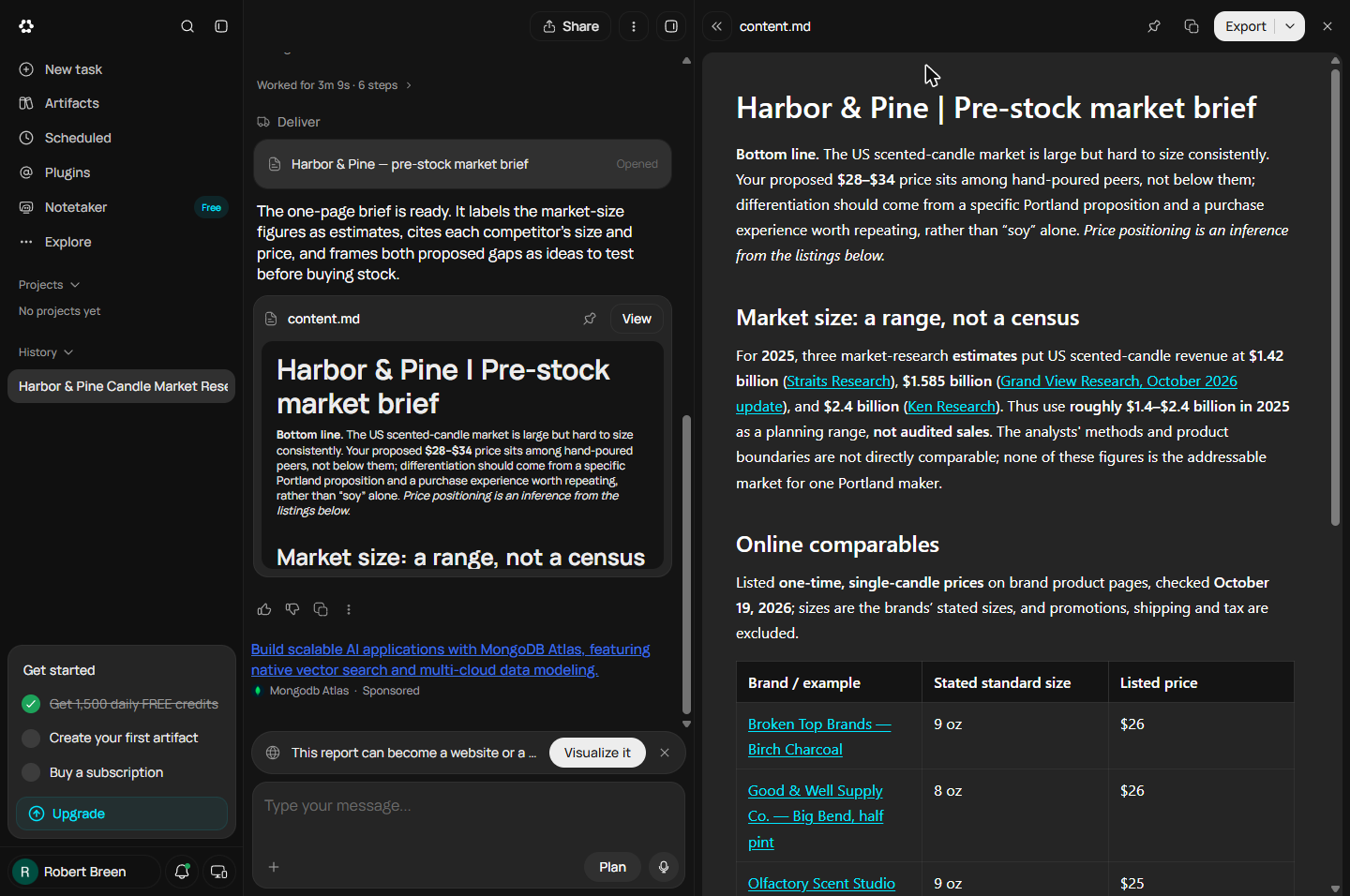
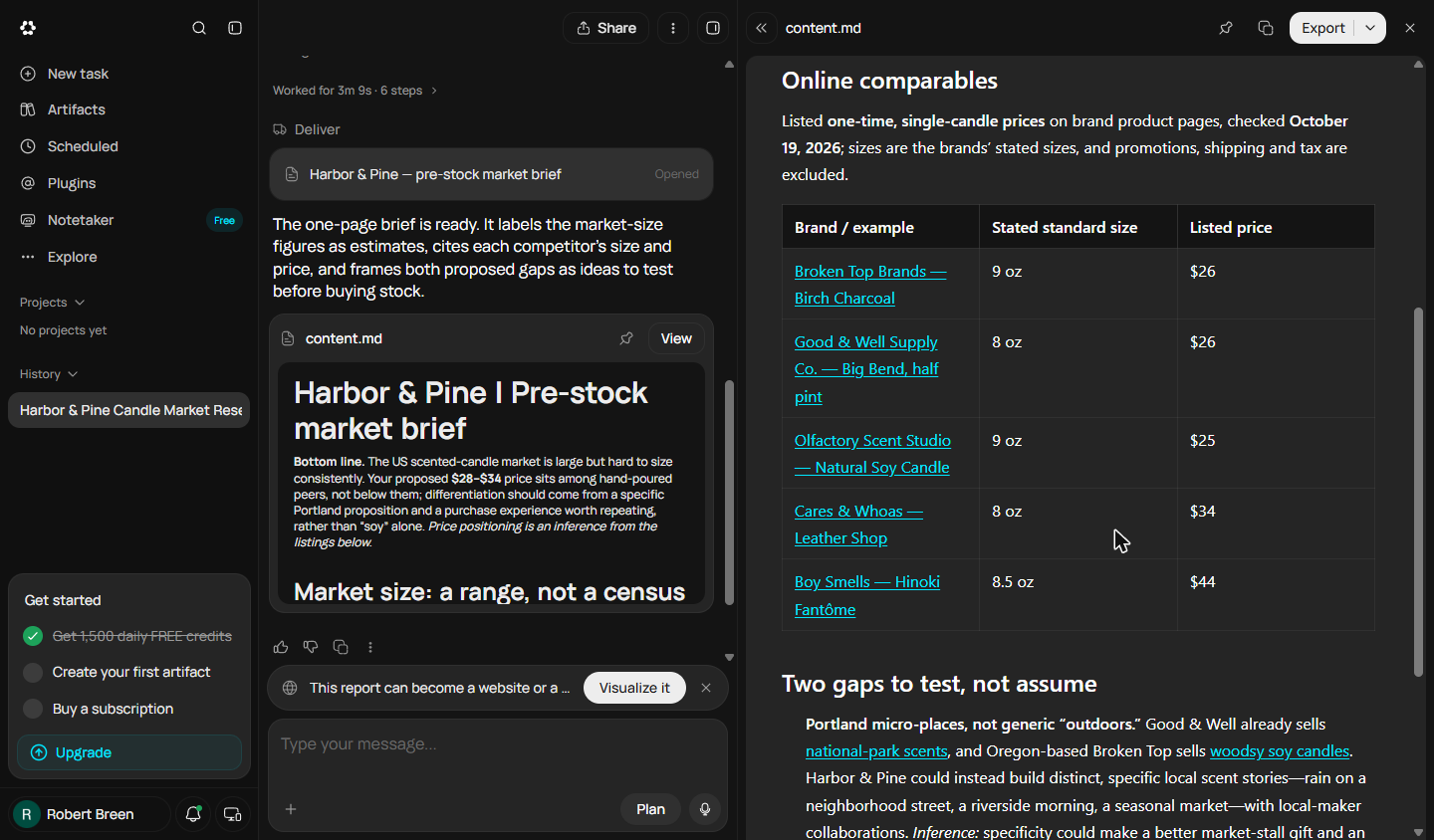
Every example is from a real Runable Free-plan run on 19 October 2026 for Harbor & Pine, a made-up small-batch candle brand in Portland. Runable is a general AI agent: it takes a goal in plain words, makes a plan and hands back finished work.
Which Runable mistakes cost the most?
| # | Mistake | Lesson | The check |
|---|---|---|---|
| 1 | A vague brief | Research | Name the decision, three questions, four rules |
| 2 | Skipping the scope question | Research | Read "Does that scope work?" before you approve |
| 3 | Treating citations as proof | Research | Open two or three sources yourself |
| 4 | Forgetting what's an estimate | Research | Ask which numbers it checked on a live page |
| 5 | Leaving the template's sample prompt | Plan, carousel | Paste your own facts over it |
| 6 | Reading past [A] tags | Plan | List every [A] line to check |
| 7 | Trusting the math | Plan | Divide the key numbers yourself |
| 8 | Posting without zooming in | Carousel | Read every slide's small text |
What goes wrong in a research brief?
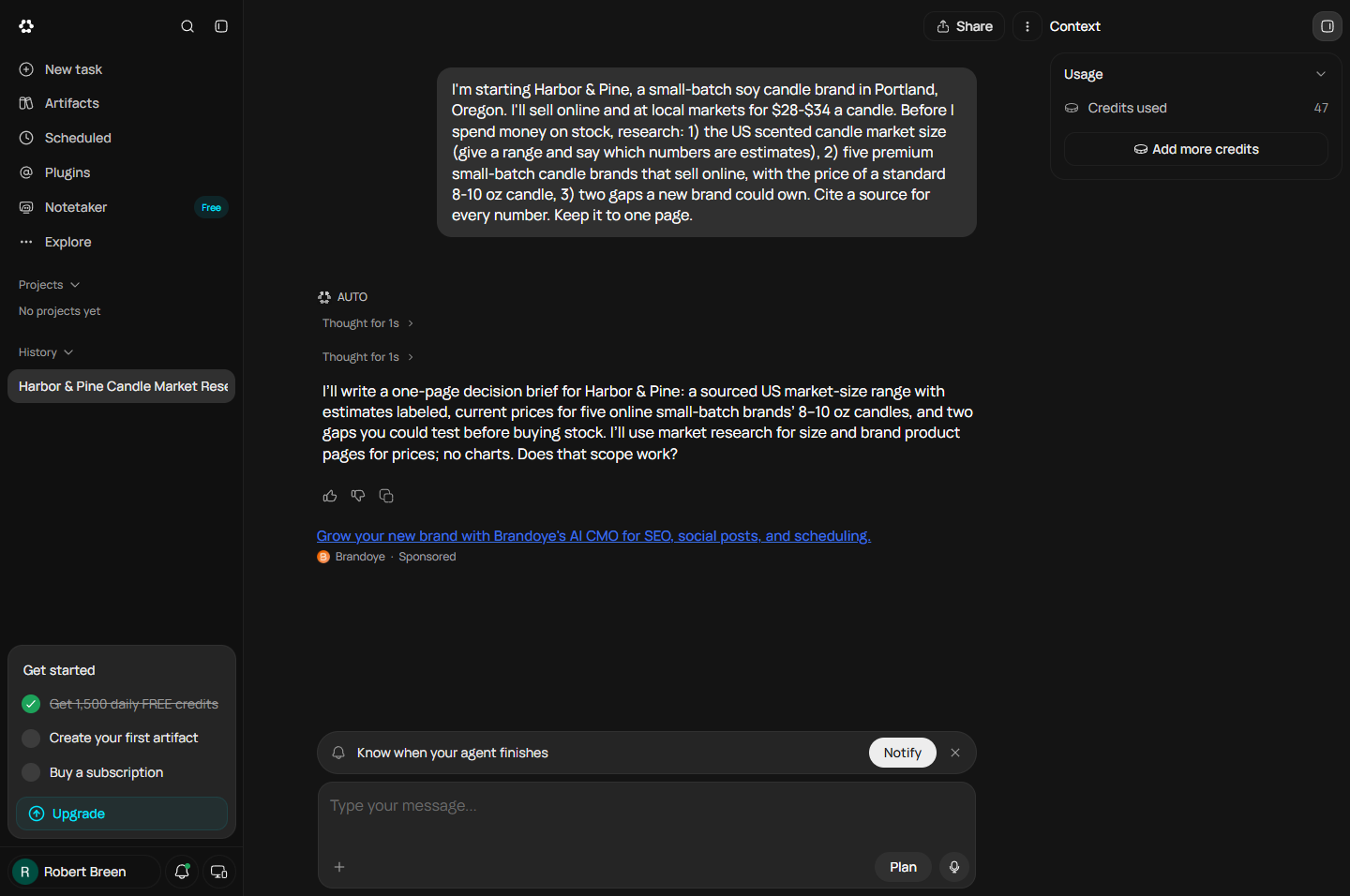
1. A vague brief. "Research the candle market" gets you a generic answer. The market research lesson names the decision ("before I spend money on stock"), asks three specific questions (market size, five competitors with prices, two gaps) and sets four rules: give a range, say which numbers are estimates, cite every number, keep it to one page. Those rules are why the brief came back with a range instead of one confident number.
2. Skipping the scope check. Before it starts, Runable restates the job and asks "Does that scope work?" Read it. Approving the scope first means credits are spent on the job you meant. If it matches, reply "Yes, that works. Go ahead." If not, correct it.
3. Treating a citation as proof. Runable worked for about three minutes and read 205 sources. Three analysts put the 2025 US scented-candle market at $1.42 billion, $1.585 billion and $2.4 billion. That spread is normal, and a citation only shows you where to look. Open two or three sources, find the figure on the page, and tick it off before it goes into a plan. That habit is source verification.
4. Forgetting which numbers are estimates. Ask: "Which numbers in this brief are estimates, and which did you check on a live page today?" In our run Runable separated the analysts' estimates from the prices it checked on live pages that day, and pointed out that the $28 to $34 target price came from Maya, not from research.
What goes wrong with templates?
5. The sample prompt left in. Runable's templates are layouts, not facts. The Business Plan template came with a sample prompt about a tea brand and a reference image; Runable used the image only for layout and said so. The Carousels Product Showcase template comes with a sample prompt too. In both lessons you select the sample prompt and paste your own.
Try it free, step by step
Turn Your Research into a One-Page Business Plan using Runable. A business case for new founders: turn your research into a one-page launch plan with Runable's Report tool and Business Plan template, read the fact and assumption tags, catch a cost-per-unit that… You do every step yourself in a practice copy of Runable, it checks your work as you go, and “Do it for me” finishes any step you get stuck on. Free, and nothing touches your real accounts.
Start the free lessonWhat goes wrong in a business plan?
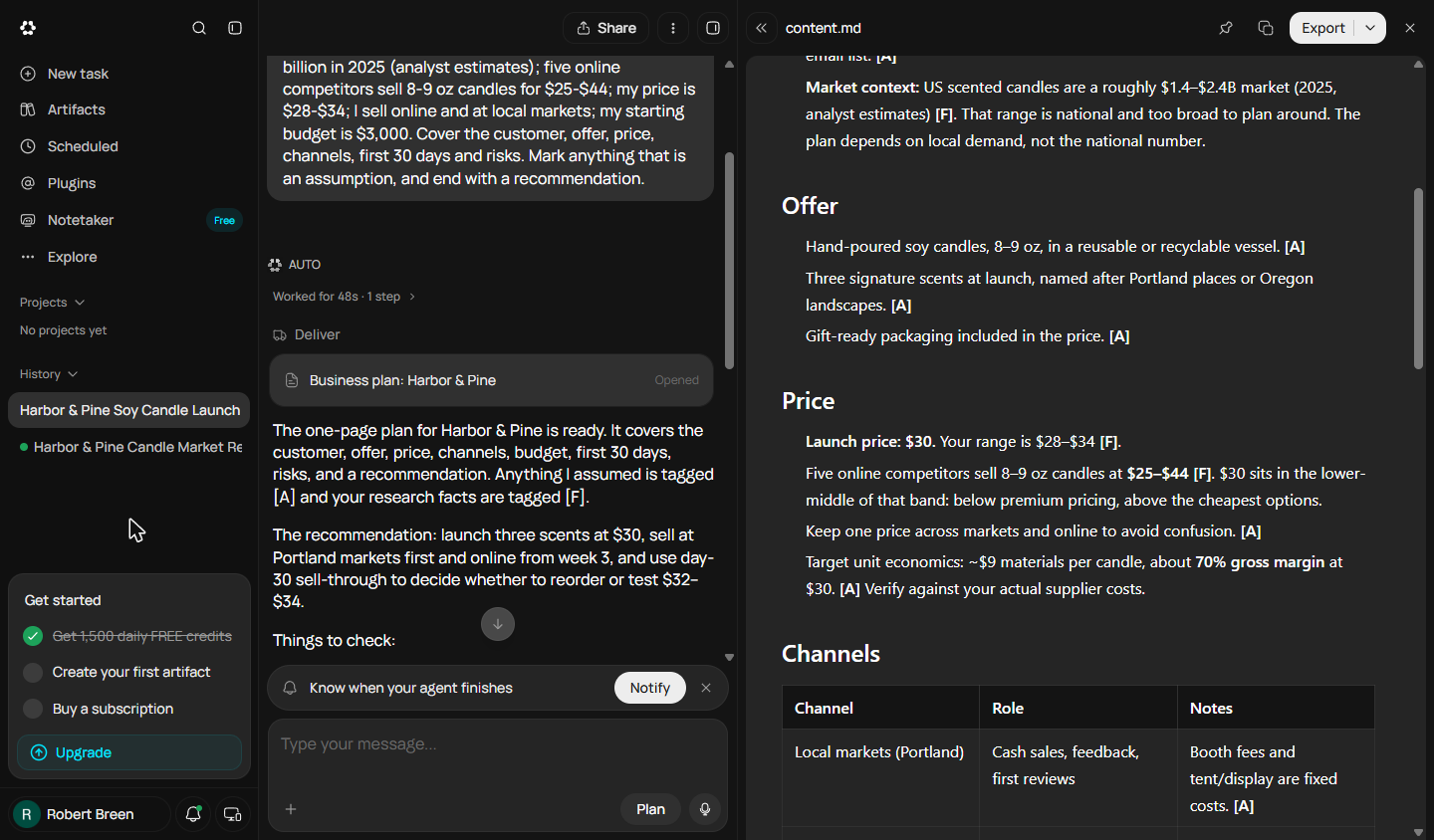
6. Reading past the tags. Ask the plan to mark every assumption. Runable tagged lines [F] (your research fact) and [A] (an assumption to verify). AI writes both in the same confident voice, so the tags tell you which lines to check before you spend money. In the plan's channel table, for example, booth fees and starting an email list at the first market are marked [A].
7. Trusting the math. The first version said about $9 of materials per candle and a 70% gross margin. Its own budget put $1,000 of materials into 60 to 80 candles: $12.50 to $16.67 each. Divide the numbers that drive the plan yourself. When they disagree, ask for the fix with the math shown. Runable added a unit economics table: $16.67 a candle and a 44% gross margin at $30, and it noted that the $1,000 is itself an estimate.
What goes wrong with AI-made images?
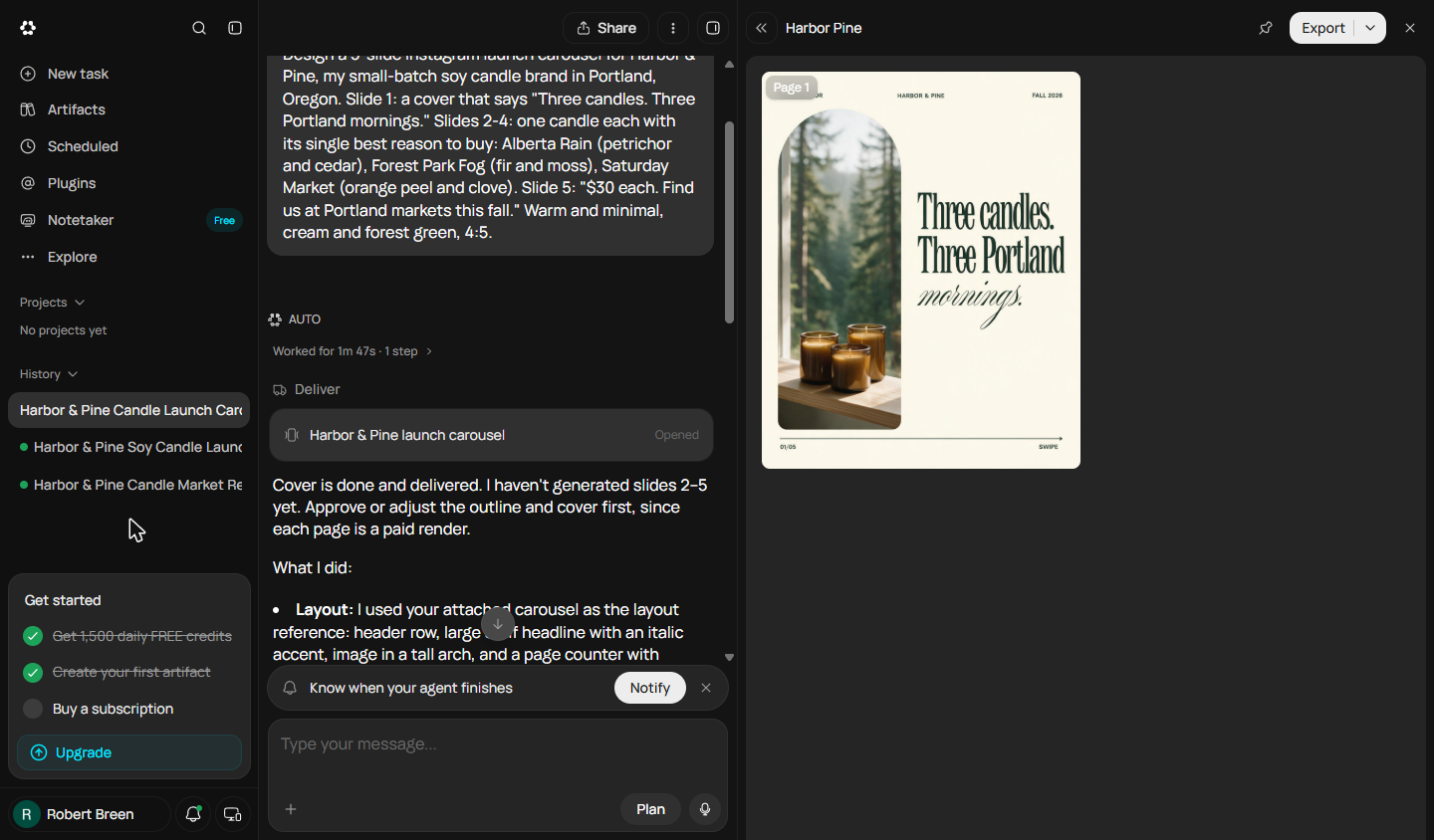
8. Posting without reading every slide. Image models draw letters as part of the picture, so small text can come out wrong. In the Instagram carousel lesson, slide 3's header read HARBOR & PIN2. Zoom in on every slide, including the small print, before you export.
A related surprise: asking Runable to fix that one word fixed the header, but it also told us the regenerated slide had a new photo and a new layout, kept the old version, and suggested fixing small text by hand in the editor. For one word, a manual edit is often faster and cheaper.
Is running out of credits a mistake too?
It can be. Images cost far more credits than text. In our run the research brief and one follow-up used 562 credits, the plan and its fix used 14, and five slides plus one fix used about 450. The Free plan showed 1,500 credits a day in October 2026. Runable rendered only the carousel cover first and stopped, because each slide is a paid render: approve the look before it makes five. Check runable.com/pricing for current limits.
Key takeaways
- Brief Runable like a contractor, and read its scope before you approve it.
- Open the sources; ask which numbers are estimates.
- Replace every template's sample prompt with your own facts.
- List the [A] lines and divide the key numbers yourself.
- Zoom in on every slide; fix one word by hand. The cheat sheets for research, the plan and the carousel have each workflow on one page, and Runable is in the AI tools directory.
Frequently asked questions
- Did Runable make these mistakes, or did we?
Mostly they are checks for the person using it. Runable flagged several itself: it asked to confirm the scope, separated estimates from checked prices, and explained what a slide fix changed.
- How do I know which plan lines to check first?
Start with every line tagged [A], then any number that drives price, cost or quantity.
- Why did fixing one word change the whole slide?
Asking Runable for the fix regenerated the slide. It kept the old version, so you can compare.
- Where are the files from these runs?
See the Harbor & Pine templates page. For more answers, read the Runable FAQ.