n8n vs Make: Which Automation Tool Fits You (2026)
Quick answer
Pick Make if you like a visual builder, want a low entry price and your workflows are short to medium in length. Pick n8n if your workflows have many steps, include AI agents, or you want the option to host it yourself, because n8n counts one whole workflow run as a single execution while Make counts each action as a credit. Both are visual, both connect Gmail and Google Sheets without code, and both have a free way to start.
Last updated
Take the free module →Module 6 of the free Intro to AI Automation course, about 12 minutes. No account needed.
This page is for office managers, operations staff and small-business owners deciding between the two. Prices below are as listed on each vendor's own pages as of October 2026. Disclosure: Stepthrough has an affiliate relationship with n8n, so I may earn a commission, at no cost to you, if you sign up through an n8n link on Stepthrough. There are no affiliate links on this page, and every figure comes from the vendors' own pages. Try both free: the AI Social Media Idea Agent lesson uses n8n and the Make: Your First Scenario lesson uses Make.
How do they compare at a glance?
| n8n | Make | |
|---|---|---|
| How usage is counted | Executions: one run of the entire workflow, however many steps it has | Credits: most actions cost 1 credit; the Router and error handler modules are not counted, and some AI features can use more |
| Free option | Community Edition is free to self-host; an n8n Cloud trial needs no credit card (1,000 executions, Pro-level features) | Free plan: 1,000 credits a month, routers and filters, 15-minute minimum interval between runs |
| Entry paid plan | Starter (n8n Cloud): €20 a month billed annually for 2,500 executions | Core: $12 a month billed annually ($13 monthly) at 10,000 credits, with unlimited active scenarios and scheduling down to the minute |
| Next tier up | Pro: €50 a month billed annually for 10,000 executions. Business: €667 a month billed annually, self-hosted | Pro: $21 a month billed annually ($22 monthly) adds priority execution, custom variables and full-text log search. Teams: $38 ($41 monthly) adds team roles |
| Best for | Longer workflows, AI agents, higher volume, teams who may self-host | Visual builders on a budget, short to medium scenarios, scheduled jobs |
| File handling | Self-hosted editions can use external storage for binary data (a paid-edition feature). Cloud plans cap run time: 5 minutes on Starter, 40 minutes on Pro | Each 10,000 credits comes with 5 GB of data transfer and 10 MB of data storage a month |
| Privacy and data controls | Cloud is hosted in the EU. n8n says its security program aligns to SOC 2 and it runs third-party penetration tests at least once a year. Self-hosting means you secure the server. SSO and LDAP start on the Business plan | Make says it has completed SOC 2 Type II and SOC 3 audits, runs an ISO 27001 certified security program and adheres to GDPR. Data is encrypted at rest (AES-256) and in transit (TLS 1.2 and 1.3). Log data is stored for 30 days by default |
| Integrations | 2,367 integrations listed, plus an HTTP Request node for services without a ready-made node | 3,500+ apps listed on its plan page (its FAQ cites more than 1,000 third-party apps) |
| Free Stepthrough lesson | Yes, several | Yes, Make: Your First Scenario and more |
What is the main difference between n8n and Make?
The main difference is what each tool counts. Make counts credits: reading, searching, creating, updating or deleting app data, reading from a webhook and built-in data transformations each cost a credit, while the Router module and error handlers do not. n8n counts executions: a single run of the entire workflow, no matter how many steps are inside it.
Both show your workflow as boxes joined by lines on a canvas, so the feel is similar. The bigger practical differences are that n8n can be self-hosted and has a dedicated AI Agent node, while Make has a very low entry price and a large app directory.
Is n8n or Make cheaper?
For light use, Make is often cheaper. Take a made-up workflow that starts from a new form entry and then does four things: an AI step, a Google Sheets row, an email and a Slack message. At 500 runs a month, that is roughly 2,500 credits on Make (five module actions, 500 times), which fits in the 10,000-credit amount its pricing slider starts with, at $12 a month billed annually on Core. On n8n it is 500 executions, which fits inside Starter's 2,500 at €20 a month billed annually. So Make wins that example on price.
Now lengthen the workflow. A ten-step workflow running 2,000 times a month is about 20,000 credits on Make, while on n8n it is still 2,000 executions, inside Starter's 2,500. Make's pricing slider shows the price at each credit level, so check it for your own numbers. As a rule, the longer your workflows and the more steps inside loops, the more n8n's per-run counting helps. Make's AI features can use more than one credit per action, and n8n's AI model is billed separately by its provider.
Prices change, so confirm on the Make pricing page and the n8n pricing page. For all three big tools side by side, see Zapier vs Make vs n8n.
Which is better for AI agents?
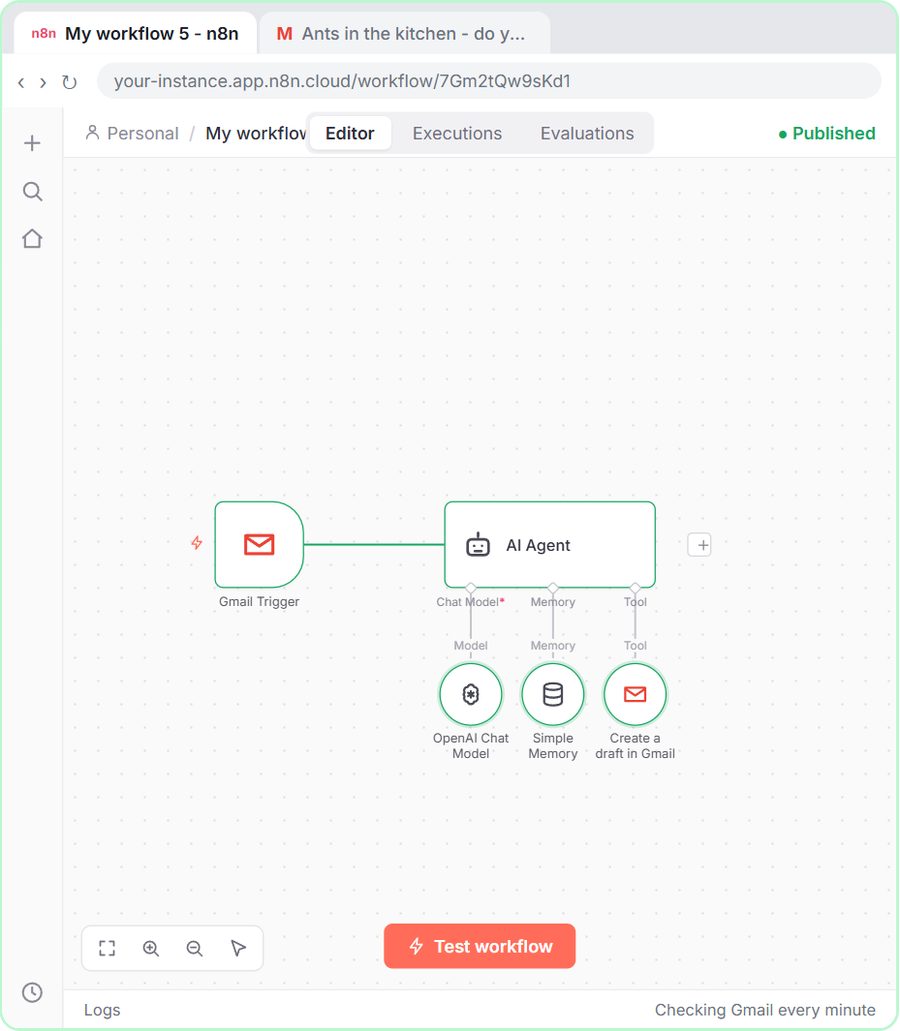
n8n is the one Stepthrough teaches for agents. Its AI Agent node lets you attach a chat model, memory and tools such as Google Sheets in one place, and the agent's inner steps do not raise your execution count. Make also has AI features, and its pricing FAQ notes that features using Make's AI Provider may use more than one credit.
If you only need an AI step inside a short scenario, such as drafting a reply, either tool works. The free Make: Add AI to a scenario lesson and the AI Email Responder lesson show each approach. The AI model itself, such as the OpenAI API, is a separate bill from your ChatGPT plan.
Which is easier to learn?
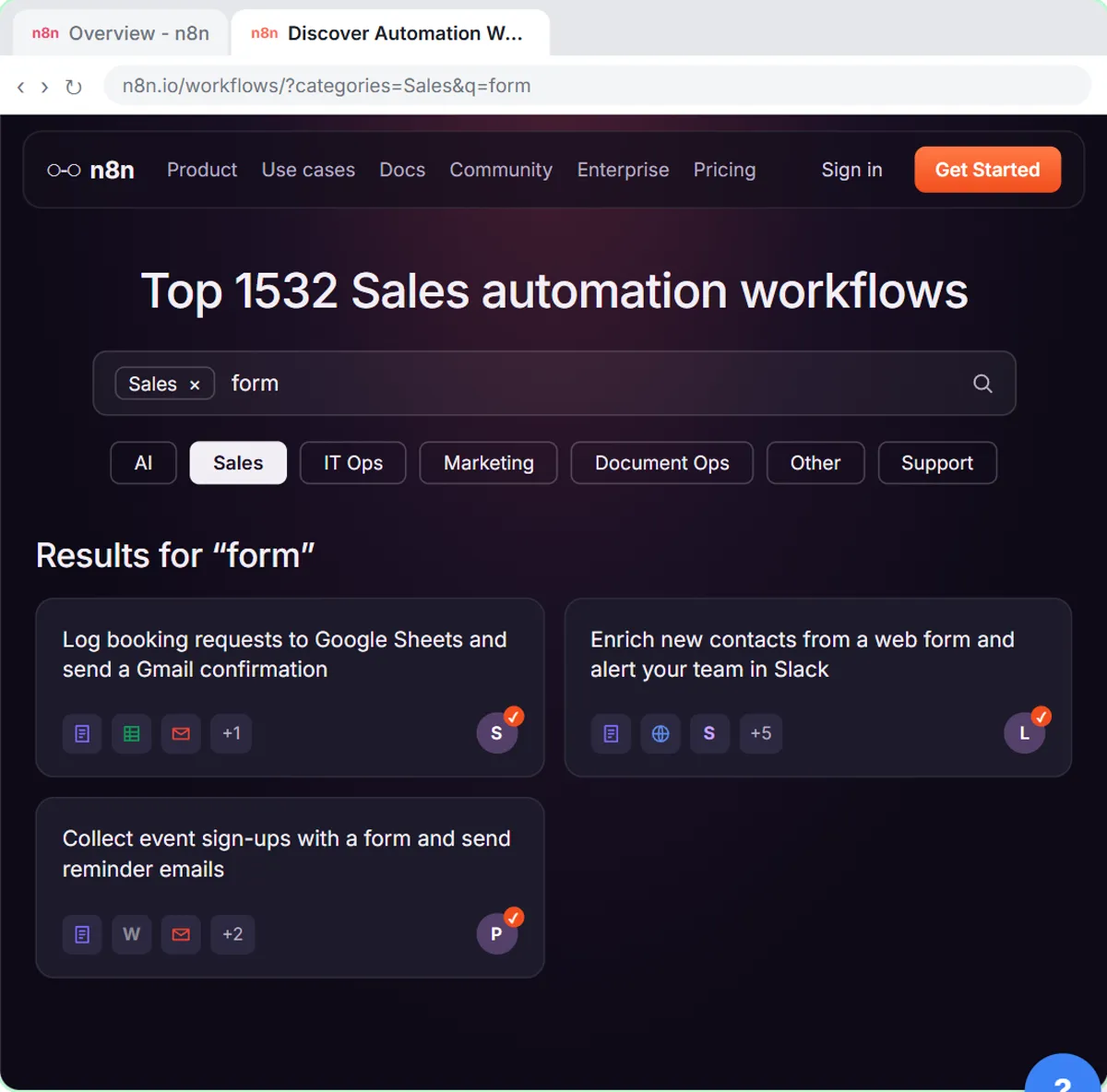
They are close. Make's free plan includes routers and filters, so you can build a branching scenario without paying, and its visual layout is friendly for people who like to see data move. n8n asks for a little more technical comfort, mostly around expressions and testing nodes, but n8n Cloud runs in your browser and the free Find and Use n8n Templates lesson lets you start from a finished workflow.
Skills transfer between them: triggers, mapping fields, filters, and testing with sample data are the same ideas. Learn one and the second takes far less time.
Can I host Make or n8n myself?
You can host n8n yourself: the Community Edition is free, and n8n's docs say the infrastructure is then your responsibility and technical knowledge is required. Make runs as a hosted service. If you do not want to run a server, n8n Cloud and Make are both hosted for you.
Who is each one for?
Pick Make if
You want a visual builder with a low entry price, your scenarios are short to medium, and you like scheduling jobs down to the minute on a paid plan. Make's free plan includes routers and filters, so you can try a branching scenario at no cost. Start with the free Make: Your First Scenario lesson.
Pick n8n if
Your workflows are long, include AI agents, or run in high volume, or you want to self-host later. It is the tool behind most free Stepthrough automation lessons, including versions for sales, operations and finance.
Which of these tools have a free Stepthrough lesson?
- n8n: free lesson: n8n AI Agent Tutorial: Save Social Media Ideas to Google Sheets
- Make: free lesson: Your First Make.com Scenario: Google Forms to Google Sheets
Practice it free, step by step
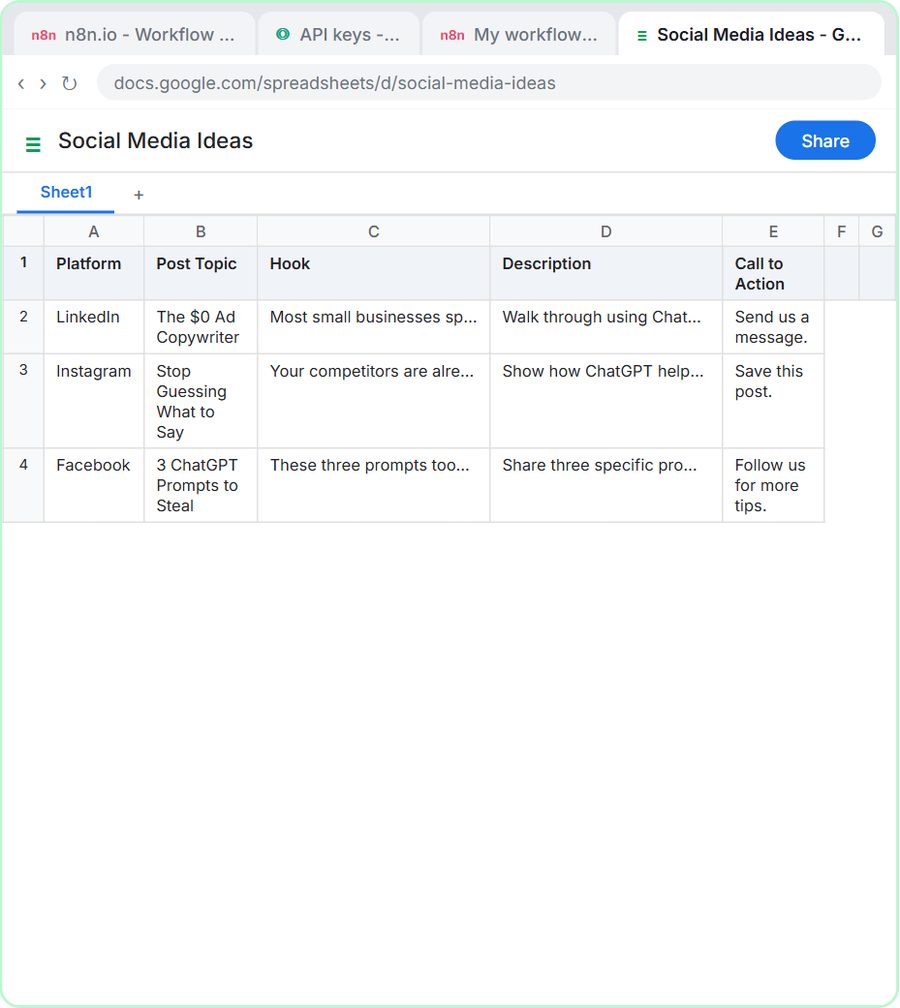
n8n AI Agent Tutorial: Save Social Media Ideas to Google Sheets. Build an AI agent for BrightPath Marketing that generates social media post ideas and saves them to Google Sheets — chat trigger, AI Agent, system prompt, model, memory, and the Sheets tool. You do every step yourself in a practice copy of n8n, it checks your work as you go, and “Do it for me” finishes any step you get stuck on. Free, and nothing touches your real accounts.
Start the free lessonWatch it in a free lesson: n8n AI Agent Tutorial: Save Social Media Ideas to Google Sheets
 8:07
8:07AI Social Media Idea Agent: video walkthrough
Build an AI agent for BrightPath Marketing that generates social media post ideas and saves them to Google Sheets — chat trigger, AI Agent, system prompt, model, memory, and the Sheets tool. The whole lesson narrated step by step, recorded in Stepthrough’s simulated practice environment.
Key takeaways
- Make counts credits (most actions cost 1) and n8n counts executions (one per whole run), so n8n's cost grows slower as workflows get longer, while Make can be cheaper for short, light workflows.
- As of October 2026, Make Core is $12 a month billed annually at 10,000 credits and n8n Cloud Starter is €20 a month billed annually for 2,500 executions.
- n8n can be self-hosted for free; Make is hosted only.
- Both are visual and both have a free way to start, so build the same small workflow in each before you pay.
Frequently asked questions
Is Make free?
Make has a Free plan with 1,000 credits a month, routers and filters, and a 15-minute minimum interval between runs. Unlimited active scenarios and minute-level scheduling start on the paid Core plan.
Is n8n free?
The self-hosted Community Edition is free to run, but you provide and secure the server. n8n Cloud is a paid plan with a trial that does not require a credit card.
Which has more integrations, n8n or Make?
Make lists 3,500+ apps on its plan page and n8n lists 2,367 integrations. n8n also has an HTTP Request node for services without a ready-made node, so the raw count matters less than whether your specific apps are covered. Check both directories for the apps you use.
Do I need to code to use n8n or Make?
No. Both are built from visual steps, and the free Stepthrough lessons for each are clicks and plain English. Code is optional in both for advanced cases.
Where do these prices and features come from?
Every price and feature on this page was checked against the vendor's own page, as of October 2026. No numbers here are estimates or third-party figures. The example businesses in the Stepthrough lessons are made up.