What is a query parameter in an API request?
Quick answer
A query parameter is a name and a value added to the end of a web address, after a question mark, that tells an API what you want back. In https://jsonplaceholder.typicode.com/users?username=Samantha, the query parameter is username=Samantha, and the API sends back only the matching record instead of the whole list.
Last updated
Take the free module →Module 4 of the free n8n Intermediate: Real Business Workflows course, about 9 minutes. No account needed.
Updated · By Robert Breen
Why it matters for a small business
Real apps hold thousands of records. If a workflow pulls them all and filters afterwards, it is slow, it moves data you never needed, and it can hit the app's rate limit. Query parameters move the filtering to the app, so only what you asked for comes back. They are also how most APIs handle paging, sorting and date ranges, for example page=2 or since=2026-10-01.
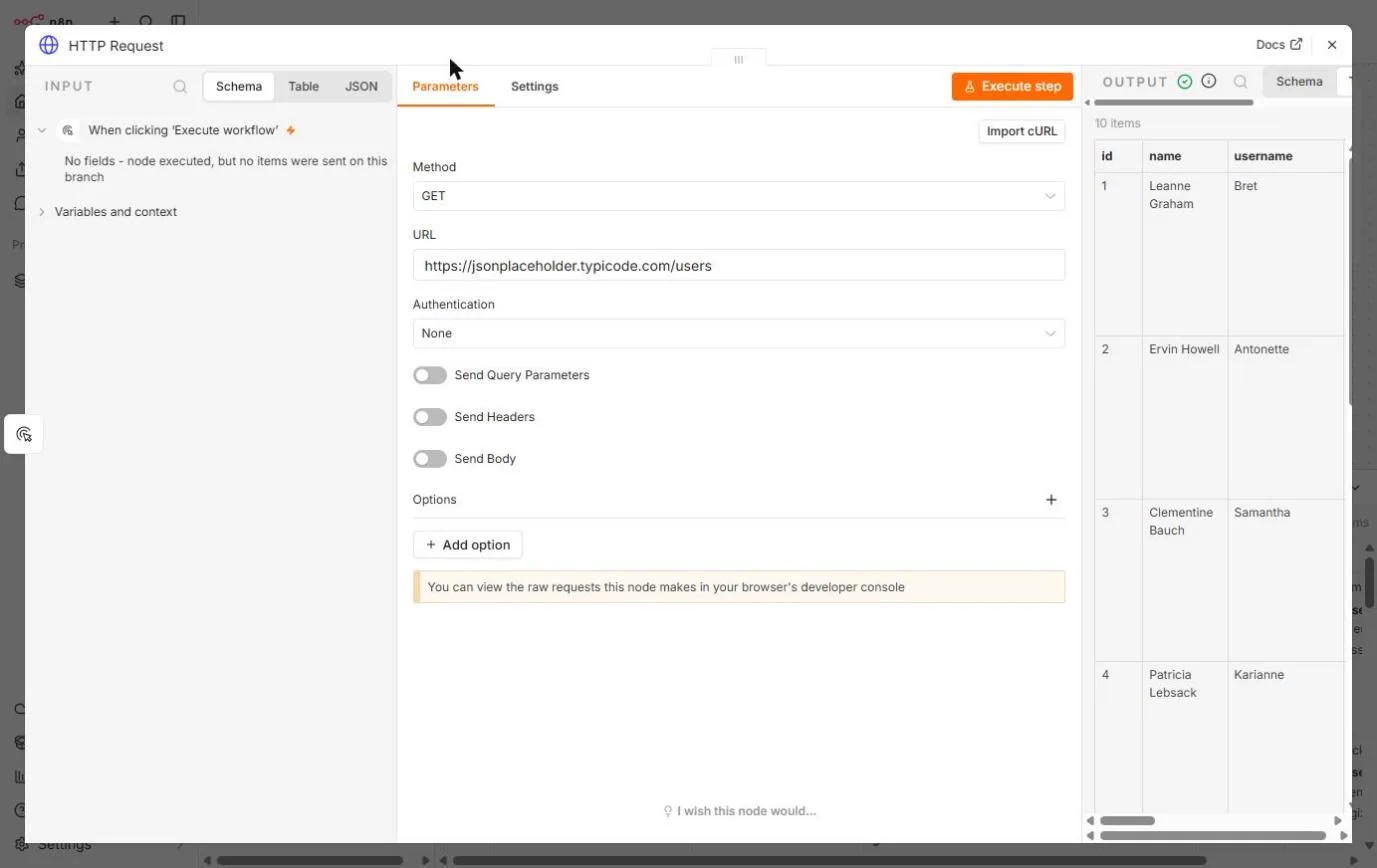
Each API decides which parameters it accepts, so the place to look is its API docs. In n8n you rarely type the question mark yourself: in the HTTP Request node, turn on Send Query Parameters and add each name and value as a field, and n8n builds the address for you.
In a real lesson: n8n: Call Any API with the HTTP Request Node
In the free n8n HTTP Request lesson, Harbor Lane Marketing (a made-up agency) pulls its client list from a practice CRM, JSONPlaceholder. A GET request to https://jsonplaceholder.typicode.com/users returns 10 items, one per client.
The agency only needs one client, so you turn on Send Query Parameters, leave Specify Query Parameters on Using Fields Below, and add Name username and Value Samantha. Click Execute step again and the output drops to 1 item: Clementine Bauch at Romaguera-Jacobson. The API did the filtering, so the workflow only carries the record it needs.
Try this lesson free or read the step-by-step guide.
Common confusions
Query parameter vs request body
A query parameter sits in the address and usually narrows what you read with GET. The request body carries the data you send with POST, such as a new note or contact.
Query parameter vs path
The path is the part of the address before the question mark, like /users, and says which list you mean. Query parameters come after it and say which records in that list.
Tips
- Check the API docs for the exact parameter names. A misspelled one is usually ignored, and you get everything back.
- Never put an API key in a query parameter if the app offers a header or a saved credential instead. Addresses end up in logs.
Related terms
More n8n and automation terms
Where you use it: free lessons
- n8n: Call Any API with the HTTP Request Node (n8n, 9 min)
- Litescrape in n8n: Swap SerpApi for a Cheaper Search API (n8n, 7 min)
Frequently asked questions
- Where do query parameters go in n8n?
- In the HTTP Request node: turn on Send Query Parameters and add a Name and a Value for each one. n8n adds them to the URL after a question mark.
- Can I use an expression in a query parameter?
- Yes. Drag a field from the INPUT panel onto Value, and each item sends its own value, for example a different username per row.