What is a policy engine for AI agents?
Quick answer
A policy engine is software that checks each action an AI agent or automation wants to take against written rules, before the action runs. It answers allow, block or hold for a person to approve, and it keeps a record of every answer it gives.
Last updated
Take the free module →Module 18 of the free n8n Jump Start course, about 14 minutes. No account needed.
Updated · By Robert Breen
Why it matters for a small business
An agent that drafts client emails or updates records saves hours, right up until it does one thing that cannot be undone. Most offices react by checking every output by hand, which hands back most of the time the agent saved. A policy engine turns that manual check into a rule: routine actions pass, risky ones stop and wait, and forbidden ones never happen at all.
It also keeps the rules apart from the agent. A line in a prompt is a request the model usually follows. A policy engine sits outside the model and judges the action itself (the recipient, the amount, the record), so a confused or manipulated agent still hits the same wall. Owners can read, test and change the rules without rebuilding the workflow, and the log of decisions doubles as an audit trail.
One Guardian policy, three answers
| What the agent asks for | What Guardian checks | Answer |
|---|---|---|
| email.send to team@harborline.example | recipient is on the allowed list | ALLOW |
| email.send to dana@brightpathdental.example | recipient is not on the list | REQUIRE APPROVAL |
| record.delete | no policy exists for this action type | Denied by Deny unmatched actions |
In a real lesson: Guardian: Make Your n8n AI Agent Ask Before It Emails a Customer
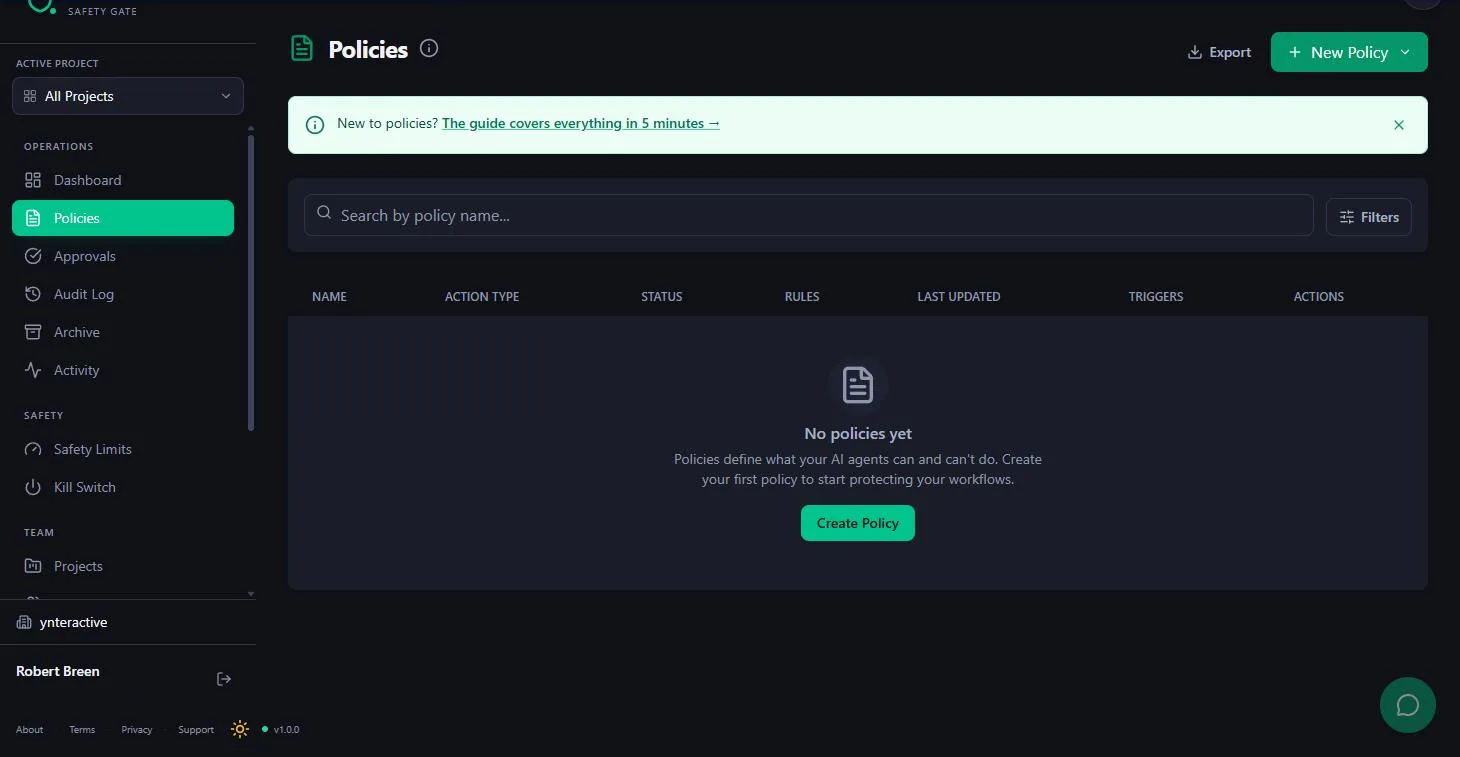
In Guardian: Make Your n8n AI Agent Ask Before It Emails a Customer, Maya Chen at Harbor Line Bookkeeping (made up) has an n8n agent that drafts about 60 invoice reminders a month. You open Policies, click New Policy, choose Manual, name it Customer emails need approval and type the action type email.send. The rule is Only allow specific values: Guardian looks at the recipient field, lets two team inboxes through and sends every other address to Require Approval with a written reason.
Before saving, Test This Policy runs the rule against a sample payload. The team address returns ALLOW. A reminder to Dana at Brightpath Dental returns REQUIRE APPROVAL with the reason underneath. After Create, Guardian shows the call your workflow will make, POST /v1/intents/check with the action type and payload. In n8n the Guardian node makes that call, and only its Allowed output is wired to the send step.
Try this lesson free or read the step-by-step guide.
Common confusions
Policy engine vs guardrails
Guardrails is the umbrella word for every limit on an AI system, including prompt rules and topic limits. A policy engine is one specific guardrail: a separate checker that rules on each action before it happens.
Policy engine vs approval workflow
An approval workflow is the path a request takes to a person. The policy engine decides which requests need that path at all and lets the routine ones straight through.
Tips
- Write the rules as plain sentences first, then turn each one into a rule.
- Make the field name in a rule match the payload exactly. A typo means the rule never fires and nothing warns you.
- Test one action that should pass and one that should not before you save.
- Leave the default for unknown actions set to deny.
Related terms
More AI agents terms
Where you use it: free lessons
- Guardian: Make Your n8n AI Agent Ask Before It Emails a Customer (Guardian, 14 min)
- Connect Claude to Google Drive, Gmail and Google Calendar (Claude, 8 min)
- Answer Client Emails in Half the Time using Lindy (Lindy, 14 min)
AI tools that use it
Frequently asked questions
- Is a policy engine the same as a prompt rule?
- No. A prompt rule asks the model to behave. A policy engine checks the action from outside the model, so it holds even when the model ignores its instructions.
- Does a policy engine slow an agent down?
- It adds one check before each action. Allowed actions carry on, and only the held ones wait for a person, which is the pause you asked for.
- Do I need to write code to use one?
- Not with Guardian. The lesson builds the rule in the Manual policy builder, and in n8n a Guardian node sends the check, so there is no code to write.