What are AI guardrails?
Updated · By Robert Breen
AI guardrails are the combined rules, limits and checks that keep an AI assistant or agent inside safe bounds: what topics it handles, what it must never say or promise, which actions it can take, and when a person has to approve the result.
Why it matters for a small business
An AI that writes for your business speaks in your name. Without guardrails it may promise a discount you don't offer, make a health claim your industry forbids, or flood a customer list with more emails than you'd ever send. Each of those is a cost you only find out about afterward.
Guardrails come in layers. Some are written into the instructions ("never invent a discount"). Some are structural, like giving the agent a spreadsheet tool but no email-sending tool, or marking everything it produces as a draft. The structural ones still hold when the model misreads an instruction.
In a real lesson: Build an n8n AI Agent That Plans Your Content Calendar
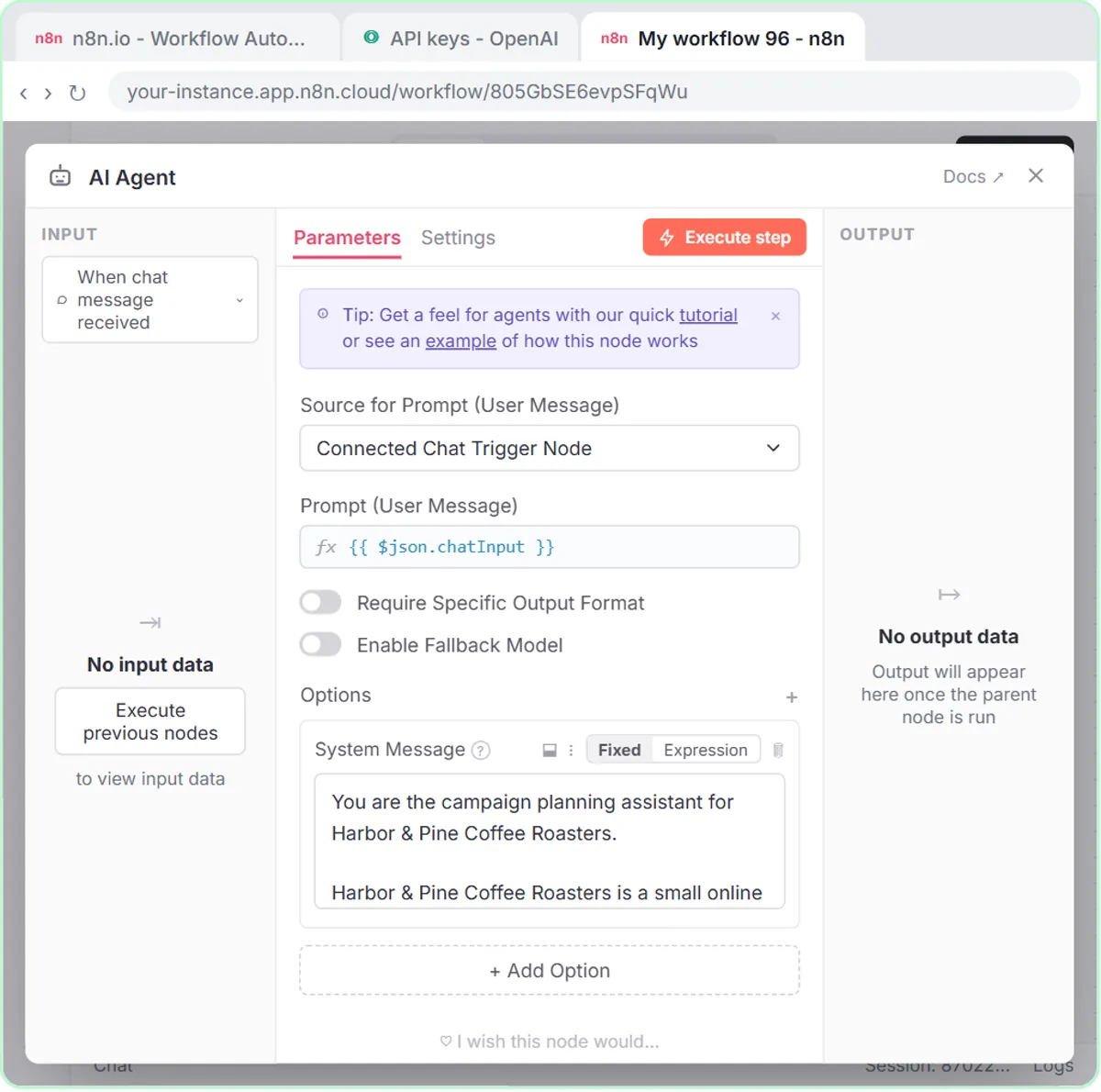
In Build an n8n AI Agent That Plans Your Content Calendar, the agent turns one campaign theme for Harbor & Pine Coffee Roasters (a made-up coffee brand) into a two-week email and content calendar. Its system prompt is full of guardrails: send no more than 2 emails a week, only mention offers the user gives you, never invent a discount, and do not make health claims or invent reviews.
One guardrail is built into the output itself: every calendar item has a Status field that is always "Draft". When you test with the Holiday Ember Blend launch starting Monday Nov 2, the only offer the agent may use is the one you supplied, free shipping over $35.
The structure adds another layer. The agent's only tool is Google Sheets, so the worst it can do is add rows to a calendar sheet someone reviews. It can't post to Instagram or send an email by itself, which keeps a person between the AI and your customers.
Try this lesson free or read the step-by-step guide.
Common confusions
Guardrails vs prompt constraints
Prompt constraints are rules inside the prompt. Guardrails include those plus everything around the model: limited tools, review steps, input filtering and logs.
Guardrails vs content filters
AI providers apply their own safety filters for harmful content. Those don't know your business rules, like which offers are real or how often you email customers. Your guardrails cover that.
Tips
- List the three mistakes that would hurt most, and write a specific rule for each.
- Back up important rules with structure: draft status, fewer tools, a review step.
- Test with a request that tempts it to break a rule, like "add a 20% off code," and see what it does.
Related terms
Where you use it: free lessons
- Build an n8n AI Agent That Plans Your Content Calendar (n8n, 12 min)
- AI Email Responder: Draft Gmail Replies Automatically with n8n (n8n, 12 min)
- Build a Custom GPT That Writes Overdue Invoice Reminders (ChatGPT, 8 min)
Prompt templates that use it
Frequently asked questions
- Do guardrails make an AI agent completely safe?
- No. They lower the odds and limit the damage of mistakes. Review and testing still matter, especially for anything customers see.
- Where do I set guardrails in n8n?
- In the AI Agent's System Message for rules, and in which tools and permissions you connect for limits on what it can actually do.