What is an instant trigger?
Quick answer
An instant trigger starts an automation the moment something happens, because the app sends the data straight to the automation tool, usually through a webhook. A polling trigger works the other way: the tool asks the app "anything new?" on a timer, such as every 15 minutes. Make and Zapier label instant triggers with the word Instant.
Last updated
Take the free module →Module 8 of the free Make & Zapier Jump Start course, about 12 minutes. No account needed.
Updated · By Robert Breen
Why it matters for a small business
Speed is the obvious gain. A web lead handled in seconds gets a reply while the person is still on your site; one handled on a 15-minute check may have already called a competitor. For urgent requests, missed calls or new orders, that gap matters.
Usage is the quieter gain. A polling trigger runs every check, even when nothing is new, and in some tools each check counts toward your plan. An instant trigger only runs when there is real data. The cost is setup: you usually paste a webhook address into the other app, and you must treat that address like a password.
Where you'll use it: when you pick a trigger in Make or Zapier, look for the Instant label; Make's Custom webhook is one. In n8n, the Webhook node and many app triggers are instant, while some, like the Gmail Trigger, poll on a schedule you set. The lessons below show both kinds side by side.
In a real lesson: Webhooks: Connect a Website Form to Make.com
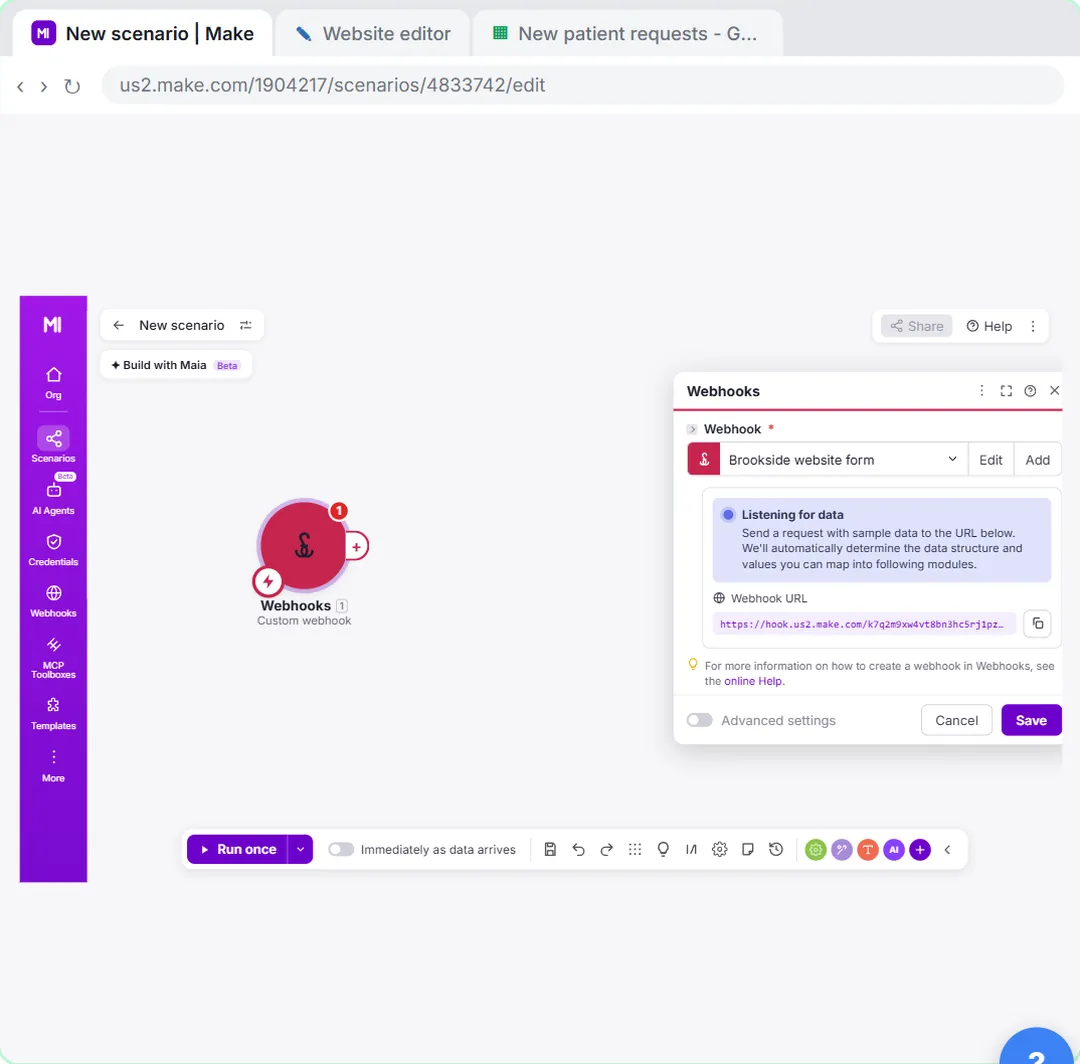
In the free Webhooks: Connect a Website Form to Make lesson, Brookside Dental's own website form sends requests to Make. You choose the Custom webhook trigger, and the lesson points out its instant tag: it runs the moment a request arrives, instead of checking on a timer. You copy the webhook address into the form's integration settings and publish the form.
At the end you switch the scenario to Immediately as data arrives, so each request lands in Google Sheets within seconds. Compare that with the first Make scenario, whose Google Forms trigger checks every 15 minutes.
Try this lesson free or read the step-by-step guide.
Common confusions
Instant trigger vs schedule trigger
A schedule trigger runs at set times whatever happens. An instant trigger waits for an event, and a polling trigger checks for events on a timer.
Instant does not always mean zero delay
Some apps batch or queue their webhook calls, so instant usually means seconds, not a guaranteed exact moment.
Tips
- Prefer an instant trigger for leads, alerts and anything a customer is waiting on.
- Keep the webhook address private, and add a check such as a webhook signature when the app supports one.
- Make your steps safe to run twice, because some apps resend events.
Related terms
More n8n and automation terms
Where you use it: free lessons
- Webhooks: Connect a Website Form to Make.com (Make, 12 min)
- Your First Make.com Scenario: Google Forms to Google Sheets (Make, 12 min)
- Never Miss a New Client Inquiry using Zapier (Zapier, 10 min)
- Zapier: ChatGPT Drafts Every Reply, Signatoro Signs It (Zapier, 12 min)
Frequently asked questions
- How do I know if a trigger is instant?
- In Make and Zapier, instant triggers carry an Instant label in the trigger list. If there is no label, assume it polls on a timer.
- Is an instant trigger always better?
- For speed, yes. For a daily summary or report, a schedule is simpler and does the job.