What is idempotency in automation?
Quick answer
Idempotency means an action has the same effect whether it runs once or many times. Updating a row to "paid" is idempotent: doing it twice leaves the same row. Adding a row or sending an email is not, because each run adds another. In automation, idempotent steps make retries and repeated events safe.
Last updated
Take the free module →Module 7 of the free n8n Jump Start course, about 10 minutes. No account needed.
Updated · By Robert Breen
Why it matters for a small business
Automations repeat things more often than people expect. A busy server makes a step retry, an app sends the same webhook twice, or someone re-runs a failed execution. If the step is "charge the card" or "send the invoice", each repeat is a real cost. Designing steps so a repeat changes nothing is cheaper than cleaning up afterward.
The usual tools are simple. Match on a unique field and update instead of always adding, which is an upsert. Mark records as done, such as a status of posted, and skip anything already marked. For payment and order APIs, send an idempotency key, a unique ID per request that tells the app "if you have seen this one, do not do it again".
Where you'll use it: whenever you turn on Retry On Fail, add an instant trigger, or re-run a failed execution, ask "what happens if this step runs twice?". In n8n, Google Sheets Append or Update Row, status columns and the Remove Duplicates node are the everyday ways to get there.
In a real lesson: Get Alerted When an n8n Automation Fails, and Let It Retry by Itself
In the free n8n error handling lesson, Maple Lane Florist turns on Retry On Fail so a busy supplier server gets three tries. The lesson adds a warning: only turn retries on for steps that are safe to repeat, never one that charges a card. Updating the price sheet is safe; a payment is not.
The Sheet to Social with Blotato lesson shows another pattern: each morning the workflow takes the first row marked ready and marks it posted, so the same post never goes out twice.
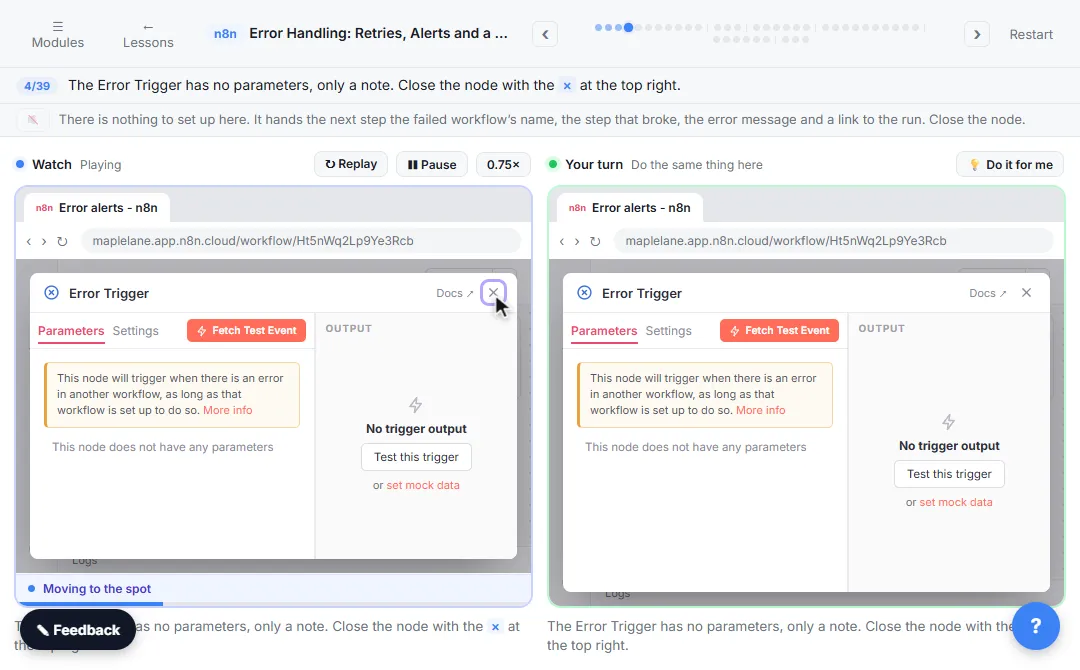
Try this lesson free or read the step-by-step guide.
Common confusions
Idempotency vs deduplication
Removing duplicates filters out repeated records. Idempotency makes the action itself harmless to repeat. Use both for important steps.
Idempotent vs read-only
Reading data is always safe to repeat. Idempotency matters for steps that change something.
Tips
- For every step that writes or sends, ask what a second run would do.
- Prefer update or upsert over add when a record may already exist.
- Keep a status column and check it before acting.
Related terms
More n8n and automation terms
Where you use it: free lessons
- Get Alerted When an n8n Automation Fails, and Let It Retry by Itself (n8n, 10 min)
- Post to Every Channel Daily from One Sheet using n8n + Blotato (n8n and Blotato, 14 min)
- n8n: Read, Add and Update Google Sheets Rows with an AI Step (n8n, 12 min)
Frequently asked questions
- Is sending an email idempotent?
- No. Each run sends another email. Check a status or a log first, or save a draft instead of sending.
- What is an idempotency key?
- A unique ID you send with a request, often to a payment API, so the app ignores a repeat of the same request.