The example business is Northfield Bookkeeping, a made-up 6-person firm in Columbus run by Dana Ortiz (also made up). She wants to sell a monthly fractional CFO package and needs to know what the market pays.
What are the most common Felo research mistakes?
Nine mistakes cover almost everything that went wrong, or nearly went wrong, in the lesson:
| # | Mistake | Fix |
|---|---|---|
| 1 | Trusting a citation without opening it | Point at the number, read the card, open the page |
| 2 | Believing the table's own label for a source | Check the site name on the card yourself |
| 3 | Stopping after the first answer | Ask a follow-up for a Source type column and the page URL |
| 4 | Not re-reading the table after a follow-up | Read every row again, firms can change |
| 5 | A short, vague question | Say who is asking, what to find, and the rules |
| 6 | Leaving Pro off for a money question | Turn on Pro before you send |
| 7 | Treating estimates like published prices | Keep the Estimate? Yes rows separate |
| 8 | Not checking that a page is current | Look for a date or a 2026 price on the page |
| 9 | Running out of credits mid-task | Check the credits pill and Usage Details |
Why is trusting a citation the biggest mistake?
A citation tells you where to look. It does not prove the number is on that page, that the page is current, or that it belongs to the company you are pricing against. The lesson's learning card puts it plainly: AI can quote a comparison article as if it were the company, or mix up two prices.
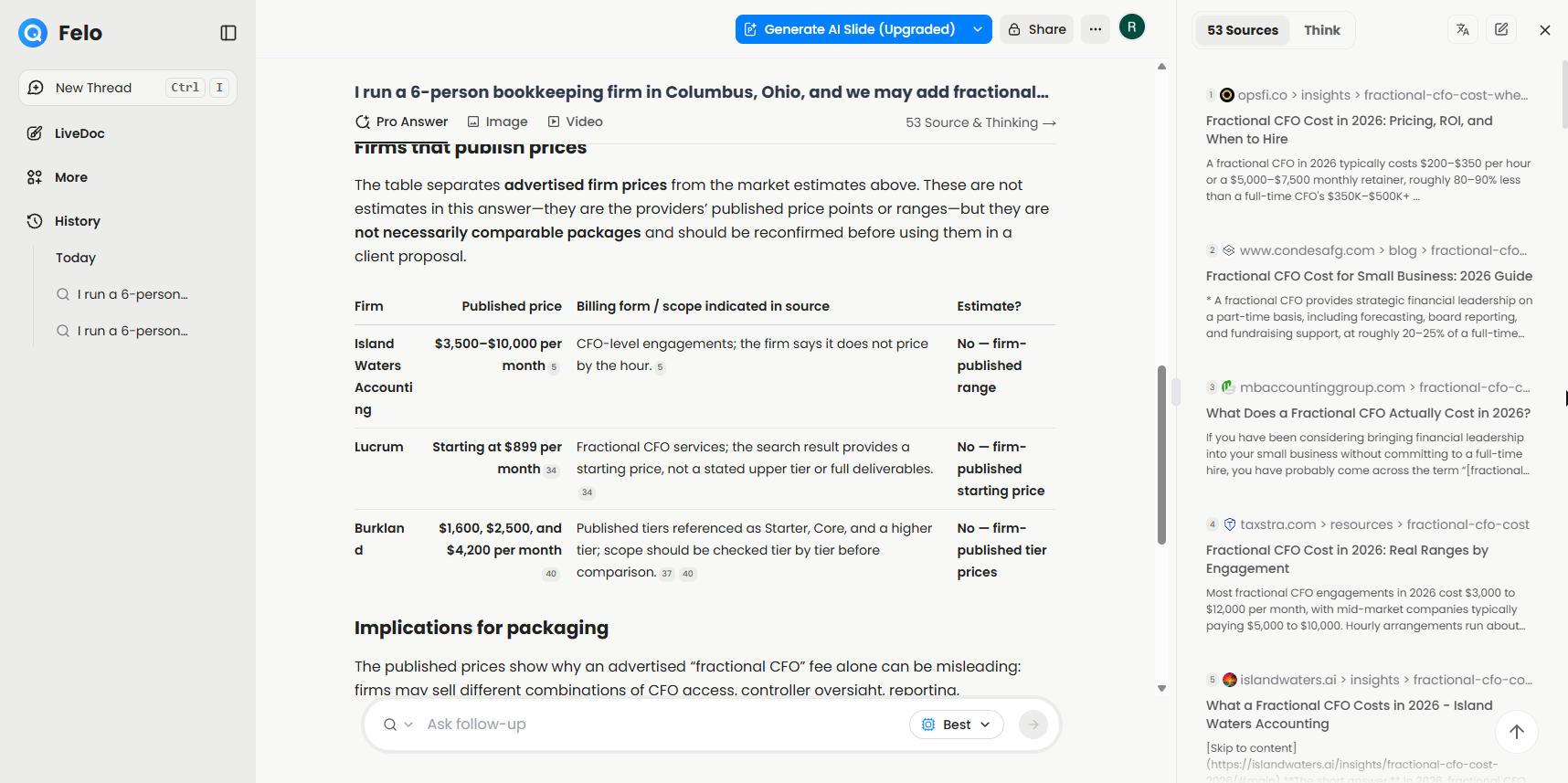
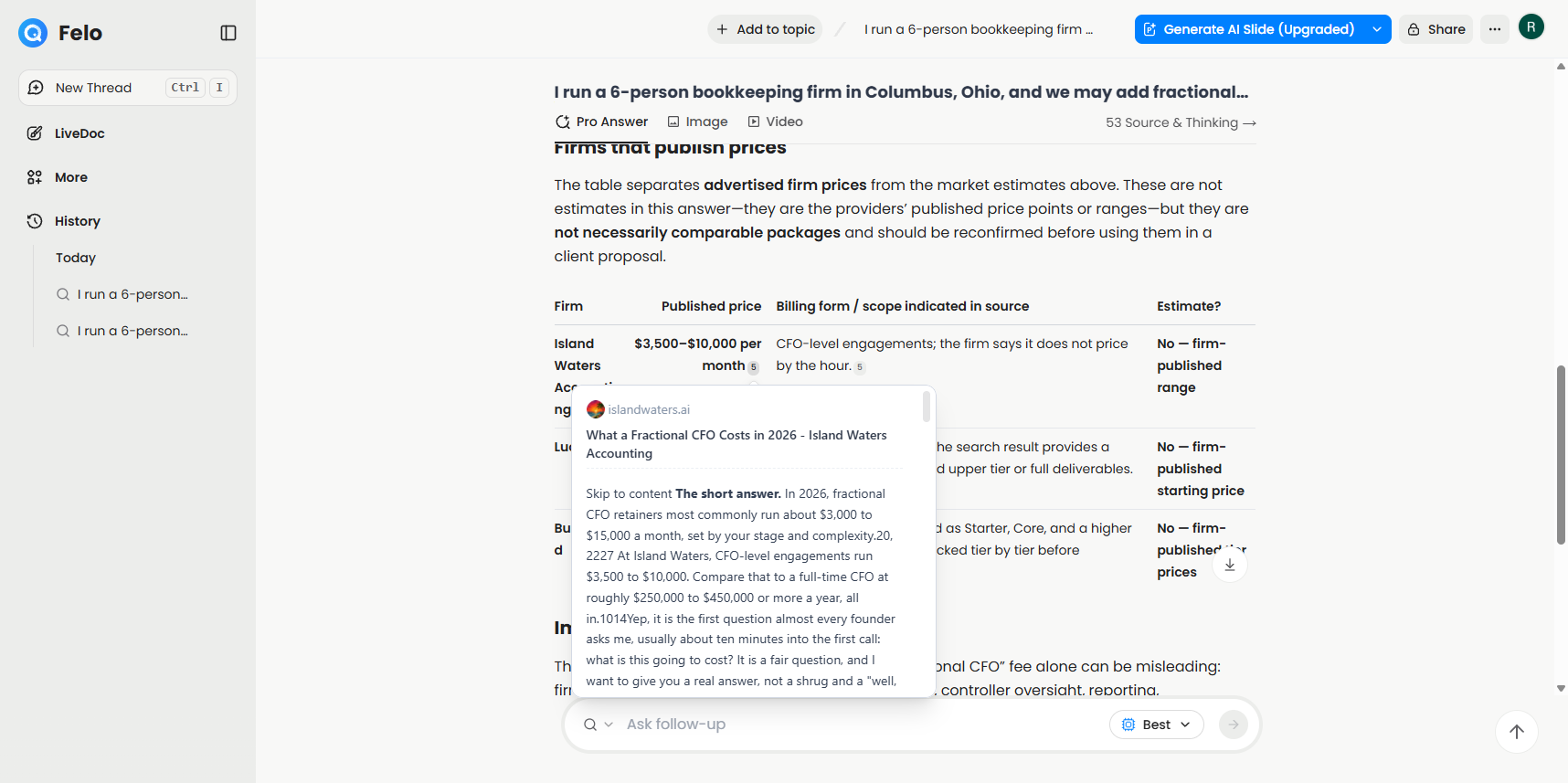
1. Trusting a citation without opening it. In Felo, each claim ends in a small number. Point at it and a card shows the page and a snippet. In our run, source 5 next to Island Waters was islandwaters.ai, and its card said CFO-level engagements run $3,500 to $10,000. That matched the answer. That is what a good check looks like: the number is on the page, and the page is the firm's own.
2. Believing the table's own label. The first answer's table said Burkland's prices were firm-published. Pointing at source 40 showed www.weaudit.com and an article titled "Fractional CFO Companies: 9 Firms Compared". The price may still be right, but it is second-hand. If you are about to put a competitor's price in a proposal, second-hand is not good enough.
The AI citations entry explains why a link next to a claim is a pointer, not proof, and source verification covers the habit of opening it.
What goes wrong after the first answer?
Most people read the first answer, like it, and stop. The lesson shows why one follow-up is worth the 15 credits.
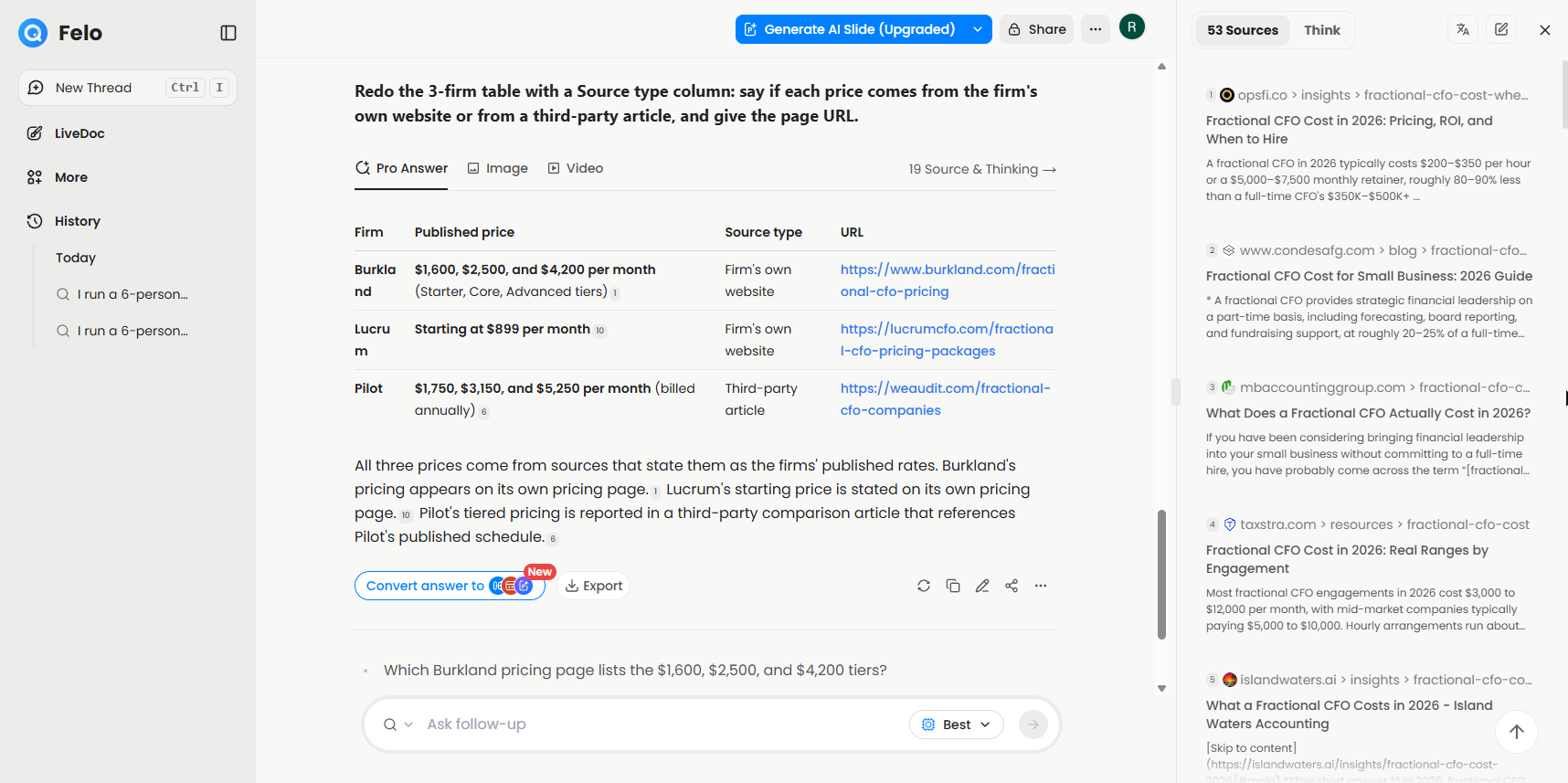
3. Stopping after the first answer. Once you spot a second-hand source, ask Felo directly. The follow-up we pasted into Ask follow-up asked it to redo the 3-firm table with a Source type column, say whether each price came from the firm's own website or a third-party article, and give the page URL. Pro stays on for the follow-up. The new table linked Burkland and Lucrum to their own pricing pages and marked Pilot as Third-party article.
4. Not re-reading the table. The same follow-up quietly swapped Island Waters for Pilot. If you only scanned the new column, you would miss that a firm had changed. Read the whole table again after every follow-up, row by row, before you copy anything out of it.
How do you set the question up so fewer things go wrong?
The question does a lot of the checking work for you, before Felo writes a word.
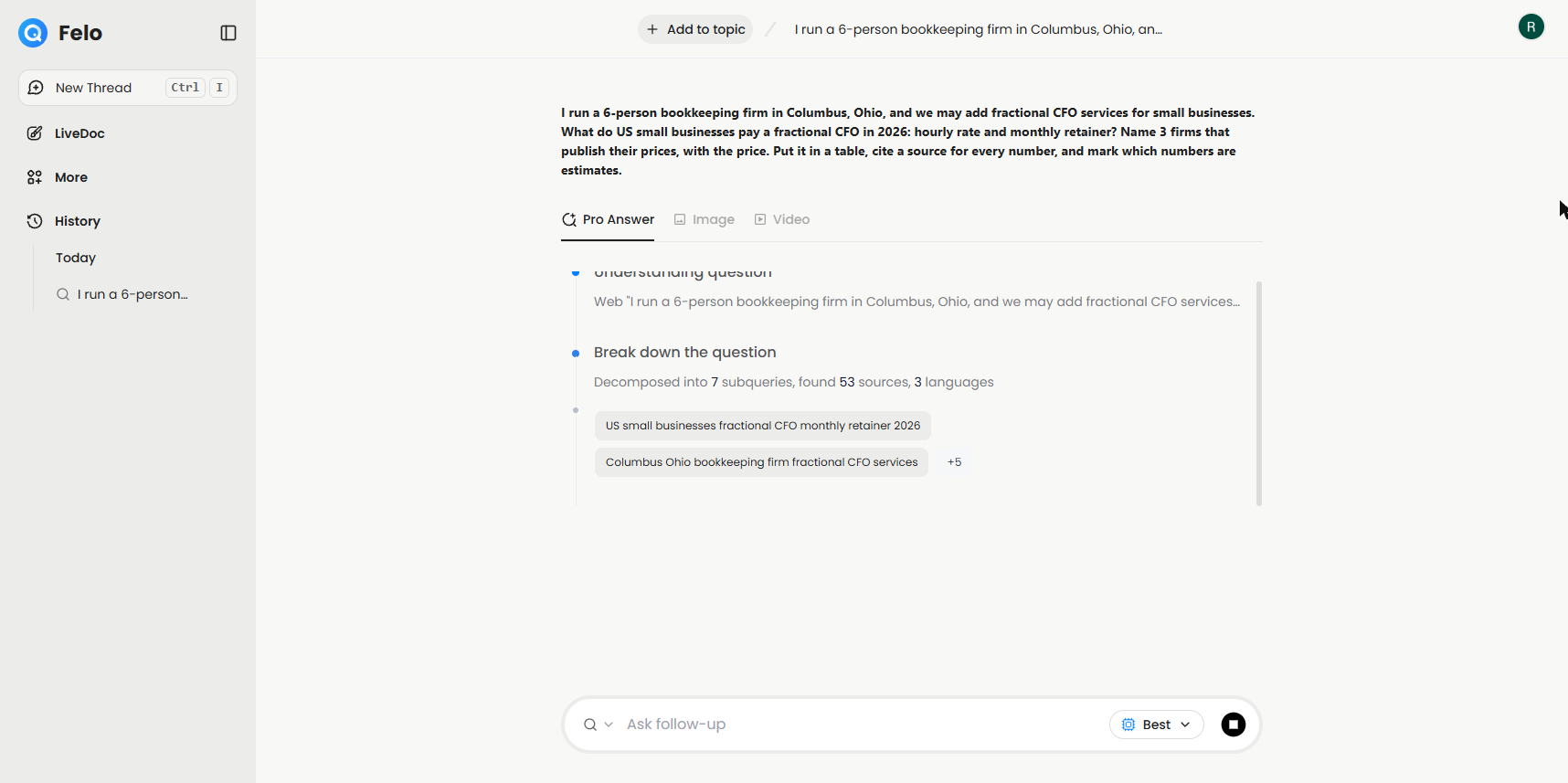
5. A short, vague question. "How much is a fractional CFO?" leaves Felo to guess who you are and what you need. The lesson's question says who is asking (a 6-person bookkeeping firm in Columbus), what to find (hourly rate, monthly retainer, 3 firms that publish prices) and the rules: a table, a source for every number, and mark which numbers are estimates. The role, context, task, format pattern is the same idea.
6. Leaving Pro off. For a money question, turn on Pro before you send. Pro split our question into 7 subqueries and found 53 sources in 3 languages, in about two minutes. Felo's pricing page listed 5 professional searches a day on the Free plan when we tested, so save Pro for questions that matter.
Which mistakes cost money or credits later?
7. Treating estimates like published prices. The answer opened with a market range: $175 to $450 an hour, or $3,000 to $12,000 a month, and about $3,000 to $8,000 for a typical small business. The table marked these Estimate? Yes. Those ranges came from articles, not price lists. Use them to sense-check, and use published firm prices for the comparison in your proposal.
8. Not checking that a page is current. The lesson's checklist asks three things for every number you will use: is it there, is it current, and is it the company itself or someone writing about it. A price page from two years ago can be accurate and still wrong for your quote.
9. Running out of credits mid-task. Our new Free account started at 500 credits: 300 one-time gift credits and 200 daily gift credits. Each Pro Search cost 15, and so did the mind map, so we finished at 455. A standard search without Pro did not use credits in our test. Click the credits pill, then Usage Details, to see each charge. Plans change, so check Felo's pricing page before you rely on the Free plan.
A small one that is not a mistake: one sentence in our answer came out with stray asterisks in red. The numbers still read fine, so don't restart the search over formatting.
Try it free, step by step
Price a New Service in 10 Minutes, with a Source for Every Number, using Felo. A business case for small firms: before you price a new service, ask Felo, an AI search tool, what the market pays and which firms publish prices, with a numbered source on every number. Then check… You do every step yourself in a practice copy of Felo, it checks your work as you go, and “Do it for me” finishes any step you get stuck on. Free, and nothing touches your real accounts.
Start the free lessonKey takeaways
- Open the source behind every number you plan to use. A citation is where to look, not proof.
- Check the site name on the card. A comparison article is second-hand, even when the table says otherwise.
- Ask one follow-up for a Source type column and URLs, then re-read the whole table.
- Write the rules into the question: a table, a source per number, estimates marked.
- Save Pro for money questions and watch your credits.
The one-page Felo pricing research cheat sheet has these checks in print form, and the source check template gives you a row for each number from our run.
Frequently asked questions
- How do I know if a Felo source is the company's own website?
Point at the small number after the price and read the site name on the card. In our run, islandwaters.ai was the firm's own site, and weaudit.com was a comparison article. If you are not sure, open the page and look for the company's own pricing page or plans.
- Should I redo the search when I find a bad source?
No. Ask a follow-up in the same thread instead. Our follow-up asking for a Source type column and page URLs fixed the second-hand price in one step, for one more Pro Search.
- Why did Felo change a firm in the follow-up?
The follow-up answer is a new answer, not an edit of the old one, so it can pick different firms. Ours replaced Island Waters with Pilot. That is why the lesson tells you to read the whole table again.
- Is a price from a comparison article always wrong?
Not always. It may be right, but it is second-hand and may be out of date. Open the firm's own pricing page before you quote it. The FAQ on how Felo works covers the rest, and the Felo entry in the AI research tools directory sums up what it does.