What is a hallucination check?
Quick answer
A hallucination check is the step where a person verifies what an AI wrote before it is used. You look for facts, numbers, names, policies and promises that you never supplied, confirm the ones that matter against a real source, and remove or fix anything that cannot be confirmed. It takes a few minutes and it belongs before every send.
Last updated
Take the free module →Module 6 of the free Better Prompts course, about 7 minutes. No account needed.
Updated · By Robert Breen
Why it matters for a small business
AI tools fill gaps with text that sounds right. If your prompt leaves out a fact, the draft may invent one: a refund window, a delivery date, a policy. Nothing in the wording warns you, which is why the check has to be a habit instead of a feeling that something looks off. The cost lands on you, because the client received your email, not the AI's.
The check is cheaper when you design for it. Give the tool the facts to use, ask it to list its assumptions, and verify anything left over. This works alongside grounding the tool in your own documents and a human in the loop before anything goes out. The tool's hallucination is the problem, and the check is the fix.
In a real lesson: Catch Made-up Facts Before They Reach Customers using ChatGPT
In the Fix Bad Answers lesson, Dana runs Juniper Lane Bakery, a made-up small bakery. She asks ChatGPT for a customer email about cake pickup but leaves out the facts, so the first draft invents a late pickup policy and a freshness window she never gave it.
The lesson walks through the check in order. Point at the exact problem instead of asking for better, ask ChatGPT to list the assumptions it made and the facts to verify, then check the one that matters with cited web sources and open a source to confirm it says the same thing. Finally, start a new chat with one clean prompt that says to use only the facts you supply.
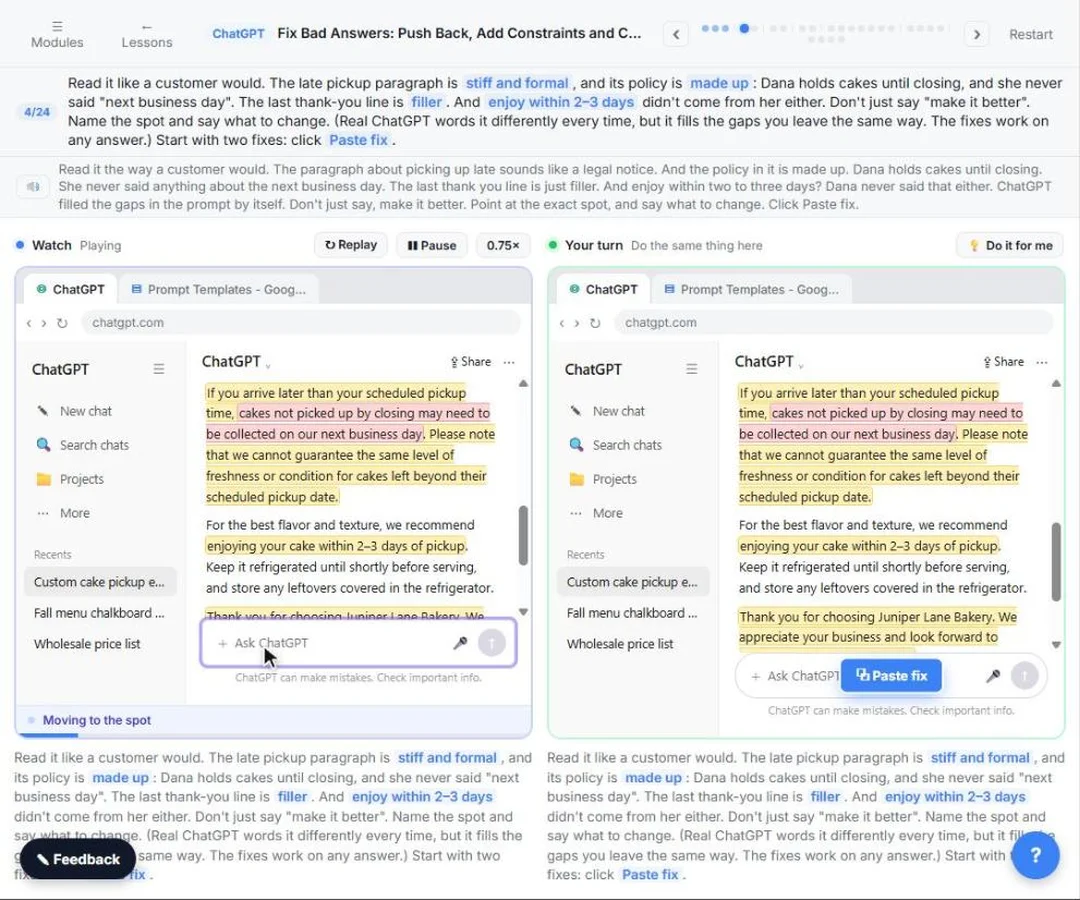
Try this lesson free or read the step-by-step guide.
Common confusions
Hallucination check vs proofreading
Proofreading fixes spelling and tone. A hallucination check confirms the facts. A draft can read perfectly and still be wrong.
Asking the AI if it is sure
A model saying it is sure is not a check. Verify against a document, a record or a source you can open.
Tips
- Ask for a list of assumptions and facts to verify at the end of every important draft.
- Check numbers, dates, names and promises first. They are the costly ones.
- When the thread gets messy, start a new chat with the facts you trust.
Related terms
More Business terms
Where you use it: free lessons
- Catch Made-up Facts Before They Reach Customers using ChatGPT (ChatGPT, 7 min)
Prompt templates that use it
Frequently asked questions
- How do I check if ChatGPT made something up?
- List the facts, numbers and promises in the draft, then confirm each against a document or source you can open. Ask ChatGPT for its assumptions to find them faster.
- Can I ask ChatGPT to fact-check itself?
- It can point out likely weak spots, which is useful, but the final check should use a source outside the chat.
- How often should I do a hallucination check?
- Every time the output reaches someone else. Quick for a routine email, deeper for numbers or policies.