What is insurance underwriting?
Quick answer
Insurance underwriting is the process an insurance company uses to decide whether to accept a risk, what coverage and terms to offer and what premium to charge. Underwriters review details such as driving or claims history, property, location and type of business, and they may review the policy again at renewal.
Last updated
Updated · By Robert Breen
Why it matters for a small business
Underwriting is why two businesses asking for the same coverage get different quotes, or why one gets declined. It sets the insurance premium, the deductibles on offer and sometimes added conditions or exclusions. For a client, it explains questions that can feel intrusive on an application: the carrier needs the answers to price the risk.
It also draws a clear line for an agency. Agents gather information and present it well, but the carrier's underwriters decide. An email that promises approval or a rate speaks for someone else. This is general information, not insurance advice. Only the carrier and a licensed agent can say how a specific application or renewal will be handled.
In a real lesson: Reply Faster to Claim-Status Emails: ChatGPT for Independent Insurance Agencies
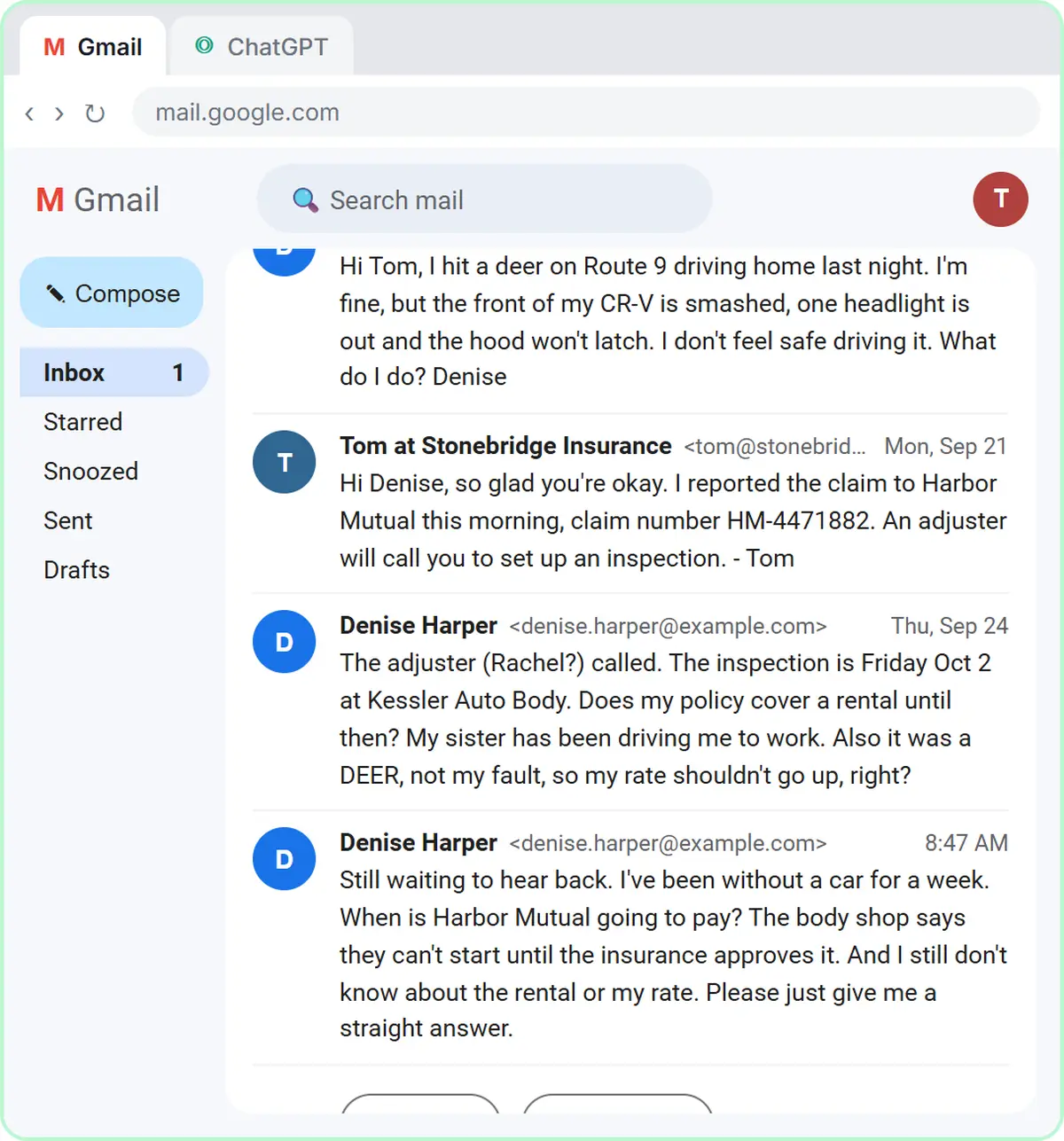
Stepthrough has no underwriting lesson. The closest is Reply Faster: Claim-Status Emails, where a rate question shows where underwriting decisions live. Denise Harper asks the made-up Stonebridge Insurance Agency, "it was a DEER, not my fault, so my rate shouldn't go up, right?"
ChatGPT's first draft says her rate won't go up. When you ask it to match every promise to a fact, that line comes back unsupported, because Fact 5 says only "Harbor Mutual sets her rate at renewal on Jan 15" and "we can't promise hers won't change."
The final reply gives the likely picture and the decision maker, and Tom offers to "go over it with you before it takes effect." That is the right stance for any underwriting question: explain the process, name who decides, and promise only what your agency itself will do.
Try this lesson free or read the step-by-step guide.
Common confusions
Underwriting vs claims
Underwriting decides whether and how to insure a risk before or at renewal. Claims handling, done by a claims adjuster, decides what to pay after a loss.
Underwriter vs agent
An agent sells and services policies and passes information to the carrier. The underwriter works for the carrier and makes the acceptance and pricing decision.
Tips
- Collect complete, accurate application answers; gaps slow underwriting down.
- Never promise approval or a premium before the carrier confirms it.
- Tell clients what renewal review means and when it happens.
- Use AI to draft a checklist of missing application details, not to guess the decision.
Related terms
More Business terms
Where you use it: free lessons
Frequently asked questions
- What does an insurance underwriter look at?
- It depends on the coverage. For auto, often driving record, claims history, the vehicle and where it is kept. For business, the type of work, location, revenue, safety practices and past claims. Each carrier has its own guidelines.
- How long does underwriting take?
- Simple personal policies can be approved quickly, sometimes the same day. Larger business policies can take days or weeks if the underwriter needs inspections or more documents. Your agent can ask the carrier for a timeline.
- Can AI do insurance underwriting?
- Carriers use software and data models in underwriting, but decisions follow their own rules and oversight. At an agency, AI is better used for drafting emails and organizing application details than for predicting a carrier's decision.