What is a policy endorsement in insurance?
Quick answer
A policy endorsement, sometimes called a rider, is a written amendment to an insurance policy that adds, removes or changes coverage. It becomes part of the policy, and where it conflicts with the base policy, the endorsement generally controls.
Last updated
Updated · By Robert Breen
Why it matters for a small business
Policies are written for the average customer, and endorsements are how they get fitted to a real one. A homeowner adds coverage for jewelry. A small business adds a client as an additional insured. A driver adds rental reimbursement. Each addition is usually paid for through the premium, and each is described in its own document.
They are easy to overlook. A claim question that sounds like a mystery is sometimes answered by an endorsement the customer forgot buying, or one that quietly excluded something. Reading the declarations page, which typically lists the endorsements attached to the policy, is the first step. Coverage decisions still belong to the carrier.
In a real lesson: Reply Faster to Claim-Status Emails: ChatGPT for Independent Insurance Agencies
In the Reply Faster: Claim-Status Emails lesson, a made-up client named Denise asks whether her policy covers a rental car while her CR-V is repaired. Tom, at the made-up Stonebridge Insurance Agency, has a fact for it: her declarations page shows rental reimbursement of $40 per day, up to $1,200 per claim.
That is the kind of line that sometimes comes from an endorsement. The lesson does not say how Denise's rental coverage was added, so do not assume it was an endorsement. What it does show is the right habit: read what the policy documents show, quote the daily limit and total honestly, and say who decides.
Tom's facts add that the carrier, Harbor Mutual, approves the rental and the dates, and that Denise pays the difference if she picks a car costing more than $40 a day. The lesson's reply states all of this plainly and promises nothing the facts do not support.
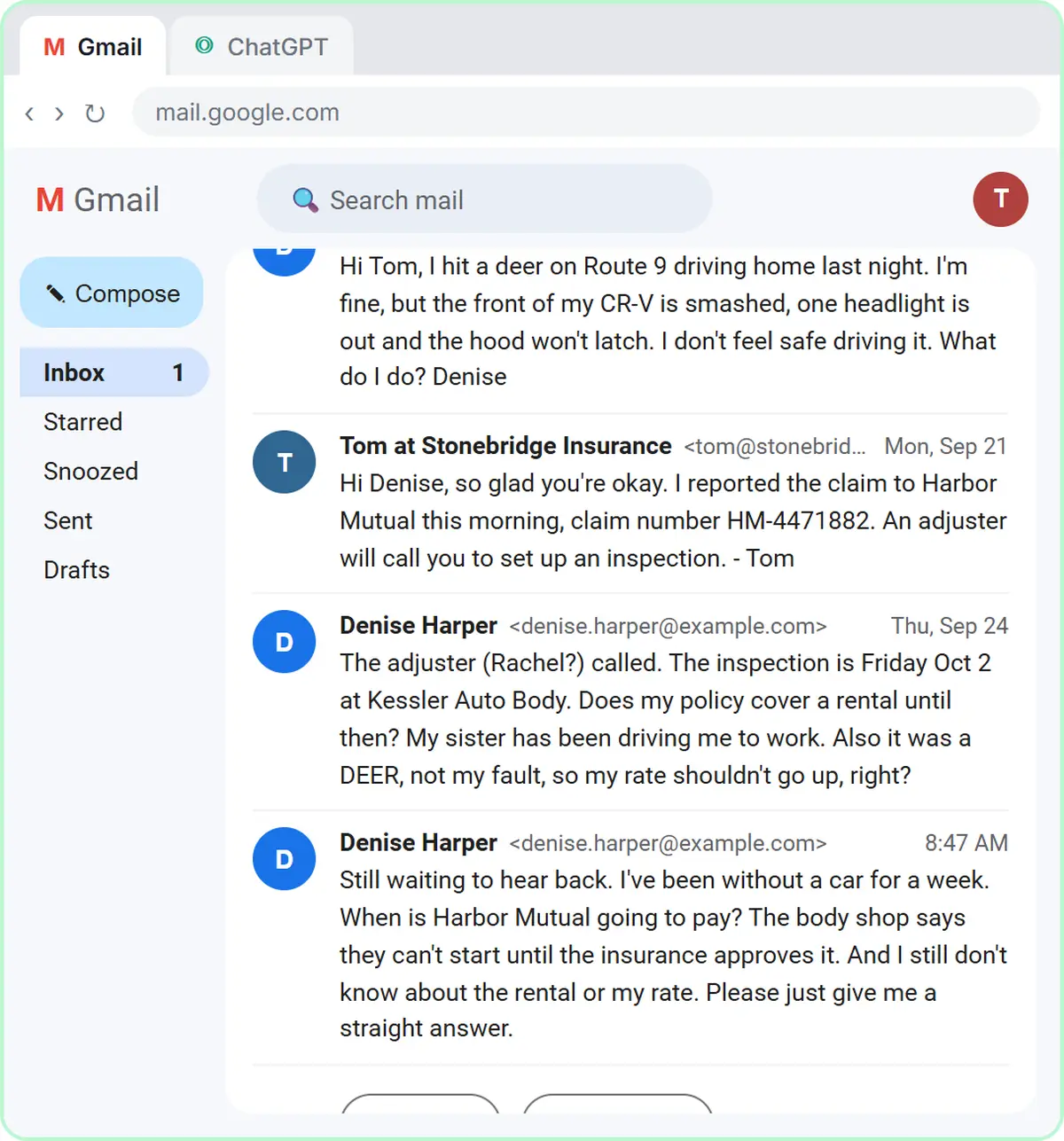
Try this lesson free or read the step-by-step guide.
Common confusions
Endorsement vs exclusion
An endorsement is the document that changes coverage. An exclusion is a thing the policy does not cover, and an endorsement can add one or remove one.
Endorsement vs a separate policy
An endorsement amends an existing policy. A separate policy is its own contract, with its own limits, deductible and renewal date.
Tips
- Keep every endorsement with the policy, and look at them at each renewal.
- When coverage is added mid-term, ask for the endorsement in writing and for the effective date.
- Do not rely on a chatbot to say whether an endorsement covers a loss. Ask the agent or the carrier.
Related terms
More Business terms
Where you use it: free lessons
- Reply Faster to Claim-Status Emails: ChatGPT for Independent Insurance Agencies (ChatGPT, 10 min)
- Reply Faster: Turn a Messy Customer Email Thread into a Clear, Friendly Reply (ChatGPT, 9 min)
- Build a Coverage FAQ Voice Agent for an Insurance Agency (ElevenLabs Knowledge Base) (ElevenLabs Agents, 9 min)
Frequently asked questions
- Do endorsements cost extra?
- Often, though some are free. The premium change is normally shown on the revised declarations page.
- Where do I find my endorsements?
- Look at the declarations page and the forms attached to your policy, or ask your agent for a list.