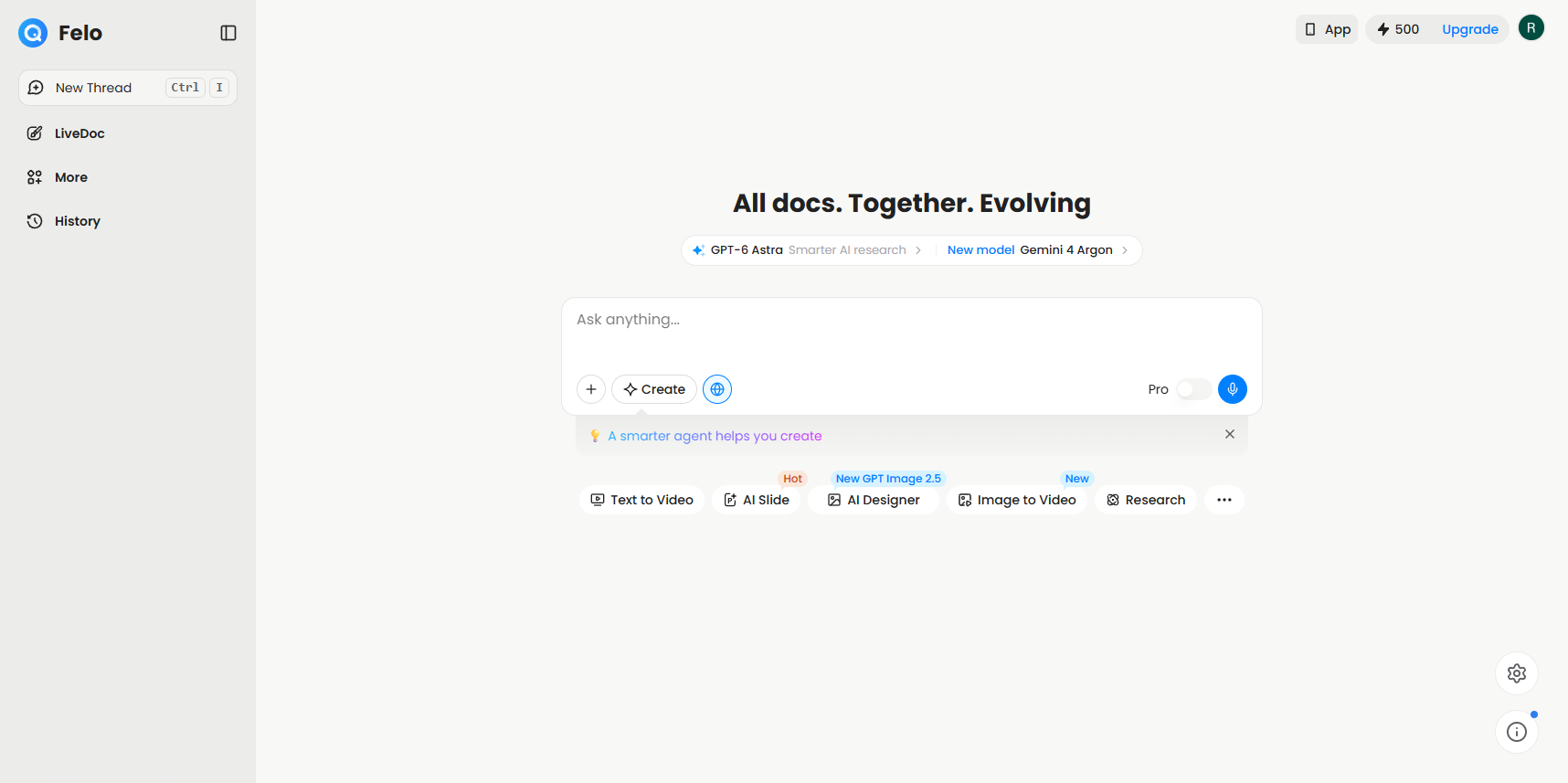
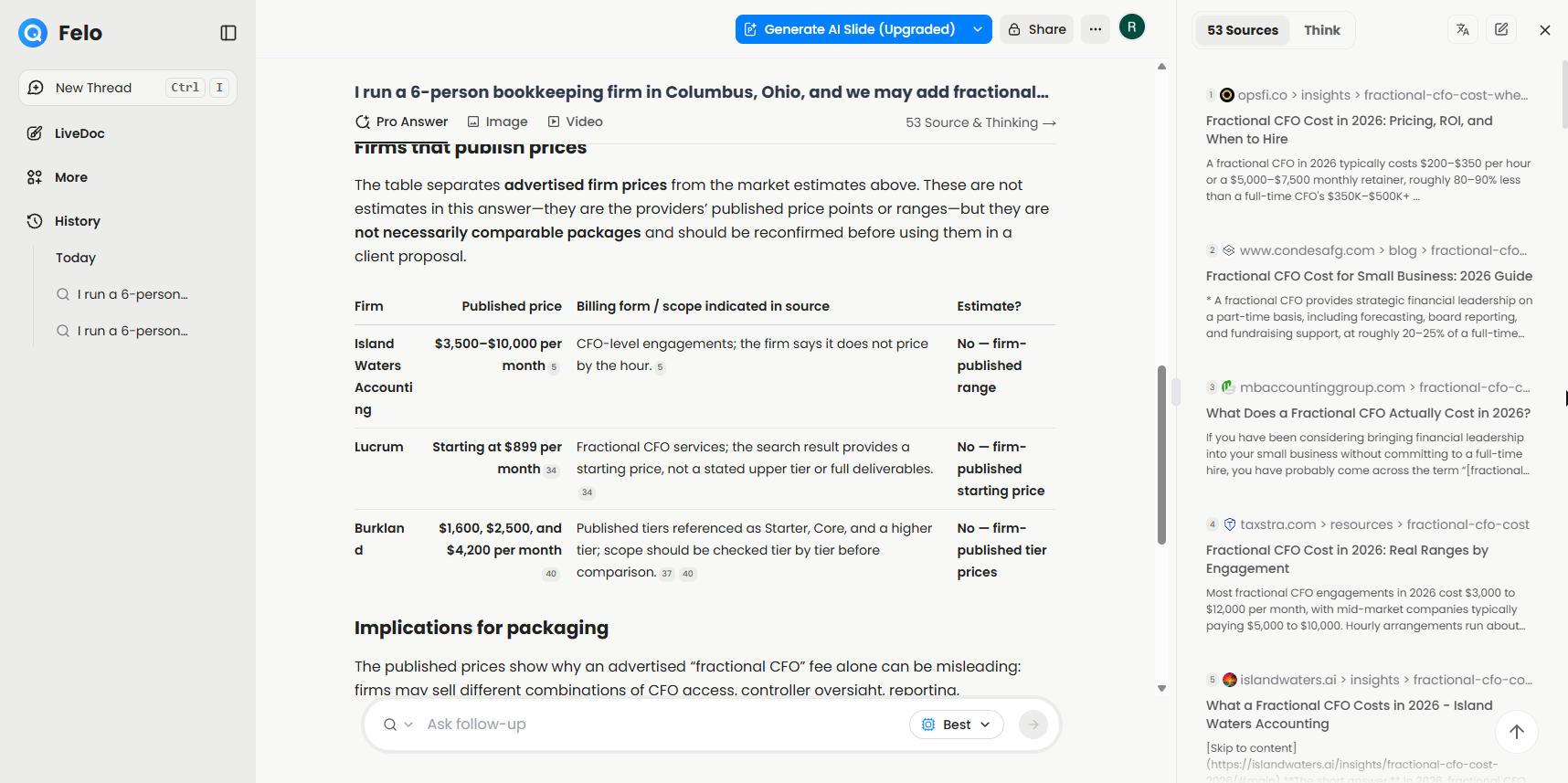
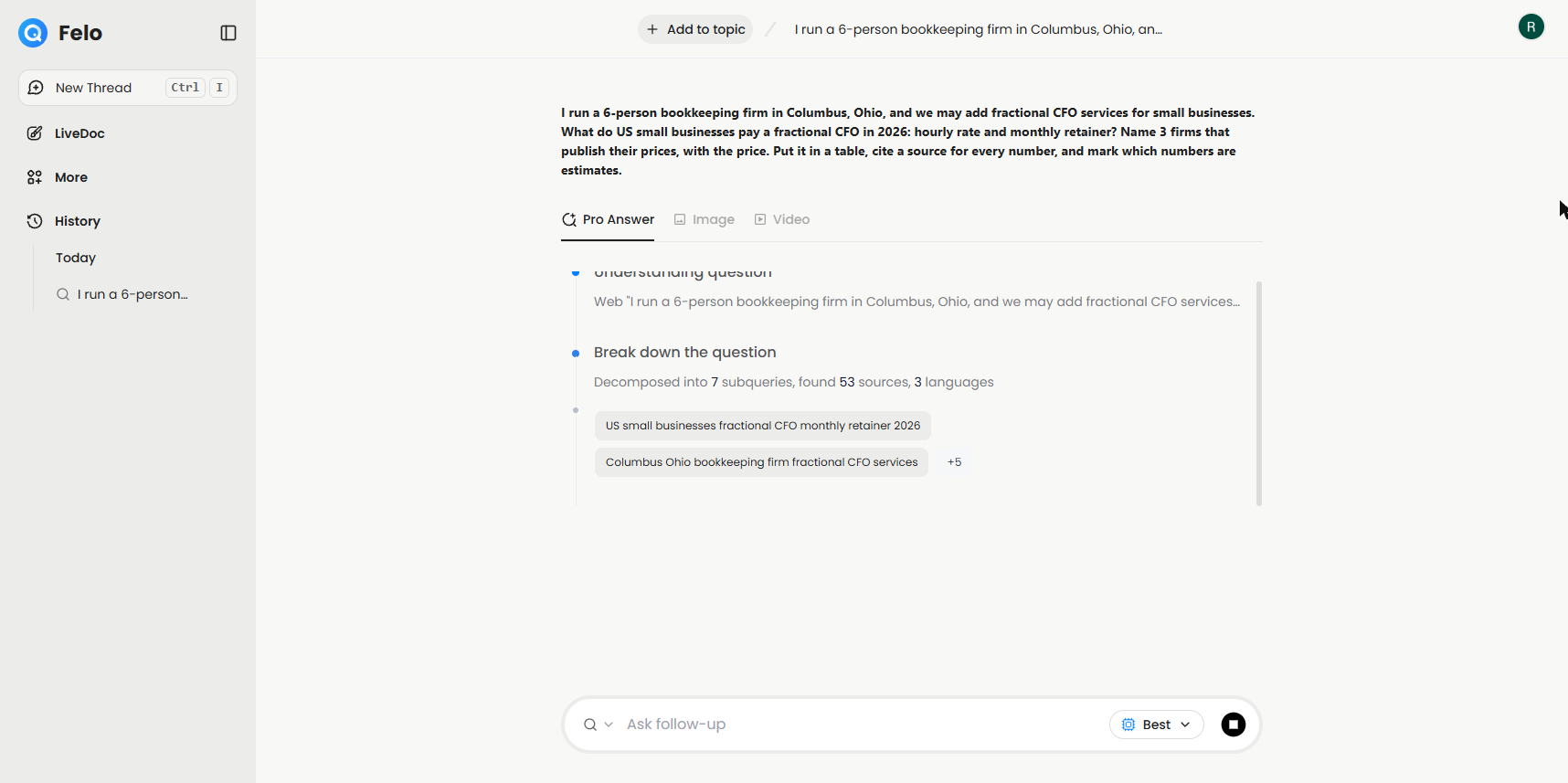
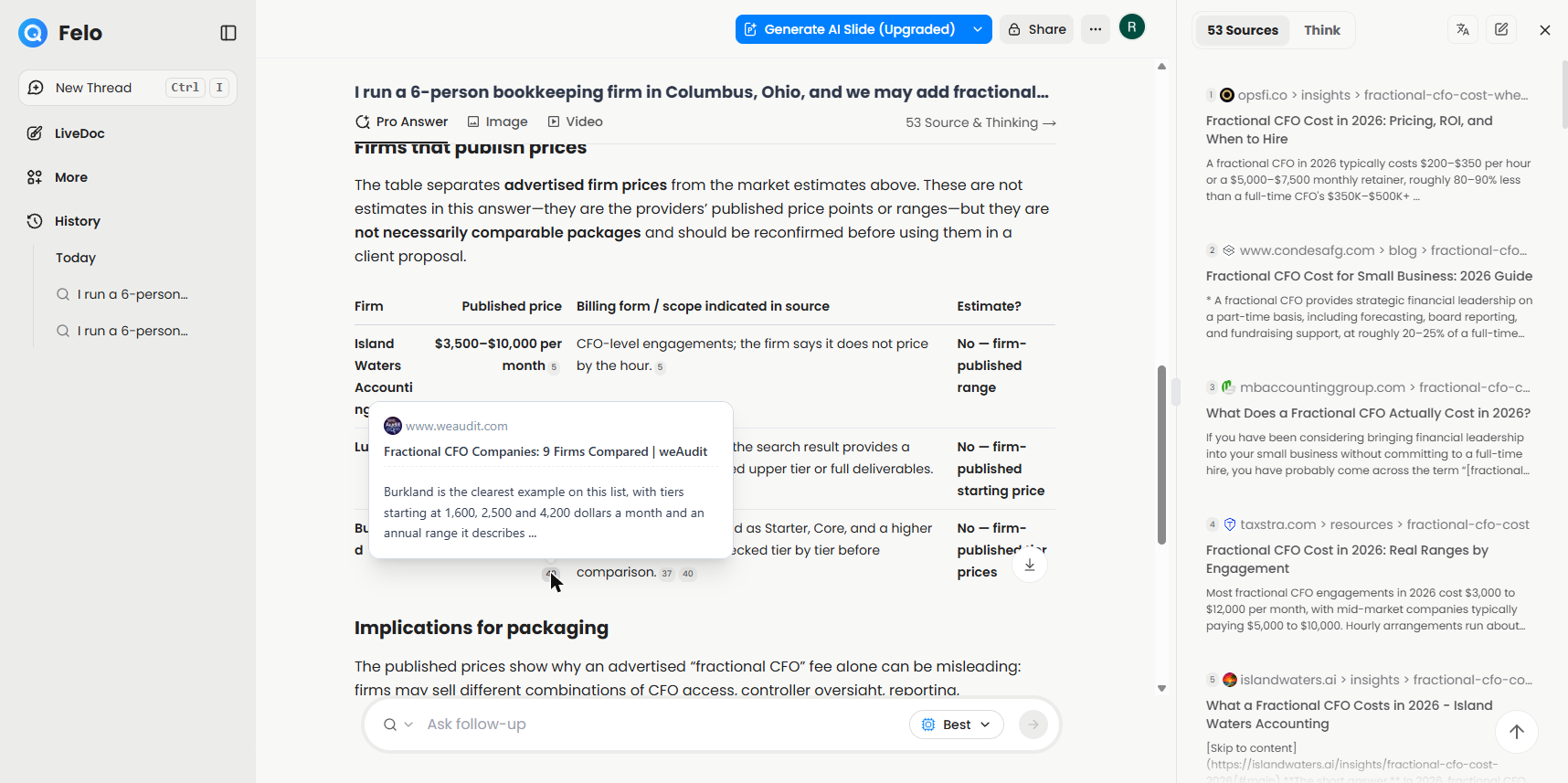
The lesson's example is Dana Ortiz at Northfield Bookkeeping, both made up, pricing a monthly fractional CFO package. Everything below reuses her question and her checks. Only the blanks change.
What kind of work is Felo good at?
Narrow, public questions. The lesson's business case says so directly: what do customers pay, and what do other firms charge? Those answers live on public web pages, so an AI search tool can find them and cite them. Felo is not the right tool for private data, your own costs, or the final decision. It does not set your price.
The question template in the lesson has blanks for your business, city, new service, type of client, year and price units. Every role below fills those in differently.
Which office roles can use the Felo pricing workflow?
Seven roles, each with the job, how the lesson's workflow applies, what to change and what to check.
Bookkeeper or accounting firm owner
The job: price a new advisory service, such as the lesson's fractional CFO package. How it applies: this is the lesson as written. Ask for hourly rate and monthly retainer, plus 3 firms that publish their prices. What to change: your firm size, city and the service, for example payroll or a cleanup package. What to check: that each firm price links to the firm's own pricing page, not a comparison article. A retainer price on a list from someone else may be out of date.
Consultant
The job: set a project or day rate for a new offer before a client asks. How it applies: ask for the price units you sell in, and 3 firms that publish them. What to change: "hourly rate and monthly retainer" becomes your units, such as a fixed project fee. What to check: many firms don't publish prices. If Felo fills the table with estimates from articles, keep those apart from real published prices, as the lesson's Estimate? column does.
Agency owner
The job: package a new monthly service and know where it sits against the market. How it applies: the same question, with your agency type and the clients you serve. What to change: the client type, for example "small B2B software companies". What to check: re-read the whole table after every follow-up. In our run, the follow-up swapped one firm for another without saying so.
Office manager
The job: check what an outside service should cost before you sign a renewal. How it applies: flip the question. Instead of "we may add a service", say "we are renewing a contract for this service" and ask what small businesses pay and which providers publish prices. What to change: who is asking and why, and the units on the invoice. What to check: that each price is current. The lesson's checklist asks whether the number is on the page, whether it is current, and whose page it is.
Marketer
The job: a competitor price scan for a new landing page or launch. How it applies: ask for 3 named competitors' published plans in a table, with a source for every number. What to change: "3 firms that publish their prices" becomes "these 3 competitors". What to check: use the follow-up from the lesson to get a Source type column and URL, so the scan only uses the competitors' own pages.
Sales rep or sales lead
The job: answer "you're more expensive than X" with real numbers. How it applies: ask what the competitor publishes, with the source type and page URL in the first question. What to change: add the URL request up front, since you already know second-hand prices won't do. What to check: open the page yourself before you quote a competitor's price to a customer. Source verification is the habit.
Founder
The job: set a first price for a new product or service line. How it applies: run the lesson's question for the market range, then a follow-up for firms that publish prices. What to change: the year and price units to match how you plan to bill. What to check: the business case math. In the lesson, guessing $1,000 a month when the market pays $3,000 leaves $96,000 a year on the table across 4 clients. Those are example numbers. Do the same sum with yours.
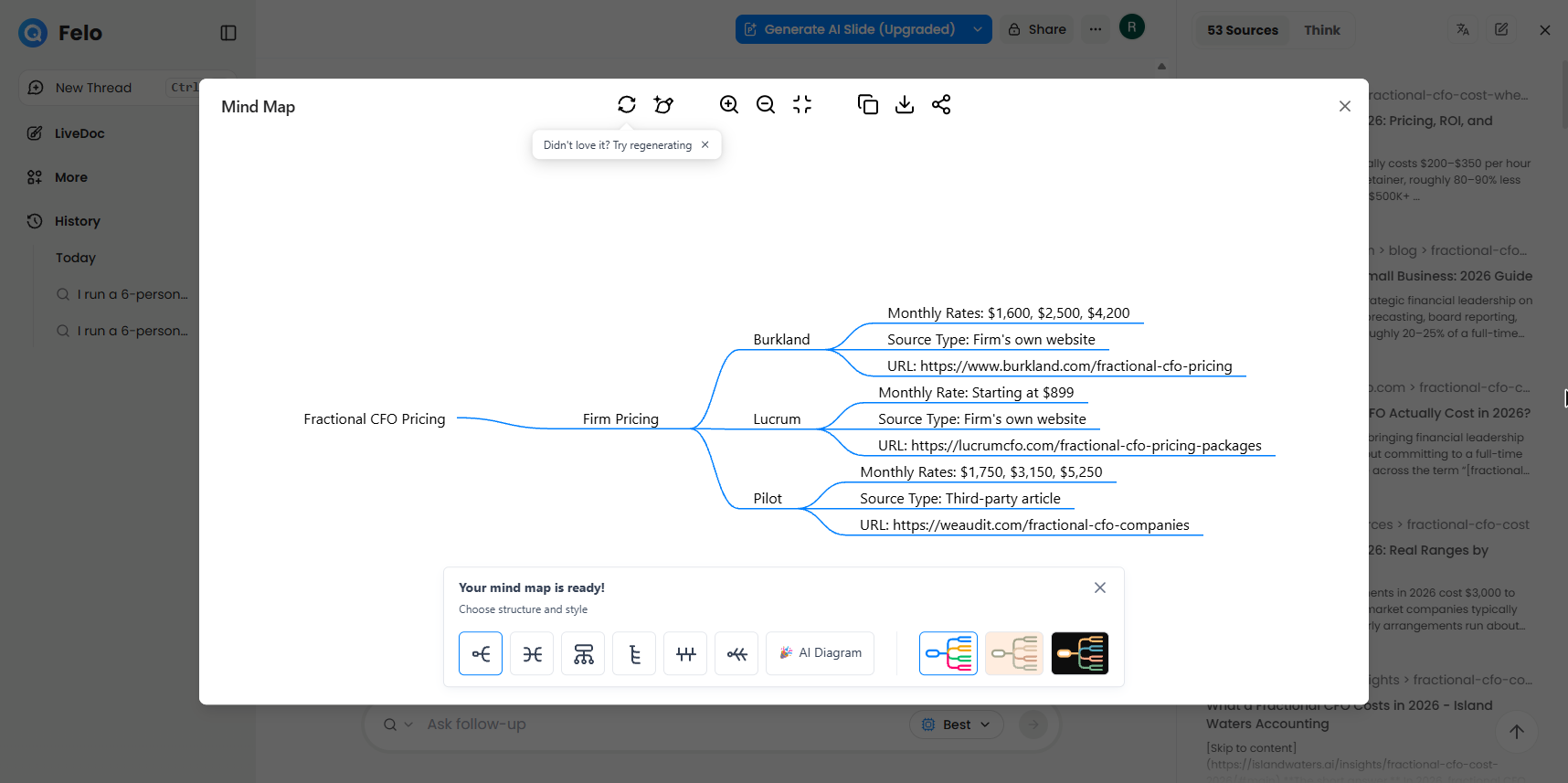
How do you share the result with your team?
Use the two tools at the end of the answer. Convert answer to made a mind map of the three firms, their prices, source types and links, with a toolbar to copy, download or share it. Export listed Notion, Google Drive, Felo Docs, PDF, Word, Markdown and TXT. For a pricing meeting, the mind map is the quick view, and an export is the record.
Before you share, mark which numbers you have opened yourself. The source check template has a column for that.
What should every role check before using a number?
Three questions from the lesson, the same in every job:
- Is the number on the page Felo cited?
- Is the page current?
- Is it the company itself, or someone writing about it?
If the answer to the third is "someone writing about it", go to the company's own page. The hallucination check entry covers what to do when a number can't be found at all.
Try it free, step by step
Price a New Service in 10 Minutes, with a Source for Every Number, using Felo. A business case for small firms: before you price a new service, ask Felo, an AI search tool, what the market pays and which firms publish prices, with a numbered source on every number. Then check… You do every step yourself in a practice copy of Felo, it checks your work as you go, and “Do it for me” finishes any step you get stuck on. Free, and nothing touches your real accounts.
Start the free lessonKey takeaways
- Felo suits public price questions in any office role. It doesn't set your price.
- Keep the lesson's question, change the blanks: who, where, what service, which units.
- Marketers and sales reps should ask for source type and URL in the first question.
- Every role runs the same three checks before a number goes into a proposal.
For the checks on one page, print the Felo cheat sheet. For the tool itself, see the Felo entry in the AI research tools directory.
Frequently asked questions
- Can I use Felo to research salaries?
The lesson only tests pricing for a service. The same question shape may work for other public numbers, but check every source the same way, and follow your company's policy for anything pay-related.
- What if the firms I need don't publish prices?
Felo can only cite what's on the web. Keep the estimate ranges apart from published prices, and say so when you share the result.
- Should every role use Pro?
For anything that will end up in a quote or proposal, yes. Felo's pricing page listed 5 professional searches a day on the Free plan when we tested, which is plenty for one or two questions.
- Can a team share one Felo answer?
The lesson shows the mind map's share button and the Export menu, including Notion and Google Drive. It doesn't test team accounts. The Felo FAQ covers what we did test.